How to tell whether an old cast iron skillet is worth
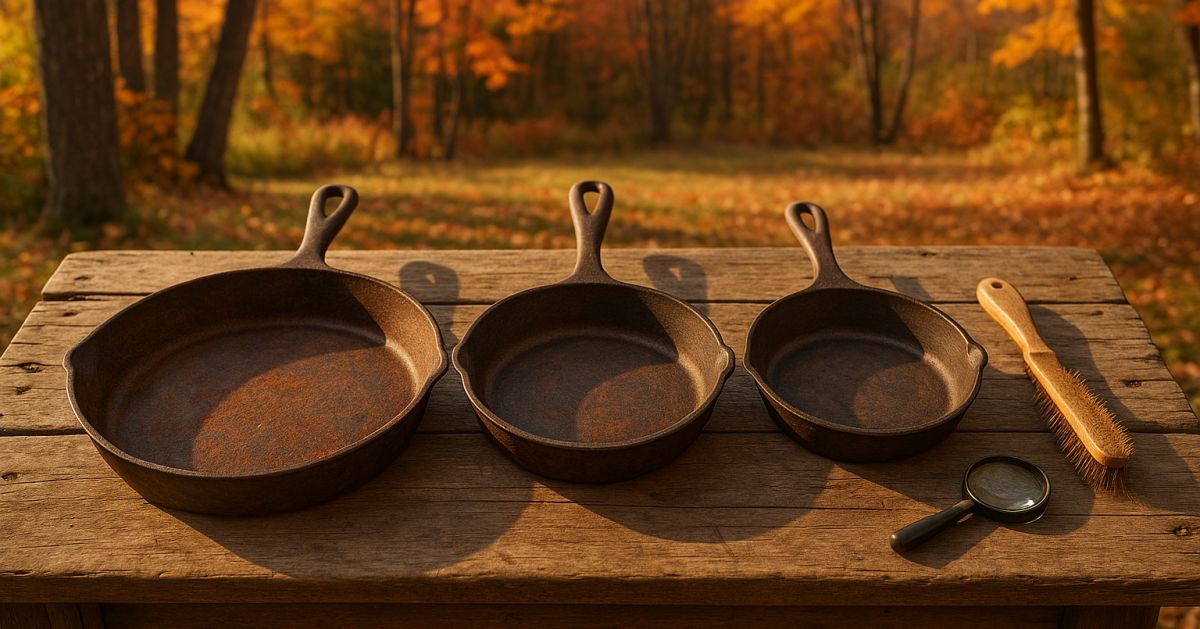
Rusty, black, and sitting in a cardboard box at an estate sale in Newfane - that old skillet might be worth serious collector attention, or it might be a decent user pan worth a good cleaning, or it might genuinely be nothing special. Knowing which is which saves you money, time, and the disappointment of paying too much for something ordinary (or throwing away something remarkable).
This guide walks you through the exact things to look at, feel, and measure so you can make an honest assessment before you invest in restoration or put a price tag on a piece.
Start with the gate mark: the single fastest clue
Flip the skillet over and look at the bottom. If you see a raised line running straight across the center of the base, that is a gate mark. Gate marks are a casting artifact from a manufacturing process that American foundries largely stopped using around 1890. A gate mark does not automatically mean a skillet is rare or expensive, but it does mean the piece is genuinely old, and that alone puts it in a different category from 20th-century production pans.
No gate mark does not mean a skillet is young. Many pre-1900 foundries ground their gate marks smooth. But if you find one, you have a real clue that the piece predates the era of mass production.
Read the heat ring on the base
Turn the pan over and look for a raised ring on the outer edge of the base. This is called the heat ring, and it was a functional feature: it sat around the eye of a wood stove burner and helped concentrate heat under the pan. Heat rings appeared on skillets from roughly the 1880s through the mid-20th century, then faded out as gas and electric ranges became standard.
A deep, well-defined heat ring is a characteristic of older American foundries. A very shallow or absent ring often points to a later production date or to a more generic pan. This is not a value judgment by itself, but it is useful context.
Identify the foundry name or trademark
Many older American skillets are marked with the foundry name, a series number, or both. A few names that collectors actively seek include:
- Griswold (Erie, Pennsylvania) - probably the most recognized American cast iron brand among collectors
- Wagner Ware (Sidney, Ohio) - a close rival to Griswold in quality and collector demand
- Birmingham Stove and Range (BSR) - well-regarded Southern foundry
- Wapak - Ohio-based, less common, which is part of the appeal
- Lodge - still in business today; older Lodge pieces (pre-1960s) carry more collector interest than current production
The markings are often on the top of the handle or on the bottom of the pan. They can be filled with grease or rust. A gentle pass with a stiff brass brush (not steel) will usually reveal them without damaging the casting.
An unmarked pan is not necessarily worthless. Many fine foundries produced pans for hardware stores under house brands, and those pans were cast to the same standards as the name-brand pieces. But an unmarked pan requires more detective work to assess.
Check the size number and series
Vintage American skillets use a size number system (typically 0 through 14) that corresponds loosely to the cooking surface diameter. Common sizes like 8 and 9 turn up constantly. Less common sizes, particularly 0, 1, 2, 13, and 14, are genuinely harder to find and tend to attract stronger collector interest.
Griswold and Wagner pans also carry series or pattern numbers that help identify the era of production. A Griswold "large logo" (the Erie logo with the wide outer ring) generally dates to the 1920s and early 1930s and is considered desirable. A "small logo" Griswold followed later. Online reference guides maintained by cast iron collector communities go into granular detail on these variations if you want to date a specific piece precisely.
Feel the cooking surface and wall thickness
Here is where a hands-on evaluation tells you things no photograph can. Run your fingers across the cooking surface. Older, high-quality American foundry work - especially pre-1950 Griswold and Wagner - was machined smooth after casting. The surface should feel almost like fine sandpaper at worst, and on the best pieces, nearly glassy.
Modern cast iron, and lower-quality vintage production, tends to have a pebbly texture that comes from sand casting without the finishing step. That texture is not a flaw for everyday cooking, but it is a marker of manufacturing quality.
Also notice the wall thickness. Well-regarded vintage foundry work is thinner and lighter than you might expect for cast iron. Pick up the pan. If it feels surprisingly light for its size, that is a sign of quality casting. A very heavy, thick-walled pan suggests either a later production run or a lower-tier foundry.
Look for cracks, repairs, and warping
Cracks disqualify a pan from safe cooking use. They can be invisible when the pan is dirty, so clean a small test area if you are unsure. Hairline cracks often start from a rim chip or at a handle stress point. Hold the pan up to the light and tilt it - surface cracks catch light differently than rust pitting.
A cracked pan is not worthless to every collector (some people collect damaged examples of rare pieces to study the markings), but for practical cooking purposes it is done. Restoration cannot fix a crack.
Warping shows up as a rocking motion when you set the pan flat on a level surface. A slightly warped pan can still cook, but it will not sit flat on a glass-top stove and will be frustrating on gas. Significant warping usually happened because someone heated the pan unevenly, or worse, quenched a hot pan in cold water. Warping cannot be corrected by reseasoning.
A repaired pan - look for evidence of brazing or welding around a crack - is something to note but not panic about. It tells you someone valued the piece enough to fix it, but it also affects value for collectors.
Rust, pitting, and what can actually be saved
Rust by itself means almost nothing about the underlying pan. Surface rust - the orange-red kind that wipes away to reveal sound metal underneath - is completely normal on a pan that has been in a barn, basement, or garage for years. Electrolytic rust removal (a common restoration method using a mild salt-water bath and a low-voltage current) can take a heavily rusted pan back to bare, clean iron in a day or two without damaging the casting.
Pitting is different. Pitting is where rust has eaten into the iron itself, leaving small craters. Light pitting on the exterior or the handle does not really matter. Light pitting on the cooking surface is manageable: after restoration, a good seasoning build-up will fill shallow pits and the pan will still cook well. Deep pitting on the cooking surface - the kind where you can feel sharp edges with a fingernail - is harder to rehabilitate and lowers both the cooking experience and any collector value.
If you are in the Brattleboro or Bellows Falls area and not sure whether the rust on a pan you have found is surface rust or deep pitting, our cast iron cookware restoration services include an initial assessment before any work begins. You do not have to guess on your own.
Regional tips for estate sale and flea market hunting
Windham County has a long tradition of working farms and old New England households, and that means old cast iron still surfaces regularly at estate sales in places like Grafton, Guilford, and Putney. A few practical observations from years of handling pans in this region:
- Pans found in farmhouse kitchens tend to be well-used but not abused. Farmhouse cooking was hard on seasoning but easy on the iron itself.
- Pans found in barns, sheds, or outbuildings will be rustier but often have intact casting because they were stored, not used.
- Church sales and town-wide tag sales (Dover and Wilmington both have active community sale seasons) can surface genuinely old pieces because collections get dispersed through estate donations.
- Antique dealers in Brattleboro who specialize in kitchen and household items will often price Griswold and Wagner correctly. A generalist dealer may have a rare piece underpriced or an ordinary pan wildly overpriced. Know what you are looking at before you negotiate.
When is a skillet worth restoring vs. worth selling as-is?
This depends entirely on what you want from the pan. If you want a working cooker, almost any structurally sound vintage pan is worth cleaning and seasoning because the quality of old American foundry iron is genuinely better for cooking than what you can buy new at a box store. If you want to maximize the collector value of a rare piece, some collectors actually prefer a pan in original crusty condition because it proves the piece has not been altered. Aggressive grinding or power-tool cleaning can remove markings and smooth features that help authenticate a pan.
For pans with collector potential, a gentle cleaning - soap and water, a brass brush, maybe a light electrolysis pass - is enough to reveal the markings without changing the character of the piece.
For pans you simply want to cook with, professional restoration brings them back to a smooth, properly seasoned cooking surface that rivals anything you could buy today. Our restoration services cover everything from light cleaning to full electrolytic rust removal and hand-applied seasoning.
A quick field checklist
When you pick up a pan at an estate sale or pull one out of a barn, run through this in order:
- Gate mark on base? (Yes = pre-1890s manufacturing method, adds interest)
- Heat ring present? (Depth and definition give production era clues)
- Maker's mark or size number visible? (Clean gently to read it)
- Size number unusual? (Sizes 0, 1, 2, 13, 14 are less common)
- Cooking surface smooth or pebbly? (Smooth = machined, higher quality)
- Pan weight light for its size? (Lighter = thinner walls = better casting)
- Any cracks? (Check rim, handle junction, base)
- Rocks on a flat surface? (Yes = warped)
- Rust character? (Surface orange rust vs. deep black pitting)
None of these factors works in isolation. A gate-marked pan with deep pitting and a cracked handle is a display piece at best. A plain unmarked pan with a glassy surface, no cracks, and light surface rust might be a genuinely excellent cooking skillet waiting for a good cleaning.
Where to learn more and get help
If you are sorting through inherited cookware or a recent find from an Athens or Wilmington estate sale and you want a second opinion, our frequently asked questions page covers a lot of the common scenarios we hear about. You can also reach out to us directly if you have a specific piece you want to talk through.
We serve communities across Windham County and the surrounding area, including Brattleboro, Putney, Bellows Falls, Brookline, Newfane, Dover, Wilmington, Dummerston, Grafton, Guilford, Halifax, and Athens. See the full list of places we work on our service locations page.
Good cast iron does not have an expiration date. A skillet that has been sitting dirty in a New England basement for forty years can absolutely come back to life and cook beautifully for another century. The question is just whether the particular piece in your hands is worth the investment of time and care - and now you have the tools to make that call with confidence.
Start a restoration
Tell us what you have
Send a couple of photos and the markings you can read on the bottom. We will tell you what the piece is, what it needs, and what it costs before anything ships. Identification and assessment are free, and stay free if you decide to do nothing.
Would rather just talk it through? (802) 348-1550