Identify a piece
Gate marks, heat rings, handle shapes and size numbers: how to read a pan that has no legible logo left on it.
Read itMail-in restoration, anywhere in the US
We strip, de-rust, repair and re-season vintage and antique cast iron cookware, then send it home ready to cook on. Griswold, Wagner, Erie, Favorite, Birmingham Stove and Range, unmarked pans from foundries nobody has identified yet. Send photos and we will tell you what you have.
Quoted before you ship - nothing is done that the piece does not need
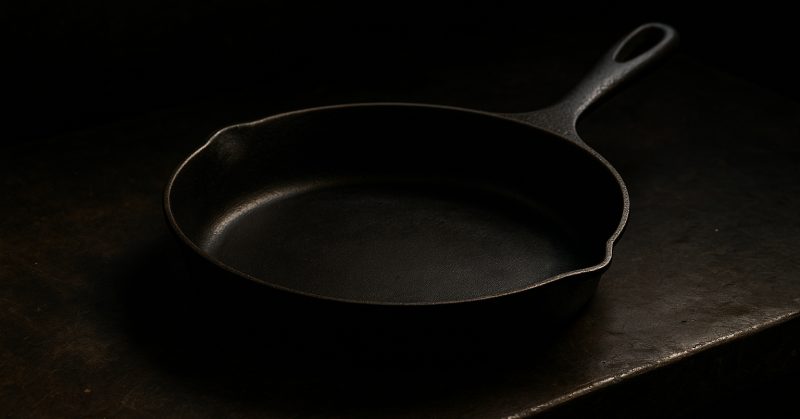
The work
Restoration is a sequence of decisions, and most of them are decisions about what to leave alone. Here is each stage of it.
We strip your vintage cast iron to bare metal, remove every trace of rust and old seasoning, assess the iron for cracks or damage, and build a fresh seasoning from scratch. The result is a pan that cooks like new.
Read moreBarn finds, cellar pulls, and pieces left outdoors through a hard winter get a full rust removal, honest pitting assessment, and proper re-seasoning. We tell you straight what survived and what did not.
Read moreFull restoration for lidded cast iron camp and Dutch ovens - bail, legs, lid fit, and cooking surface. Two-piece work done right, from electrolytic strip to seasoned finish ready for fire or stovetop.
Read moreFull restoration of shaped and hinged cast iron - cornstick pans, muffin pans, and waffle irons - cleaning every cavity and hinge point without eroding the fine detail that makes these pieces worth keeping.
Read moreFind out exactly what your vintage cast iron piece is, when it was made, and what it is realistically worth on today's market. Identification and appraisal is free with any restoration quote.
Read moreBefore and after
Most pieces that arrive here look unsalvageable, and almost none of them are. What reads as ruin is usually forty years of polymerized grease over a casting that has not moved a thousandth of an inch since it left the foundry. Under it there is a maker mark, a size number, sometimes a pattern number that dates the piece to a particular decade.
The photographs on every job are taken the same way, in the same light, before anything is touched and after the last coat of seasoning is cured. You get both. If you are selling the piece later, that record is worth having.
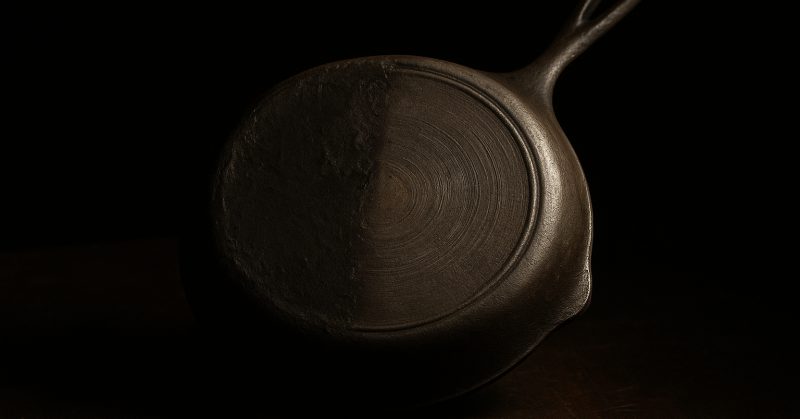
Mail-in
Top, bottom, and anything you can read on the underside. A phone photo in daylight is plenty. If the piece rocks on a flat surface or you can see a crack, say so.
You get an identification of the piece, an assessment of what it needs, a price, and an honest answer if the answer is that it needs nothing but a scrub at home.
Cast iron is heavy and brittle at the handle and the rim. Our packing guide covers it. Most pieces travel for less than people expect.
Stripped, de-rusted, assessed for cracks and pitting, and seasoned in multiple cured coats. With photographs of both ends of the job.
Reference
You do not have to send us anything to use this. The identification guides, the maker histories and the glossary are here because the information is genuinely hard to find in one place and half of what circulates is wrong.
Gate marks, heat rings, handle shapes and size numbers: how to read a pan that has no legible logo left on it.
Read itLogo eras, pattern numbers and casting methods, and what each of them narrows a piece down to.
Read itGriswold, Wagner, Erie, Favorite, Sidney, Birmingham Stove and Range and the rest, with what each one is known for.
Read itWhy condition beats rarity for most pieces, and the handful of cases where it genuinely does not.
Read itWhy bother
The case for old cast iron is not sentimental. It rests on how the metal was finished, how thick the walls are, and what both of those facts mean when you put a pan over heat. A well-made American skillet from roughly the 1890s through the early 1930s has a cooking surface that was ground and polished after casting, leaving it nearly glassy. That surface releases food the way a seasoned carbon steel pan does - not because of a thick polymer crust built up over years, but because the metal itself offers almost nothing for proteins and starches to grip. A new skillet cast today by any major domestic manufacturer has a cooking surface that looks and feels like coarse sandpaper under magnification. The bumps and pits are real, and they matter. No amount of seasoning fully fills them. The argument is that simple, and it holds up under scrutiny. The honest part is noting where it does not.
American cast iron cookware was produced by dozens of foundries through the nineteenth century and into the twentieth. The pieces that collectors and cooks prize most were made during a period when foundry work included mechanical finishing of the cooking surface after the rough casting came out of the sand mold. That finishing - grinding, milling, or polishing depending on the foundry and the era - removed the surface texture left by the sand. The result was a flat, tight surface.
That step cost time and labor. As the twentieth century progressed and labor costs rose, foundries began eliminating it. The shift was not sudden or uniform. Different makers dropped the practice at different points, which is one reason that identifying a piece and dating it roughly matters if you are buying for use rather than display. By the mid-twentieth century most American production had abandoned the smooth finish entirely. The cooking surface on a pan made in the later decades of the century is structurally the same rough texture that comes straight from the sand casting process, and that has been true of virtually all mass-market domestic production since.
There was also a gradual change in wall thickness over the same period, though the story there is less linear. Some older pieces are quite thin, and some later pieces are quite heavy. The relationship between era and thickness depends on the maker and the specific line. What is generally true is that the lightest and most refined old skillets - particularly the larger sizes from foundries like Griswold and Wagner during their peak production decades - were cast to dimensions that balance heat retention with responsiveness in a way that very heavy modern pans do not.
Heavier is not automatically better. This is worth saying directly because the marketing around modern cast iron leans hard on mass as a proxy for quality. A very thick pan holds a lot of heat, which matters if you are searing a cold piece of meat and do not want the surface temperature to drop sharply. But a very thick pan also responds slowly to changes in burner output, which makes it harder to cook delicate things and harder to manage on anything other than a high-output burner or open fire. It is also heavier to lift, which is a real consideration for daily use.
The thinner-walled vintage pieces heat unevenly over a small gas or electric burner, which is a genuine limitation. That unevenness is a reason some cooks prefer the mass of a heavier pan. The point is not that thin is better, but that there is a range of thicknesses that cook well and the extreme end of the modern spectrum trades responsiveness for mass without a clear functional payoff for most home cooking.
Seasoning is polymerized oil bonded to the metal. On a smooth surface it forms a continuous thin layer. On a rough surface it fills the low spots and coats the high spots but cannot fully eliminate the texture, because the texture is structural. The rough peaks catch food mechanically even when the pan is well seasoned. A cook with a rough-surfaced modern pan can get excellent results with enough fat and correct technique, but they are working against the surface in a way that someone cooking on a polished vintage pan is not.
The practical consequence is that a smooth old pan is more forgiving. It releases eggs and fish at lower temperatures with less fat. It recovers from a neglect-and-rust cycle more easily because the seasoning it needs is thinner and simpler to rebuild. It is not that the rough pan cannot be seasoned well - it is that the seasoning is doing more compensatory work. If you want to understand seasoning and maintenance in detail, the care guide goes through the chemistry and the practical steps for both surface types.
A cast iron pan that is a hundred years old and still in usable condition has already passed the most important durability test there is. Cast iron does not corrode the way steel does - surface rust is iron oxide and it is reversible. The metal does not fatigue under normal cooking stresses. It does not warp. It does not develop pitting from acidic food in any meaningful timeframe for a home cook.
Two things reliably end a cast iron pan's useful life. The first is a crack. Cast iron is brittle, and a thermal shock - pouring cold water into a screaming-hot pan, or dropping it at the wrong angle - can crack it. A crack is typically terminal for cooking use, though hairline cracks sometimes stay stable for years. The second is neglect so prolonged that rust penetrates deeply enough to pit the surface badly. Surface rust that has not had years to work is almost always recoverable. Deep pitting that removes metal is not fixable in any way that restores the original surface, though a piece with pitting can often still cook.
What does not kill cast iron: soap, the dishwasher once in a while, cooking acidic food occasionally, metal utensils, high heat, and most of the things people worry about. The FAQ addresses most of those concerns directly.
The durability argument for old iron over new is simply that the old piece has already demonstrated its structural integrity across a century of use, storage, and handling. A new pan has to prove that. Most will. Cast iron is not a fragile material. But the old piece is not an unknown quantity.
A restored vintage pan required no new raw material, no new foundry energy, and no new packaging. It displaced demand for a new manufactured object. That is the full environmental argument, stated plainly. It does not require elaboration.
The economic side is that well-made vintage cast iron holds value in a way that new cast iron generally does not. A piece bought in good condition, used well, and passed on is not a consumption event in the normal sense. It is closer to the way a good hand tool works economically - the cost is front-loaded and the useful life is open-ended.
Not all old cast iron is good. This needs to be said plainly because the collector enthusiasm around vintage pieces has a tendency to treat age as a quality signal in itself. It is not.
Some old pans were poorly made when new. Gate marks were ground off badly. Walls are uneven in ways that cause hot spots regardless of the burner. The cooking surface looks smooth but has waves and low spots from inconsistent finishing. Some pieces were damaged in use and repaired badly or not at all. A pan with a repaired crack is not a cooking pan.
Some foundries produced better work than others, and the same foundry could produce better work in one decade than another. The collector literature has spent considerable effort ranking makers and eras, and some of that ranking reflects genuine quality differences. Some of it reflects the scarcity and desirability that come from a collector market rather than from anything a cook would notice. Learning to evaluate a piece rather than just identifying it matters. The identification guide covers makers, markings, and what to look for.
Mid-century American production also deserves fair treatment. Pieces made from roughly the 1940s through the 1960s by established foundries are often excellent. They may have rougher cooking surfaces than earlier examples from the same makers, but the casting quality is typically high, the dimensions are well considered, and they are often significantly less expensive than prewar pieces in the collector market. A mid-century Wagner or Griswold skillet in good condition is a genuinely useful pan, not a consolation prize.
And a modern pan cared for well will outlast most of the people who buy it. The surface is rough, but it is cast iron. It will not rust through. It will not wear out. Someone who buys a new skillet today, seasons it consistently, cooks on it regularly, and does not drop it is buying something that will be in that family for generations. The case for old iron is not that new iron is disposable. It is that old iron, when it is good, is already finished in a way that new iron is not, and that the best of it represents a standard of manufacturing that is not currently in production at any price point in the mass market.
If you have an old piece and you are not sure what it is or what condition it is genuinely in, the dating guide is a starting point for placing it in time, and the identification guide covers maker's marks and foundry characteristics in more depth. If you have a piece that is rusty, sticky, or warped in its seasoning but otherwise sound, that is almost always a restoration problem rather than a pan problem. The restoration service handles pieces by mail from anywhere in the country - stripping, surface work where the metal allows it, and re-seasoning. If you are not sure whether a piece is worth restoring, the quote page is where to start. There is no charge to ask.
Start a restoration
Send a couple of photos and the markings you can read on the bottom. We will tell you what the piece is, what it needs, and what it costs before anything ships. Identification and assessment are free, and stay free if you decide to do nothing.
Would rather just talk it through? (802) 348-1550