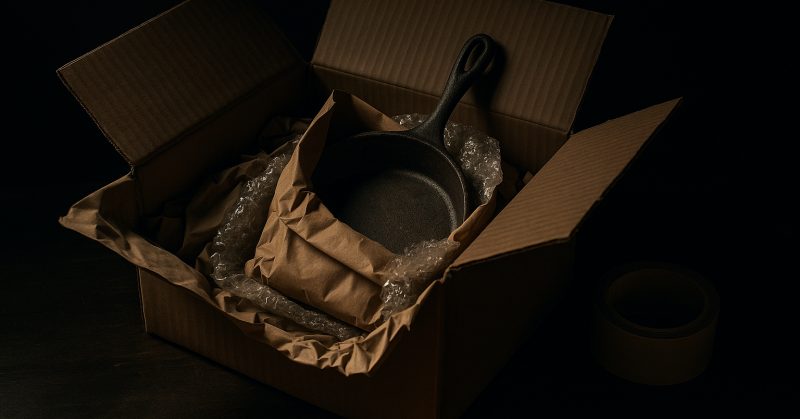
Cast iron breaks in transit for one reason almost every time: the piece moved inside the box. It did not break because it was heavy, or because a carrier was rough with it, or because cast iron is uniquely fragile as a material. It broke because something shifted, a corner struck a wall, a lid rocked against a rim, or a handle caught the edge of a folded flap. Cast iron is strong in compression and weak in tension. The handle root, the pour spout, the rim of a skillet, and the gate scar on the bottom are all places where the geometry creates stress concentration. When a piece moves and then stops suddenly, those points take the load and they crack. Every packing decision you make should be aimed at one outcome: the piece arrives immobilized. Not padded, not cushioned after the fact, but held so firmly that it cannot generate impact in the first place. Get that right and the weight is irrelevant.
Why cast iron actually breaks
Before choosing a box or cutting bubble wrap, it helps to understand the failure modes. Cast iron is a brittle material. It does not bend under load the way wrought iron or steel will. When stress exceeds the material's limit, it fractures cleanly, often along the grain of the casting. The vulnerable points on most pieces are:
- The handle root - where a long handle joins the pan body. The handle acts as a lever. A relatively small impact at the tip translates to a large bending moment at the root.
- The rim - especially on skillets and Dutch ovens, where the casting is thinner and has no geometric reinforcement.
- Pour spouts and lips - these are thin, projecting features with no support behind them.
- The hinge ears on waffle irons and the bail ears on Dutch ovens - small casting features that receive stress in multiple directions.
- Gate scars and cold shuts - pre-existing weaknesses in the casting that may not be visible until a piece fractures.
Knowing this, you can see why wrapping a piece in newspaper and dropping it in a box full of packing peanuts is not packing. It is loading a spring. The piece will settle, the peanuts will compress, and the piece will move. It will arrive broken, or it will arrive intact and break the next time it is used, having been invisibly cracked in transit.
Choosing the right box
Use a double-wall corrugated box. Single-wall boxes compress under the weight of cast iron before the package even leaves your hands. A double-wall box maintains its geometry under load, which means the cushioning inside keeps doing its job throughout the journey.
The box should be snug, not roomy. A common mistake is choosing a box that seems generously large because it feels safer. It is not. A large box creates space for the piece to travel. The goal is a box that, once packed, has no voids and no movement. If you pick up the finished package and feel or hear anything shift, the box is wrong.
A box that has been used before is acceptable only if it retains its full rigidity. Crush the corners lightly with your fingers. If they give, find a new box. Damp or compressed corrugated is nearly useless as structural protection.
For most individual pieces - a single skillet, a Dutch oven without its lid, a griddle - a box sized to allow roughly two inches of cushioning on every face is about right. That two-inch clearance is the practical minimum, not a target to exceed without reason. More cushioning in a larger box does not improve protection if the cushioning compresses and allows movement.
The two-inch rule
Measure your wrapped piece. Add four inches to each dimension. That is the interior box size you need. Two inches on every face, six faces total. This applies to the top and bottom as well as the four sides. The bottom cushion matters as much as the sides, because the piece will be set down hard at some point in transit. The top cushion matters because packages are stacked.
If your wrapped piece measures nine inches across, twelve inches front to back, and five inches tall, you need a box with an interior of at least thirteen inches by sixteen inches by nine inches. Work from the wrapped dimensions, not the bare piece dimensions. Wrapping adds bulk. Measure after you wrap.
Wrapping the piece
Bubble wrap is the right primary wrapping material. Use medium or large bubble, not the small-cell variety sold for china. Small-bubble wrap compresses almost immediately under the weight of cast iron and provides little effective cushioning after the first settling.
Wrap the piece completely. Start at one end, overlap each pass by half the width of the wrap, and keep the tension firm. The wrap should conform to the shape of the piece, not float around it. Tape the wrap closed so it cannot unwind in the box. Two or three layers of bubble wrap is right for most pieces. A thin skillet may need more because there is less mass to resist movement. A heavy Dutch oven base needs the same coverage but the weight itself helps keep it stable once it is set.
Pay particular attention to the handle and the rim. Double the wrap at the handle root. Fold a separate piece of bubble wrap around the handle tip and tape it. If there is a pour spout, wrap it separately before wrapping the whole piece. These projections are what catches on the box wall during impact.
Do not use newspaper alone. Newspaper compresses to almost nothing under cast iron. It is useful as a secondary fill for small voids, but it cannot substitute for cushioning material.
Lids: Always separate
A lid sitting on a pot in a box is a loose object waiting to become a projectile. Even a lid that fits tightly when the pot is on a stove will rock and shift when the orientation changes in transit. Wrap every lid as its own independent package within the box. Wrap the knob separately if it is a raised or ornate casting. Place the wrapped lid so that it cannot contact the wrapped pot at any point. Foam sheets or additional bubble wrap between them is not optional.
The rim of a Dutch oven lid and the rim of the pot are both thin. If they contact each other during transit, one or both can chip or crack. The damage often looks minor but weakens the piece structurally and reduces its value significantly. Treat a lid with the same care as the pot. It is not an afterthought.
Handles, bails, and awkward geometry
Long-handled pieces like a spider skillet or a skillet with a helper handle require thought about orientation in the box. The handle should not run diagonally or be forced into a corner. A handle under compression from a too-small box will transmit force directly to the handle root. Better to choose a longer box and orient the piece so the handle extends along the long axis.
Bail handles on Dutch ovens and kettles should be secured before wrapping. Fold the bail down and tape it lightly against the body, then wrap over it. A bail that swings freely inside a wrapped package creates impact points at the bail ears with every movement. If the bail has a hinge, check that the ears are not already cracked before packing. A pre-existing crack at a bail ear will almost certainly complete itself in transit.
Waffle irons and other hinged pieces should be wrapped in the closed position, with padding between the two halves so they cannot slam against each other if the hinge flexes. The hinge pins and hinge ears on antique waffle irons are among the most fragile features in the entire range of cast iron cookware.
Multiple pieces in one box
Shipping multiple pieces together in one box usually costs less than shipping them separately, because carriers charge by dimensional weight or actual weight (whichever is higher), and combining pieces into one package often produces a more favorable dimensional weight than two or three small packages. It also reduces the number of handling events, which reduces risk.
The condition for this to work is the same as for a single piece: no piece can contact any other piece, and nothing can move. Wrap every piece individually. Place them in the box so that the wrapped pieces fit snugly against each other and against the box walls. Fill any remaining voids with additional bubble wrap, foam sheets, or crumpled kraft paper. Do not use loose packing peanuts as the sole void fill for cast iron. Peanuts migrate, compress unevenly, and allow pieces to settle toward each other over the course of transit.
If you are uncertain whether multiple pieces will fit safely in one box, err toward a second box rather than forcing the fit. A cracked piece costs far more to repair than an extra shipping label, and some damage - a broken handle root, a fractured rim on a rare early piece - cannot be fully reversed.
Before combining pieces, consider which pieces are highest risk. A fragile waffle iron and a heavy Dutch oven base are poor companions even with good packing, because the Dutch oven's mass creates force that the waffle iron's hinge ears cannot absorb if anything shifts. Pieces of similar size and mass travel together better than pieces of very different character.
Taping and labeling
Use pressure-sensitive packing tape, two inches wide or wider. Tape every seam on the box, including the bottom. The bottom of a box is the seam most likely to fail under sustained weight, and cast iron provides sustained weight. Run tape along the center seam and then over the edges in both directions. Three strips of tape on the bottom, applied in a H pattern, is the practical minimum. Do the same on the top.
Label the package clearly on at least two faces. Include the return address and the destination address on the outside of the box, and place a duplicate of both addresses inside the box, visible without unwrapping anything. Outer labels occasionally come loose in transit. An inner label ensures the package can be redirected if needed.
Do not mark the package "fragile." Carriers see fragile markings as background noise. They do not change handling procedures. Good packing is the only thing that changes outcomes.
What not to use
A few packing materials and methods that appear in boxes we receive, and that do not work:
- Loose packing peanuts alone. They compress and migrate, leaving hard points of contact between the piece and the box wall.
- Newspaper alone. It provides almost no cushioning under cast iron's weight. It is good only as void fill around already-cushioned pieces.
- Single-wall corrugated boxes. They compress under the weight of a heavy Dutch oven before the package reaches the first carrier facility.
- Boxes that rattle. If you can hear or feel movement when you shake the finished package, open it and fix it. No exceptions.
- Plastic shopping bags as primary wrap. They add no cushioning and they cause the piece to slide rather than stay put.
- A box sized for the bare piece without accounting for cushioning thickness. The piece ends up against the box wall with inadequate protection on at least one face.
Insurance and declared value
Carrier insurance for collectibles and antiques is complicated, and the language matters. Most carriers offer a basic level of included coverage, with the option to declare additional value for an additional fee. Declaring value does not guarantee a payout equal to the declared amount. Carriers will investigate the claim, and they will ask how the piece was packed. If the packing was inadequate, they will use that as a basis to deny or reduce the claim. This is not an unfair clause buried in fine print - it is a reasonable policy. If you packed the piece correctly, the claim is straightforward. If the piece moved because the box was too large or the cushioning insufficient, the carrier has grounds to reduce the settlement.
For pieces of meaningful value, declare that value honestly. Under-declaring to save money on the declared-value fee creates a real loss if the claim exceeds the declared amount. For a piece of significant collector or monetary value, the declared-value fee is small relative to the potential loss.
Keep records. Photograph the piece before wrapping. Photograph the wrapped piece. Photograph the finished box before sealing. These images are your evidence if you need to file a claim, and they demonstrate that you packed the piece with care.
We cannot advise you on which carrier to use or what their current coverage terms are. Those terms change and vary by service level. Read the current terms for whichever service you choose before shipping anything.
How weight and distance drive cost
You do not need a quote to know the rough shape of shipping costs. Cast iron is heavy. Carriers price by whichever is greater - actual weight or dimensional weight, which is calculated from the package's exterior dimensions. A well-packed Dutch oven in a snug double-wall box will usually be priced on actual weight, because it is dense relative to its volume. A large griddle in a necessarily large box may be priced on dimensional weight instead, even though the actual weight seems dominant, because the box is wide and flat.
Distance matters. Ground service rates increase with distance between origin and destination zones. A piece shipped across one or two zones costs substantially less than the same piece shipped coast to coast. Expedited services cost more and do not improve packing outcomes - they simply reduce transit time, which reduces the number of handling events slightly.
The only way to know the actual cost for a specific piece going to a specific destination is to get a quote with the actual dimensions and weight of the finished package. Estimates based on the bare piece weight are unreliable because they do not account for packing materials, which add both weight and volume. Weigh and measure the finished package.
The sequence: Quote first, then ship
The correct order is firm, and deviating from it creates problems that are difficult to undo. Get a written quote from us first. That means using our quote request form before you pack anything, so we can confirm what services apply to your piece, identify any special considerations, and give you an accurate figure. Our pricing page gives you a general sense of what restoration work costs, but it does not substitute for a quote on a specific piece.
Once you have a written quote and have accepted it, then you pack. Then you ship. Not before. A piece that arrives without a prior quote cannot be guaranteed a place in the work queue, and in busy periods it may have to wait. A piece that arrives with a confirmed quote is expected and processed in order.
Before you pack, review our shipping information page, which covers carrier options, how to address packages to us, and what to include inside the box. If you have questions about whether a particular piece is a good candidate for restoration or what the work is likely to involve, the identification guide and the restoration guides may help you understand what you are looking at before you reach out. For pieces you are considering selling rather than restoring, the sell or trade page explains how that process works.
What happens when your box arrives
Every incoming package is opened at the bench, not at a desk. The outer box is cut carefully on one face rather than torn open, so that the packing state can be assessed and, if there is any question about damage, documented before anything is disturbed. We note the condition of the outer box, the tape lines, and any obvious deformation before we touch the contents.
The piece comes out wrapped. We photograph it wrapped, then unwrapped. If there is any damage that could have occurred in transit, we document it completely before doing anything else and contact you before proceeding. We do not begin work on a piece with transit damage without discussing it with you first, because transit damage changes the restoration scope and sometimes changes whether restoration is the right path at all.
If the piece arrives in good order, it goes onto the work log in queue position. You receive a confirmation that it arrived safely, with any notes about condition that differ from what was described at the quoting stage. If those differences affect scope or cost, we tell you before we start work. Nothing happens to your piece without your knowledge and agreement. That is the agreement from the moment you request a quote to the moment the finished piece ships back to you.
Questions
Common questions
Do I ship before or after the quote?
After. Send photographs first, get a written quote, and only then pack anything. It costs you nothing to find out that a piece needs less than you thought.
What does shipping usually cost?
It varies with weight and distance more than anything else, and a single skillet is normally less than people expect. A large Dutch oven costs meaningfully more, both ways, and that is worth knowing before you commit.
Should I insure it?
For an ordinary user piece, your call. For anything you would be genuinely upset to lose, yes, and declare a real value rather than a token one.
Can I send several pieces in one box?
Yes, and it usually saves money. Wrap each piece individually so metal never touches metal, then pack the bundle so nothing can shift inside the box.
Do you ship the piece back?
Yes, packed the same way, with return shipping quoted up front as part of the job rather than added at the end.
Start a restoration
Tell us what you have
Send a couple of photos and the markings you can read on the bottom. We will tell you what the piece is, what it needs, and what it costs before anything ships. Identification and assessment are free, and stay free if you decide to do nothing.
Would rather just talk it through? (802) 348-1550