Marked American skillets
Griswold, Wagner, Erie, Favorite, Sidney, Birmingham Stove and Range, Vollrath, Martin and the rest. Any size, any condition short of cracked.
We buy
Single pieces, a shelf of them, or an entire collection somebody spent forty years assembling. Rusted, crusted, and unloved is fine. We will tell you what it is before we tell you what we would pay.
Griswold, Wagner, Erie, Favorite, Sidney, Birmingham Stove and Range, Vollrath, Martin and the rest. Any size, any condition short of cracked.
Including orphaned lids, which are worth more than most people expect because so many have been lost.
Corn stick pans, muffin and gem pans, waffle irons with their bases, griddles, kettles, and anything you cannot identify.
If you are clearing a house or settling an estate, we will look at everything at once rather than cherry-picking the good pieces and leaving you the rest.
Some pieces are worth materially more to a collector than to a dealer, and on those you will do better listing it yourself. We say so. A reputation for straight answers is worth more than the margin on one pan.
Submit the form and reply to the confirmation email with photographs: the cooking surface, the underside with any markings, and the piece from the side. That is enough for an offer on almost everything.
How buying works here
You send the photos, and within a few business days you get a specific written response: what the piece is, roughly when it was made, its condition as far as the photos allow, and either an offer range or a clear explanation of why one cannot be given yet. That is what happens. There is no holding pattern, no vague acknowledgment, no request to call during business hours. The response is substantive because the identification has to come first regardless of whether any sale follows, and doing that work carefully takes a little time. If the piece turns out to be something the shop will not buy, or something worth more on the open market than what makes sense to offer here, that is what the response says. The goal is to give you something useful whether or not money changes hands.
The broadest answer is: marked American cast iron cookware in restorable condition. In practice that covers a wide range of forms and conditions, and it is worth being specific about both.
Skillets from the major American foundries - Griswold, Wagner, Lodge, Birmingham Stove and Range, Wapak, Sidney Hollow Ware, Martin, Favorite, and others - are the core of what changes hands most often. A skillet does not need to be clean, seasoned, or even particularly pretty to be worth buying. Heavy rust, baked-on carbon, and discoloration from heat or storage are restoration problems, not reasons to decline. What matters is the casting itself.
Dutch ovens and camp ovens, both the flat-bottomed kitchen style and the footed camp style with a flanged lid, are worth sending photos of. Marked examples in good sizes are consistently useful, and even unmarked ones with distinctive casting details are worth examining. Orphaned lids - meaning lids without a matching base - are not automatically worthless. A well-cast lid from a known maker, especially in a size that is hard to find, is worth something on its own. If you have a lid and are not sure whether the base is gone or just separated, send photos of both if you have them.
Shaped and specialist pieces are always worth asking about. Cornbread pans, waffle irons, gem pans, Vienna roll pans, animal and character molds, oval roasters, griddles, and long-handled pieces each have their own collector demand and their own identification challenges. Some are common and bring modest interest. Others are legitimately scarce. The only way to know which category a specific piece falls into is to identify it properly first, and that work gets done regardless.
Whole collections and estate situations are handled differently from single pieces, and that difference is explained in more detail below.
Unidentified pieces are not turned away at the photo stage. Many pieces circulate without their maker being known to the person selling them. That is what the identification process is for. Send the photos and let the identification happen. Some unidentified pieces turn out to be well-known makers with worn or obscured marks. Others are genuinely obscure foundry work that requires cross-referencing logo databases and casting details. A small number remain unattributed after research. All of that is communicated plainly.
A cracked piece. This is not a policy that gets made case by case. A crack in cast iron is a structural failure. Welding and brazing repairs exist, but a repaired crack changes what the piece is and limits how it can be used safely over heat. Selling a cracked piece as functional cookware - even restored, even beautiful - is not something this shop does. If you have a cracked piece, the honest answer is that it has decorative value only, and what it will bring reflects that. Some collectors do want cracked examples of rare pieces for display, but that is a different market, and you should go into that sale understanding what you have.
The starting point is identification - maker, approximate era, pattern number or form, size - cross-referenced against current collector demand for that specific piece in that specific condition. The value guide covers how condition, rarity, and maker interact to affect what cast iron is actually worth, which is worth reading before you send photos if you want context for the offer you receive.
For common, clearly marked pieces in standard sizes, a firm offer can usually be given from photos alone, provided the photos are clear and show the relevant surfaces: the cooking face, the back, the heat ring or base, and any markings. The condition visible in photos is taken at face value, and if something turns out to be worse than it appeared, the offer is adjusted when the piece arrives. That adjustment is explained in writing, and you have the option to have the piece returned at the shop's expense if you do not agree.
For anything unusual - a rare pattern, a piece in exceptionally good condition, a form where a small casting variation matters significantly to value - the honest answer at the photo stage is a range rather than a number. This is not evasion. It reflects the fact that certain assessments simply cannot be made from a photograph. The weight and balance of a piece, the depth and sharpness of a logo, whether a surface has been machined or is original casting, whether a rim is truly flat - these things have to be evaluated in hand. When a range is given, both ends of it are real. The piece will come in somewhere in that range, and the final number and the reasoning behind it are communicated before any obligation is created on your end.
This point is worth stating plainly because it is not universal practice. The identification of your piece - maker, approximate dating, pattern, form - is given whether or not there is a sale. If the shop cannot make you an offer that makes sense, or if the piece turns out to be something outside what gets bought here, you still receive whatever is known about the piece. You are not left with "we'll pass, good luck." You get information. What you do with it is up to you.
If you want to pursue dating further on your own after that, the dating guide explains how logo evolution, casting construction, and heat ring styles are used to place pieces in rough eras - along with where the evidence runs out and honest uncertainty begins.
This happens, and it is said directly when it does. There are categories of cast iron - certain Griswold block logo pieces in excellent condition, specific early Wapak examples, some unusual Wagner specialty forms - where collector demand in the right venue will outpace what makes sense to offer in a buying context. A shop buying for resale has to account for the work of restoration, the time a piece sits in inventory, and the uncertainty of finding the right buyer. When those factors mean the gap between a buying price and what a piece could actually bring is large enough that you would come out meaningfully ahead by listing it yourself, that is what the response says.
This is in the shop's own interest to say. A reputation built on fair dealing is worth more over time than any single transaction. If you are told to list it yourself and you do, and it goes well, you will remember that you got straight advice. That matters more than squeezing a margin on one piece.
What "list it yourself" looks like in practice, and where the realistic venues are for different types of pieces, can be discussed as part of the response. That context is useful and it costs nothing to include it.
These are handled differently from single-piece inquiries, and the difference is worth understanding before you send photos.
When a collection comes in as a group - whether it is a dozen pieces from a single estate or several hundred from a long-term collector - everything gets looked at together. The shop does not cherry-pick the desirable pieces and leave you to deal with the rest. An offer covers the collection as presented. If certain pieces within it are ones that would not normally be bought individually, those are noted and explained, but they are not used as a reason to dismiss the rest.
For large collections, photos of every piece are not always practical to send individually. A reasonable approach is a representative set of photos - overall shots showing the range of pieces, close-ups of any markings that are visible, photos of anything that appears particularly old or unusual - along with a rough inventory if one exists. From that, an initial assessment can be made and a conversation started about whether an in-person evaluation makes sense. For very large collections, shipping logistics are part of the conversation, not an afterthought.
Estate situations often come with time pressure and the practical difficulty of evaluating pieces when you are not yourself a collector. Both of those things are understood. The process is designed to move at a pace that works for the situation, and no one is pushed toward a decision before they are ready.
Payment is made promptly once a piece arrives, is evaluated, and a final offer is agreed to. The method of payment is confirmed before you ship anything. Nothing ships before an offer has been made and accepted in writing.
Shipping cast iron safely requires some care, and the shipping guide covers how to pack pieces so they arrive without damage. The shop provides packing guidance as part of the inquiry response for anything fragile or unusual. For collections large enough that packing and shipping cost is a significant factor, that is part of the offer conversation, not a surprise at the end.
If a piece arrives and the final evaluation results in an offer you do not accept, the piece is returned at the shop's expense. That commitment is unconditional.
Some people send photos expecting to sell and end up deciding to keep the piece instead. That is a reasonable outcome. Once you know what you actually have - who made it, when, how rare it is - the calculation sometimes changes.
If that happens, the piece can be restored rather than sold. The restoration service handles the same range of pieces that come in through the buying process: electrolytic rust removal, stripping of old seasoning and carbonized grease, surface evaluation, re-seasoning. A piece does not need to be in good condition to be worth restoring. Many pieces that come in looking like they belong in a scrap pile leave looking and cooking the way they were built to.
The two paths - selling and restoring - are not in competition. What matters is that you end up with accurate information and a clear choice. The photos you send start that process either way.
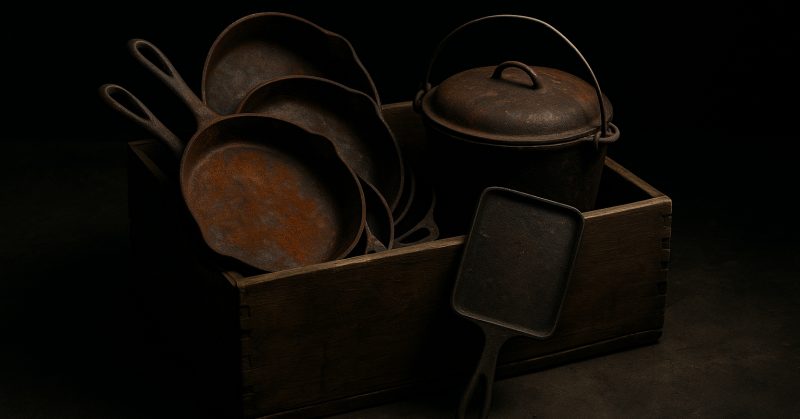
We will look at everything in one go, including the pieces nobody else wants, and tell you which items are worth listing separately rather than selling as a lot.