Full Restoration
From $45
- Complete strip to bare iron
- Rust removal and neutralizing
- Surface assessment for pitting
- Multi-coat cured seasoning
Quoted from photos
Pricing
Published starting prices, not a quote generator. Every piece is priced from photographs before it ships, and the price does not move afterwards unless something turns up that nobody could see.
From $45
From $65
From $60
Shipping is separate and quoted at cost, both ways. Several pieces in one box costs less per piece than sending them one at a time.
How the number is arrived at
The price of a cast iron restoration is almost entirely a function of bench time. Materials cost almost nothing - lye, electrolytic solution, abrasives, seasoning oil. What costs something is the hour or two a craftsman spends reading a piece, deciding what it needs, moving through the stages in the right order, and stopping when the result is actually good. That is what the pricing structure reflects. The from prices on each service are honest starting points, not teaser rates. They represent the simplest version of that service on a straightforward piece in a size that fits the equipment without awkwardness. Most pieces are not the simplest version of anything, and the quote adjusts for that in ways this page explains in detail.
Full Restoration starts from $45. Heavy Rescue starts from $65. Dutch ovens and large pieces start from $60. Each of those figures is the floor for a real job on a piece that presents no unusual complications. A number 8 skillet with moderate surface rust and ordinary polymerized grease is a straightforward piece. The electrolytic tank removes the rust cleanly, the carbon comes off without extended mechanical work, the cooking surface is sound, there is no lid, no hinge, no second cavity, no old paint, and nothing discovered mid-process that changes the picture. That piece at that service level is at or near the floor price.
The price moves upward when the actual bench time required moves upward. That is the only mechanism. There is no surcharge table, no multiplier for brand or collectibility, no penalty for a piece being old. If a signed Griswold spider skillet and an unsigned farm-sale skillet of identical size and condition land on the bench the same week, they cost the same to restore because they take the same time.
Surface rust that has spread across most of a cooking surface can look alarming in a photograph and can clean up in an hour. Pitting that has gone deep into the iron in a concentrated area takes much longer and may leave a textured surface even after extended work. The distinction that matters is depth. Deep active pitting means the bench time to address it is substantially longer, and in some cases a full removal is simply not achievable without grinding into the iron itself, which this shop does not do because the result is irreversible. A piece with deep pitting will be restored to the best condition the iron will accept, and the quote reflects the work required to reach that condition, not a promised outcome of a mirror-smooth surface.
Carbon buildup from decades of use at high heat or from repeated overheating bonds to the iron differently than ordinary seasoning does. Lye will address most of it given enough time, but extremely heavy carbon - the kind that has essentially become a structural layer on the outside of a piece - can require extended soaking, mechanical attention, or multiple cycles. A skillet someone baked in a campfire for thirty years may have carbon buildup that a skillet stored in a kitchen cabinet for the same period simply does not. That is not a judgment on how the piece was used. It is a statement about bench time.
Number 12 skillets, large oval roasters, and similar pieces are physically harder to handle and may not fit standard equipment in a single pass. Anything larger requires extra handling, repositioning, and attention to make sure every surface is reached. The from price for Dutch ovens and large pieces acknowledges this at the starting point, and pieces that are unusually large within that category will reflect that in the quote.
A lid is a separate piece of iron. It goes through the same cleaning, inspection, and seasoning process as the base. A Dutch oven quoted for restoration with its lid is two objects, and the price reflects that. A skillet with a matching lid is similarly two objects. This is not a gotcha - it is the accurate picture of what the work involves. Submitting a lid separately is fine; the quote form asks about lids specifically for this reason.
Cast iron that was painted, enameled on the outside only, or plated at some point in its life presents an additional stage before the standard process can begin. That coating has to come off safely before the iron underneath can be assessed and treated. The stage takes time and the result of that stage determines what the iron actually looks like and what it actually needs - which may not be fully known until that outer layer is gone. The quote will flag this when photographs show evidence of it.
Waffle irons, hinged broilers, and similar pieces have internal geometry that a skillet simply does not. Getting cleaning solution into and back out of tight cavities, making sure no residue is trapped in a hinge, and seasoning every interior surface without the piece being easily repositioned - all of that takes time that a flat skillet does not require. These pieces are quoted individually and the quote will explain what drives the number.
It is worth being direct about this. The lye in an electrolytic tank, the abrasives on the bench, the seasoning oil - none of that is expensive. What costs something is the judgment involved in reading a piece, deciding which method is appropriate for that specific combination of rust, carbon, iron quality, and geometry, moving through the stages in the right order, knowing when to stop rather than keep working, and catching the things that a fast process would miss. A piece that gets the wrong treatment - mechanical abrasion on iron that would have responded to the tank, or extended soaking on a piece with a hairline that should not get wet - is a worse piece than when it arrived. The price is a charge for getting it right.
The quote is built from photographs. Good photographs of cast iron in reasonable light tell a skilled eye quite a lot: approximate size, surface rust character, carbon type and distribution, whether a lid is present, whether there is evidence of paint or coating, whether the piece has been ground or machined previously, whether there are obvious cracks. The identification guide and the quote form both explain what photographs to send and how to take them.
What photographs cannot reliably show is rust that is hiding under heavy carbon, the full depth of pitting that looks uniform from above, a hairline crack under surface rust, or a warp that is subtle enough to be invisible without placing the piece on a flat reference surface. When something in one of those categories appears during the work and it changes the time required, the customer is contacted before any further work happens. The price does not move quietly. If the work is going to cost more than quoted, the customer decides whether to proceed.
In the other direction: if a piece cleans up faster than the photographs suggested, the charge reflects the actual work. The quote is not a fixed contract padded for uncertainty.
Two things come up often enough in inquiries that they need a plain statement. First: warp correction and flattening are not offered at this time. A warped skillet that arrives for restoration will be cleaned, inspected, seasoned, and returned, and the assessment will include a clear note about the warp - what it looks like, whether it is severe enough to affect cooking, and whether it appears to be a casting warp from manufacture or a warp introduced later by thermal shock. That information is genuinely useful to the owner. But the warp itself will not be corrected, and no service listed here implies that it will be. Anyone who needs that specific work should seek it out separately and understand that it involves its own risks to the iron.
Second: grinding the cooking surface is declined regardless of the condition of the piece or how the request is framed. Surface grinding removes iron. That removal is permanent and it changes a piece that may be decades or over a century old in a way that cannot be undone. A rough cooking surface that is the result of casting, age, or deep pitting will be addressed as thoroughly as the chemistry and non-abrasive mechanical work can address it. The result will be the best that surface will accept. If that is not good enough for a particular use, the honest answer is that grinding is not the solution this shop will provide, because the permanent alteration is not a trade the shop is willing to make on someone else's iron. The guides section has more on what a restored but not ground surface actually performs like in a kitchen.
Shipping is quoted separately at actual cost both ways. The shop does not build shipping into the service price or treat it as a revenue line. Cast iron is heavy and requires proper packing, and the real cost varies enough by piece size and origin that a flat fee would either overcharge most customers or undercharge on large pieces. The shipping page explains how to pack a piece safely and what carriers and services work best for this kind of weight and fragility. Sending multiple pieces in one box, when the pieces are packed so that they cannot damage each other in transit, costs less per piece than sending them separately. If a customer has several skillets to send, it is worth asking about that before boxing them individually.
Not every piece needs Full Restoration. A skillet with light surface rust and decent seasoning that someone wants to bring back to kitchen use may need only what the lighter service provides. The quote process is designed to catch this. Recommending a more expensive service than a piece requires is not something this shop does, because the goal is a result the customer will actually use, not a transaction. If the photographs show a piece that needs a $45 service rather than a $65 one, the quote will say so.
Some pieces need nothing at all. A skillet with intact seasoning and no rust that someone wants to "restore" because they are uncertain about it may simply need cleaning with hot water and a fresh coat of oil. Sending it through a full restoration process would strip seasoning that is actually fine. The care guide covers home maintenance in enough detail that many pieces can be brought back to good condition without any professional service. The shop is not reluctant to say that.
Some pieces are declined outright, and declining is the right answer rather than a failure to find a way.
A cracked piece intended for cooking use will not be restored for that purpose. A crack in cast iron is a structural failure. Cleaning and seasoning a cracked skillet does not make it safe to heat on a stove or in an oven. Cast iron at cooking temperatures with a crack can fail suddenly, and that failure can cause burns, fire, or damage. The shop will not accept a cracked piece for restoration to cooking condition regardless of how small the crack appears or how long the piece has apparently been used with it. If a cracked piece has value as a display piece or a collector item and the owner understands it will not be used for cooking, that is a different conversation, but it starts with that understanding being explicit.
Pieces with cracks are also worth understanding from a value perspective. The value guide is direct about what cracks do to collector value. It is not a recoverable condition in any conventional sense, and no restoration makes it one.
Other pieces may be declined because the work they would need is outside what this shop does - flattening, as noted above, or repairs that require welding or filling, which are not services offered here. In those cases the quote will say so and explain why, not simply decline without reason. The goal of the quote process is to give the owner accurate information about their piece and what options exist, including the option of doing nothing. That is useful information even when it is not the answer someone was hoping for.
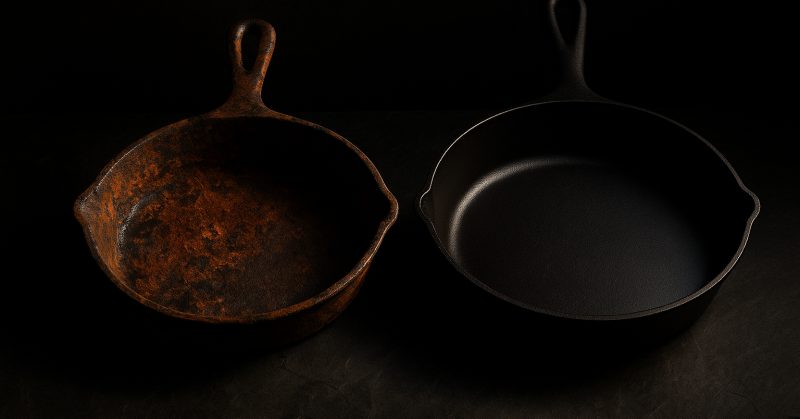
Identification and assessment cost nothing, whether or not the job goes ahead. If the piece needs less than you expected, or nothing at all, you get told that instead of sold something.
Start a restoration
Send a couple of photos and the markings you can read on the bottom. We will tell you what the piece is, what it needs, and what it costs before anything ships. Identification and assessment are free, and stay free if you decide to do nothing.
Would rather just talk it through? (802) 348-1550