| Maker | Where | Years | Known for | Collectibility |
|---|---|---|---|---|
| Griswold Manufacturing Company | Erie, Pennsylvania | 1865 - 1957 | Smooth, light, beautifully finished skillets and the deepest collector following of any American foundry | High |
| Wagner Manufacturing Company | Sidney, Ohio | 1891 - 1952 | Thin walls and an exceptionally smooth cooking surface; the other half of the two great American names | High |
| Erie and the early Griswold marks | Erie, Pennsylvania | 1880s - 1900s | The earliest Griswold output, marked ERIE with no logo, including the famous spider skillet | Very high |
| Favorite Stove and Range Company | Piqua, Ohio | 1849 - 1935 | Very light, very thin castings that many cooks rate above the better known names | High |
| Wapak Hollow Ware Company | Wapakoneta, Ohio | 1903 - 1926 | A short-lived foundry known for its Indian head mark and for castings that follow Griswold patterns closely | High |
| Sidney Hollow Ware Company | Sidney, Ohio | 1880s - 1890s | An early Ohio foundry whose name causes constant confusion with Wagner, which was also in Sidney | Moderate |
| Birmingham Stove and Range | Birmingham, Alabama | c. 1902 - 1980s | Excellent, genuinely usable mid-century cookware that stayed affordable because collectors chased other names | Moderate |
| Lodge Manufacturing Company | South Pittsburg, Tennessee | 1896 to the present | The last major American cast iron foundry still operating, and the maker of most modern new iron | Everyday |
| Blacklock Foundry | South Pittsburg, Tennessee | 1896 - 1910 | The foundry that burned and was rebuilt as Lodge; its marked pieces are scarce | High |
| Martin Stove and Range Company | Florence, Alabama | early to mid twentieth century | Southern foundry output that turns up constantly in estate lots and is routinely underrated | Everyday |
| The Vollrath Company | Sheboygan, Wisconsin | 1874 to the present | Better known now for stainless, but its early cast iron and enameled ware are worth knowing | Moderate |
| Chicago Hardware Foundry Company | North Chicago, Illinois | late nineteenth century - mid twentieth century | Heavy, plain, honest castings, including a lot of institutional and hotel ware | Moderate |
| Atlanta Stove Works | Atlanta, Georgia | late nineteenth century - late twentieth century | Large southern producer of everyday cookware, closely tangled with Birmingham Stove and Range | Everyday |
| Filley | Troy and St Louis, New York and Missouri | nineteenth century | Very early American gate-marked hollow ware from the era before the famous foundries | High |
| Columbus Hollow Ware | Columbus, Ohio | late nineteenth century | An Ohio producer from the crowded early period, whose pieces are often mistaken for better known marks | Moderate |
| W. C. Davis and Company | Cincinnati, Ohio | nineteenth century | Early Ohio Valley hollow ware from the gate-mark era | Moderate |
| General Housewares Corporation | Sidney, Ohio | 1957 - 1990s | The company that ended up owning both great names and made pieces that carry them without being them | Everyday |
| Store brands and jobber marks | roughly 1900s - 1960s | Pieces cast by the big foundries and sold under a retailer name, which is why so many look familiar | Everyday | |
| Le Creuset | Fresnoy-le-Grand, France | 1925 to the present | The enameled French tradition, and the vintage pieces from it that are worth seeking out | Moderate |
| Descoware | Belgium | mid twentieth century | Belgian enameled ware with a devoted following, largely because of who cooked on it | Moderate |
| Staub | Alsace, France | 1974 to the present | Modern French enameled iron, and how it differs from the vintage alternative | Everyday |
| Imports, reproductions and faked marks | mostly 1970s to the present | What a reproduction actually looks like in the hand, and the tells that give a faked mark away | Everyday | |
| Unmarked and unattributed pieces | roughly 1880s - 1950s | The largest category of all: good pans that were never signed, or whose mark is gone | Everyday |
One page each
Read a maker in full
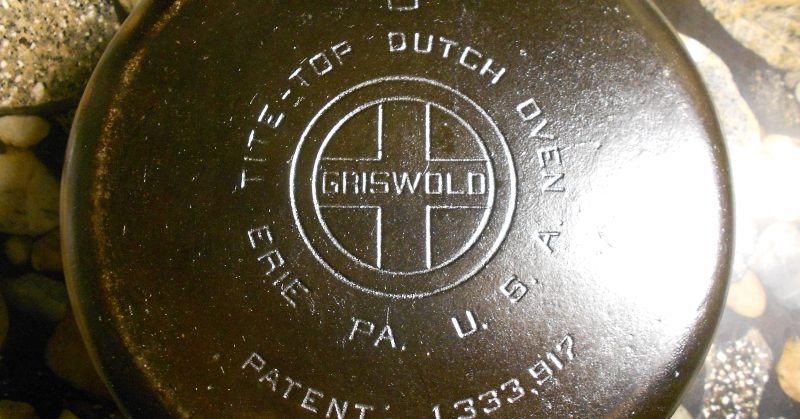
Erie, Pennsylvania
Griswold Manufacturing Company
Sidney, Ohio
Wagner Manufacturing Company
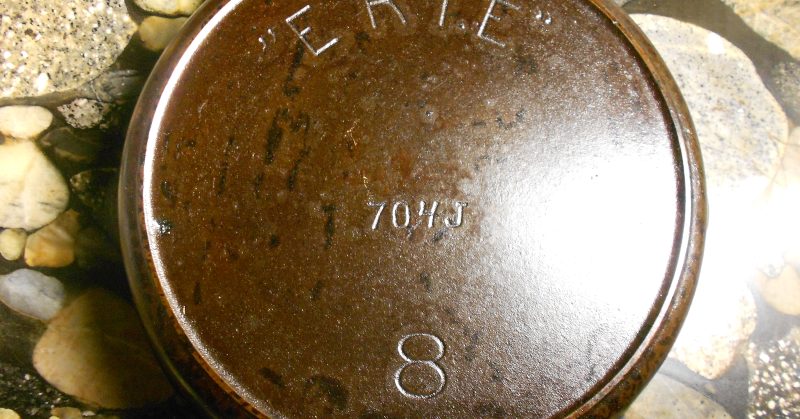
Erie, Pennsylvania
Erie and the early Griswold marks
Piqua, Ohio
Favorite Stove and Range Company
Wapakoneta, Ohio
Wapak Hollow Ware Company
Sidney, Ohio
Sidney Hollow Ware Company
Birmingham, Alabama
Birmingham Stove and Range
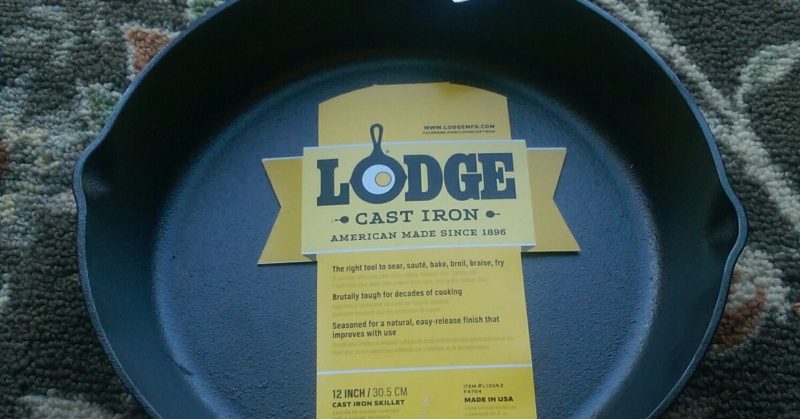
South Pittsburg, Tennessee
Lodge Manufacturing Company
South Pittsburg, Tennessee
Blacklock Foundry
Florence, Alabama
Martin Stove and Range Company
Sheboygan, Wisconsin
The Vollrath Company
North Chicago, Illinois
Chicago Hardware Foundry Company
Atlanta, Georgia
Atlanta Stove Works
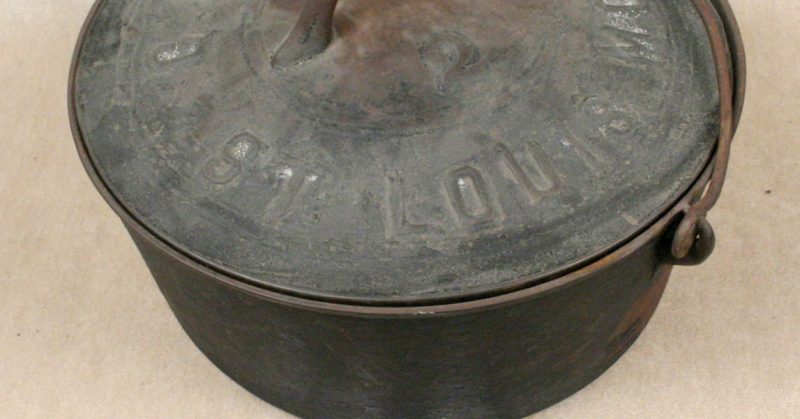
Troy and St Louis, New York and Missouri
Filley
Columbus, Ohio
Columbus Hollow Ware
Cincinnati, Ohio
W. C. Davis and Company
Sidney, Ohio
General Housewares Corporation
Store brands and jobber marks
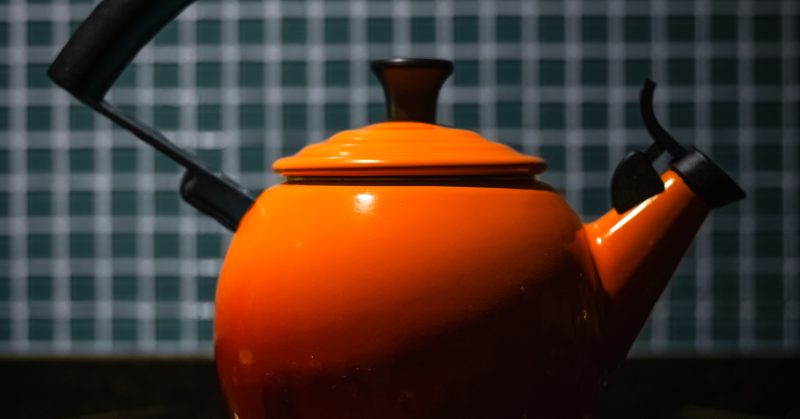
Fresnoy-le-Grand, France
Le Creuset
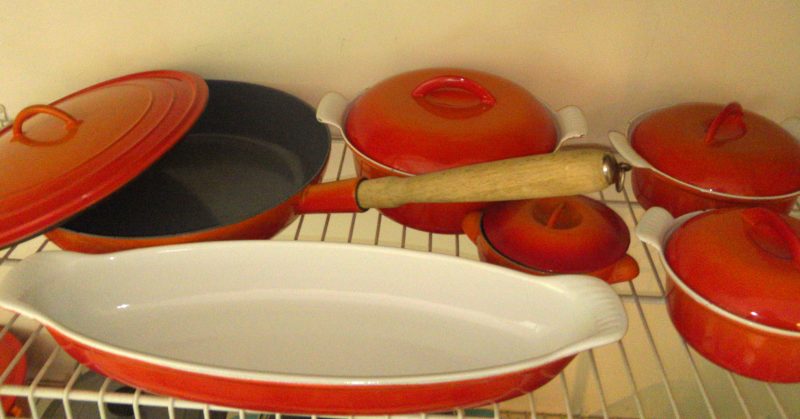
Belgium
Descoware
Alsace, France
Staub
Imports, reproductions and faked marks
Unmarked and unattributed pieces
How to use this
Why the maker matters, and when it does not
The maker of a piece of cast iron tells you something real and worth knowing. It tells you roughly when the piece was made, something about the foundry's methods and ambitions, and whether what you are holding is common or genuinely hard to find. What it does not tell you is whether this particular pan is any good. That is a condition question, and condition is answered by looking at the metal, not the mark. A pristine Wagner skillet is a fine thing. A warped, pitted Wagner skillet with a cracked handle is a problem, and the name on the bottom does not fix it. Keep that separation clear and the maker directory becomes a useful tool. Let it blur and you will overpay for damaged famous pieces and walk past excellent unknown ones.
What the maker actually tells you
A foundry mark locates a piece in time and place. Different foundries operated in different eras, and most went through enough logo and casting changes that the mark itself can narrow the date of manufacture to a range of decades. That narrowing matters because casting methods changed substantially from the mid-nineteenth century through the mid-twentieth. Earlier pieces were typically finished by hand, with smoother cooking surfaces and thinner, lighter walls than what most people think of as cast iron today. Later production became more automated. The surface texture changed. Wall thickness changed. The gates and sprues were handled differently. None of that is secret knowledge, but it takes a maker identification to get there, which is why the dating guide starts with the mark rather than with the shape of the piece.
The maker also tells you something about what the foundry was good at. This is not uniformly true across every piece every foundry ever made, but patterns exist. Some foundries concentrated on skillets and did them well across a long production run. Others built their reputation on dutch ovens, or on griddles, or on specialty pieces like waffle irons and gem pans. Collectors who focus on a particular form learn these tendencies over time, and they show up in the reference literature. When you look up a foundry in a maker directory, you are not just looking for a name. You are looking for context about what that shop was trying to make and roughly when.
Scarcity is the third thing the maker tells you. Some foundries ran for decades and produced millions of pieces. Others operated briefly, in limited markets, and left behind relatively few pieces that have survived in usable condition. Scarcity by itself is not the same as quality, and it is not the same as value to someone who wants to cook. But if you are trying to understand why two skillets of the same size carry very different prices at an estate sale, the foundry mark is often the explanation.
What the maker does not tell you
A foundry mark does not tell you whether the cooking surface of this pan is flat. It does not tell you whether the metal has stress cracks running from an old drop or a rapid temperature change. It does not tell you whether someone tried to strip the piece with an angle grinder and took the seasoning layer down into the metal. It does not tell you whether the handle has been repaired, or whether the piece has been sitting in soil and has deep pitting that a fresh seasoning will temporarily hide but never correct.
These are the things that determine whether a pan will cook well for the next fifty years or frustrate every person who tries to use it. A warped skillet rocks on a flat burner and creates hot spots that no amount of preheating resolves. A pitted cooking surface is harder to season evenly and harder to clean. A stress crack is a safety issue. None of these problems are changed by the name cast into the bottom. If you are buying cookware rather than assembling a display collection, flatness and surface integrity outrank the maker every time. The value guide goes into this in more detail, but the principle is simple: a common piece in excellent condition cooks better than a rare piece in poor condition, and it will hold its value better too.
Famous names, collector momentum, and the math behind the premium
Certain foundry names carry a price premium in the secondary market. Some of that premium is earned. The foundries that built those reputations often did produce consistently fine work, with smooth cooking surfaces, balanced weight, and careful gating that left fewer voids in the metal. Collectors who have handled many pieces from those makers have generally found that quality to be real, not imagined.
But part of the premium is collector momentum, which is a polite way of saying that prices are high partly because prices have always been high, and because the name is the one people know. When something becomes collectible, demand rises independent of the underlying quality argument. People who would not recognize a casting flaw if they held one pay a premium for a name they read about online. That premium then becomes part of the price discovery for the next sale, and so on. The mark gets traded as much as the pan.
This creates a real opportunity for cooks who are not collectors. A number of foundries produced work that is genuinely excellent by any cooking standard and that sells for a fraction of the famous-name price because collector attention never landed on them. The cooking surface is just as smooth. The weight balance is just as good. The seasoning takes identically. The gap is not quality. It is name recognition. Any honest look at the range of foundries active between roughly the 1870s and the 1950s will turn up several of these. The maker directory notes where collector attention has and has not concentrated, so you can make that judgment yourself rather than taking the market's word for it.
Why an unmarked pan is not an anonymous pan
A lot of cast iron never carried a maker's mark, or carried a mark that has worn away, or was marked on a paper label that is long gone. None of that makes the piece unidentifiable or unworthy. Shape, proportion, casting style, handle profile, heat ring dimensions, gate placement, and surface texture all carry information. Experienced handlers can often narrow an unmarked piece to a foundry, a region, or at minimum a production era using those physical characteristics alone.
This matters for a few reasons. First, some fine pieces are unmarked, and dismissing them because the bottom is bare means walking past good cookware. Second, some of the most interesting pieces in the collector literature are unmarked ones whose attribution has been worked out through careful physical comparison. That work is documented in reference books and in the serious collector forums, and it is the same kind of reasoning the identification guide walks through. Third, an unmarked piece that cooks well is still a piece that cooks well. The absence of a name does not change what the metal does on a burner.
There is also a subset of unmarked pieces that were made as store-brand or private-label goods, where a retailer contracted with a foundry to produce pieces without foundry identification. These pieces are sometimes attributed through the casting details and sometimes remain genuinely uncertain. Uncertain attribution is an honest answer. It is better than a confident wrong one.
The reproduction and fake-mark problem
Reproductions of vintage cast iron have been in circulation long enough that some of them are now being sold as originals by people who genuinely do not know better, not just by people who do. A piece does not have to be fraudulently represented to mislead a buyer. Honest ignorance produces the same result.
The problem is worse with certain high-demand marks. When a name reliably produces a price premium, it becomes worth someone's time to cast or stamp that name onto pieces that did not come from that foundry. This happens. It is not rampant, but it is real, and the collector literature is specific about which marks have been reproduced and what the tells are. Surface texture is often the first clue. Reproduction pieces typically show a rougher, grainier surface than the originals, because modern casting sand and methods are different from what was standard in the production eras of the foundries being imitated. The heat ring profile, the depth and style of the lettering, the weight distribution, and the finish of the gate area all provide additional information.
The honest position is that detecting a reproduction or a fake mark takes handled experience. Reading about the tells helps, but there is no substitute for having the piece in hand and comparing it to known originals. If you are spending serious money on a marked piece you cannot inspect in person, proceed carefully. The FAQ covers what to ask a seller and what photographs to request before committing.
Moving from a mark to a date
Maker identification and dating are closely linked but not the same thing. The mark tells you the foundry. Dating tells you when within that foundry's history the piece was made, which often matters a great deal. Most significant foundries changed their marks over time, changed their casting methods, and changed their designs. An early piece from a long-running foundry may be very different from a late piece from the same foundry, in surface quality, in wall thickness, and in collector interest.
The sequence of mark changes is the most reliable dating tool for most foundries. Gate style and location is the second. Design details like handle shape and heat ring presence or absence can help narrow the range further. The dating guide covers the known mark sequences for the major foundries and explains the physical characteristics associated with each period. It also explains where the record is incomplete and where a confident date is genuinely not possible. Giving a range is not a failure of knowledge. It is what the evidence supports.
What to do with all of this at the point of purchase
If you are putting together a collection and the maker matters to you for its own sake, use the directory to understand what you are looking at, track the mark sequences carefully, and treat condition as part of the evaluation rather than an afterthought. A collection of damaged famous pieces is a less interesting collection than one that includes lesser-known foundries in excellent shape, but that is an aesthetic and intellectual judgment you get to make for yourself.
If you are buying cookware to cook with, the calculus is different and simpler. Look at the cooking surface first. Is it flat? Run a straight edge across it. Is the surface smooth enough to season evenly, or is it rough or pitted? Pick it up. Is the weight reasonable for the size and form? Check the handle for cracks at the hang hole and at the junction with the pan body. Those are the stress points. If the piece passes those checks, the maker is useful context but not the deciding factor. A lesser-known foundry that produced a flat, smooth, uncracked skillet in the right size for your stove is a better buy than a celebrated name in compromised condition.
That principle is easy to state and harder to hold onto when you are standing at an estate sale and the famous name is right there in your hand. But it is the right principle. The care guide can rehabilitate surface rust and stripped seasoning. It cannot straighten a warped pan or fill a stress crack. Buy the metal, not the name, and you will end up with cookware that actually cooks. If you are unsure what you have before buying, the identification guide is a reasonable starting point, and a quote request can tell you what restoration is realistic for a specific piece.
Cannot find your mark?
Send a photograph of the underside. Identification costs nothing and we will tell you when the honest answer is that nobody knows.