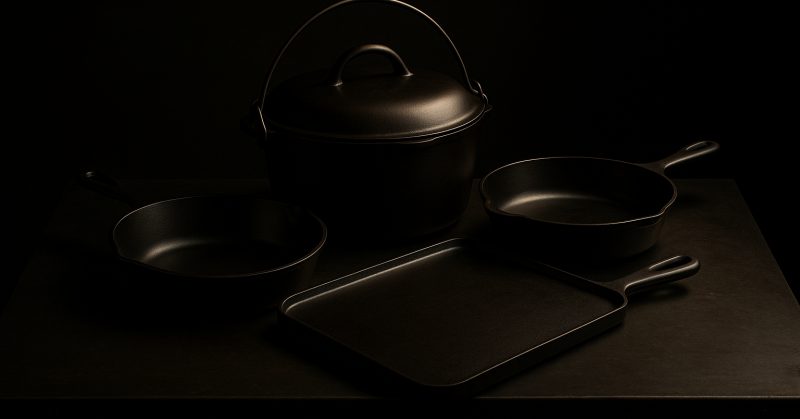
Have it done to your own pan
Most people who land here already own the piece they want. Mail-in restoration works from anywhere in the country and costs less than buying a restored one.
The shop
Everything here came through the bench and is photographed exactly as it is, flaws included. Each piece is a single object, so when one sells it is gone.
Pieces go up as they come off the bench, usually a few at a time, and they tend not to sit long. In the meantime, tell us what you are hunting for and we will write when something matching turns up rather than making you check back.
Stock here is one piece at a time and it moves. Say what you are after and we will write to you when a piece is listed. Nothing else, ever, and one click stops it.
Most people who land here already own the piece they want. Mail-in restoration works from anywhere in the country and costs less than buying a restored one.
The maker directory covers what each foundry made well and what to avoid, which is most of the value of a dealer anyway.
Before you buy anywhere, the value guide explains what actually drives the price and where the asking prices you see are fantasy.
Buying from us
When you buy a restored piece from this shop, you are buying that specific object - the one in the photographs, the one that was cooked on before it was listed, the one whose flaws are named in the text. There is no warehouse of interchangeable units, no stock photography, no representative image pulled from a different example of the same model. Every piece in the catalog is a single physical thing with its own history, its own minor quirks, and its own set of photographs taken after the restoration was complete. What you see is what ships.
This distinction matters more than it might seem. A great many online sellers photograph one nice example of a skillet and list that image against every copy they have in inventory. The piece that arrives may have a different pour spout, a hairline that was not visible in the photograph, or a rim that sits less true. That does not happen here because there is no inventory in that sense. There is one skillet. It is the skillet in the pictures. The photographs are taken after restoration, under consistent light, from the angles most likely to reveal surface condition, rim levelness, the interior cooking surface, the gate mark or heat ring on the bottom, and any area of concern. If a piece has a crack that has been stabilized, you will see the crack in the photographs. If the original heat ring has been worn almost flat by decades of use, the photograph will show that.
The photographs also stay up after a piece sells. If you are trying to identify a piece you own, or trying to understand what a certain logo variation looked like on a particular model, the old listings are useful reference material. A sold piece is marked clearly, but the page and its images remain. The shop's catalog becomes part of the identification record over time, which is part of the reason the identification resources here can be specific rather than generic.
Every listing names flaws that would matter to a buyer making a considered decision. The threshold for disclosure is not whether a flaw affects cooking performance - that is too narrow a standard. The threshold is whether a reasonable buyer, handling the piece in person, would notice it and want to have known about it in advance.
Things that are always named in a listing:
Things that are not named as flaws because they are not: the normal variation in surface texture between different casting generations, minor cosmetic marks on the exterior that do not affect cooking, the absence of the original lid where a lid was not part of the original listing, and the standard slight color variation in seasoning that appears within the first few uses.
No piece ships without having been cooked on first. This is not a marketing claim about quality - it is a functional step. The first use of a freshly seasoned piece reveals things that do not show up on a dry surface: whether the seasoning has bonded evenly, whether there is any micro-porosity that causes sticking in a specific area, whether the heat distribution matches what the casting shape suggests it should be. If a piece fails that test, it goes back through the seasoning process or it goes out of the catalog. A piece that passes goes into the listing with that confirmation already made.
The cooking test also lets the listing say something honest about how the piece actually performs, not how it looks. An old Griswold No. 8 with a worn but intact cooking surface that released cleanly can be described as doing so. A piece that requires more fat than average due to light pitting can be described that way too.
Payment is processed through Stripe. Your card details are entered directly into Stripe's interface and never pass through this site's servers. The shop does not see, store, or handle your full card number at any point in the transaction. Stripe is one of the more widely audited payment processors in use, and this arrangement was chosen specifically because it removes the shop from the data path entirely. If you have questions about a piece before purchasing, use the contact page and those questions will be answered before any payment is requested.
Cast iron is heavy, dense, and unforgiving of inadequate packing. A skillet that shifts inside a box during transit will punch through single-wall cardboard and arrive damaged, or will arrive intact but having damaged itself against a corner. Every piece ships in double-wall corrugated, surrounded by enough cushioning material that the iron cannot contact the box wall under any normal handling condition. The shipping weight for even a modest No. 8 skillet is substantial once proper packing is accounted for, and the listings reflect actual shipping costs rather than estimates. For more detail on how the shop approaches packing and what to expect at your end, the shipping page covers the specifics.
Pieces ship from southern Vermont. Transit times vary by destination and by carrier, and the shop will give an honest estimate at time of purchase rather than a guaranteed window that cannot be kept. If a piece arrives damaged because the packing failed, that is the shop's problem to resolve, not yours. If a piece arrives damaged because a carrier did something genuinely unusual to the box, the shop works with you on the claim rather than directing you to handle it alone.
The listing stays in the catalog after a piece sells, marked sold. The photographs and the identification information remain visible and useful. If you are trying to identify a piece you own and find a sold listing that matches closely, the description will tell you what foundry characteristics the shop observed, what size and weight measurements were taken, and what condition issues the piece showed. Over time this becomes a reference record. The makers index draws on this kind of accumulated observation as well as the published literature.
The shop buys pieces. If you have cast iron you want to sell - whether it is a single skillet or a larger collection - the process starts with the sell page, where you can describe what you have and send photographs. The shop is interested in pieces across a wide range of condition, including pieces that need significant restoration work, because the restoration process is what the shop does. A piece that looks rough is not automatically a piece the shop will pass on. What matters most is structural integrity: iron that is not cracked through, not so severely pitted that the cooking surface is lost, and not so warped that it cannot be used. Pieces outside that range may still be of interest depending on rarity.
The shop is also straightforward about the fact that buying pieces to resell is one part of a larger operation that includes identification, restoration, and reference work. The price offered for a piece will reflect what that piece will cost to restore and what a fair price for the finished result looks like. There is no formula that works perfectly across all pieces, and the shop will explain the reasoning rather than just stating a number.
The shop would often rather restore the piece you already own than sell you one of its own. This is not false modesty. A piece that has been in your family, or that you found and want to use, has a kind of continuity that a shop piece does not. If the iron is structurally sound, the restoration process - stripping, repair where needed, re-seasoning, testing - can return it to full cooking condition regardless of how bad the rust looks now. Rust looks alarming and is almost always reversible. The restoration service page explains what the process involves and what it can and cannot fix. If you are not sure whether your piece is worth restoring or whether you would be better served buying something already done, send a description and some photographs through the quote page and the shop will give you an honest answer, including the answer that your piece is not worth the cost of restoration if that happens to be true.
What is not available is an in-person consultation at the shop. The restoration service operates by mail from anywhere in the United States. An in-person drop-off option in southern Vermont is being developed but is not open yet. Everything described on this page - the catalog, the quotes, the buying and selling process - happens through the mail and through the contact and quote forms on this site.