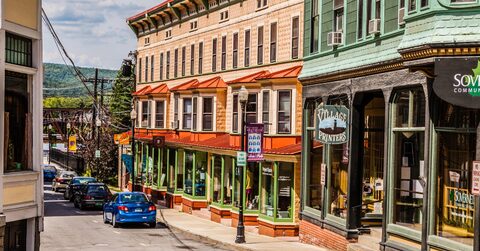
This bench in southern Vermont restores vintage cast iron cookware for customers in Bellows Falls and the surrounding Connecticut River valley. Every job is mail-in: you ship your piece, it is cleaned, reseasoned, and made cook-ready here, then shipped back to you. In-person drop-off for local customers is in the works but not yet available. See exactly what the work covers.
Bellows Falls and the Cast Iron That Lives Here
Bellows Falls is one of the most architecturally intact mill towns in Vermont. The downtown core along the riverfront was built up through the nineteenth century, and the residential streets climbing the hillside behind it are full of Victorian-era and early-twentieth-century housing stock - double-deckers, Italianate frames, Greek Revival farmhouses pushed close to the road. Houses like those were heated and cooked on wood stoves and coal ranges for generations before natural gas or electric heat arrived. That history is directly relevant to what turns up in local kitchens and barns: Wagner skillets, Griswold griddles, Lodge Dutch ovens, and generations of unmarked country-store ironware that cooked on those ranges and absorbed the character of the households that used them.
A River Town With Layers of History
The falls of the Connecticut River at this bend were a powerful draw for industry, and the town grew up around that power. The Bellows Falls Canal, one of the first in the country, and the later railroad connections made this a working crossroads for much of the nineteenth century. Working families settled here in numbers, and working households used cast iron almost exclusively. Many of those pieces - inherited, stored, forgotten, and occasionally handed down without explanation - are still turning up in cellars and attic corners of the old homes here. When an estate is settled in Bellows Falls, cast iron almost always appears. It is heavy, it does not obviously rot, and it outlasts everything else in the kitchen.
What the Climate Does to Cast Iron Here
The Connecticut River valley at Bellows Falls collects cold air and moisture. Winters are hard and long, springs are wet, and the humidity in an unheated basement or barn can be punishing to bare iron through March and April. Cast iron left in a garage through a Vermont winter will rust through its seasoning entirely by mud season. Pieces stored in a stone-foundation cellar - which describes a large portion of the housing stock here - face persistent ambient moisture that attacks bare iron slowly but steadily. By the time a piece surfaces from that environment, it may have years of rust built up, combined with carbonized old grease that has polymerized into a thick black crust. Both conditions require patient, controlled restoration rather than a wire wheel and a quick coat of oil.
What Bellows Falls Customers Typically Bring In
The most common pieces arriving from the Bellows Falls area are skillets and Dutch ovens in the medium-to-large range - the kind of workhorses that cooked for big households or on a camp stove in a deer-hunting camp in the hills above town. Warping from thermal shock is a concern with pieces that were used on wood stoves, where heat is uneven and intense. Cracks from a drop onto a stone or brick floor are another regular finding in older homes with hard flooring. Heavily carboned cooking surfaces - sometimes a quarter-inch of buildup - are extremely common in pieces that cooked at high heat for decades before being put away. And spider-web pitting from sustained rust is the signature of pieces left in damp outbuildings, which this area has in abundance.
Sugaring season is a particularly relevant tradition here. The hill farms north and west of town have run sap for generations, and the sugar house cast iron - large flat pans, deep kettles, utility skillets used to cook for the crew during boil - sees extraordinary heat and moisture cycling that degrades seasoning fast and leaves the metal in rough shape by the time it retires from active sugaring use. These pieces are worth restoring: the iron itself is almost always sound.
How the Work Is Done for This Area
Because the business operates by mail-in, geography does not limit what can be done for a Bellows Falls customer. You do not need to find a local shop willing to touch old cookware - a thing that is harder to find than it sounds. You pack the piece carefully, ship it here to southern Vermont, and the work happens at a dedicated bench. Check the common questions page for guidance on how to pack cast iron safely for shipping; it is more straightforward than most people expect. For Bellows Falls residents, local drop-off is being planned as a future option, but it is not open yet. The mail-in route is reliable and fully available right now.
The Restoration Process, Start to Finish
A piece coming in from Bellows Falls goes through the same careful sequence regardless of its condition. First, a full assessment of the metal: checking for cracks, warping, deep pitting, and whether the cooking surface has enough material left to season properly. Then comes the removal of old seasoning and rust, using a controlled lye soak followed by careful neutralization and electrolytic cleaning where the rust is heavy. No wire wheels, no sandblasting, no aggressive abrasion that removes metal and destroys the original machined surface. Once the metal is clean and bare, it is dried thoroughly - a critical step in a humid environment - and then multiple thin layers of seasoning are built up in a controlled oven over several cycles. The piece comes back to you black, lightly sheened, dry, and ready for its first cook. You can learn more about what to expect by reading through our services.
What Can Go Wrong Without Proper Care
The biggest mistakes people make with old Bellows Falls cast iron are well-intentioned ones. Running a rusted skillet through a self-cleaning oven cycle will remove seasoning and old carbon, but it also applies extreme heat that can warp thin vintage iron, especially pre-war pieces with thinner casting profiles than modern Lodge. Soaking in water to loosen crust invites deep rust fast. Using a wire wheel on an angle grinder removes the original surface machining that made old Griswold and Wagner iron so prized for its smooth cooking face - that surface cannot be put back. And re-seasoning with the wrong fat, or with too thick a layer, creates a sticky, peeling surface that looks worse than raw iron. These are exactly the reasons a patient, process-driven approach matters.
Estate Sales, Barn Finds, and the Antique Trade
Bellows Falls and the surrounding Great Falls area have a genuine antique culture. Estate sales here regularly surface cast iron that has been in families for a century or more. The antique trade along the Connecticut River corridor moves ironware regularly, and pieces from this region tend to be old, often pre-Erie, and sometimes marked in ways that require some knowledge to identify. If you are buying at an estate sale or picking a piece from a barn find and are unsure whether it is worth restoring, the general rule is this: if the casting is intact with no cracks, the piece is almost certainly restorable no matter how bad the surface looks. Rust is surface-level until it has created deep pitting, and even moderate pitting does not prevent a functional cook surface. Reach out for a free consultation if you are on the fence about a specific piece.
Nearby Communities and Where Their Cast Iron Comes From
Bellows Falls sits within easy reach of Westminster, Rockingham, Saxtons River, and across the Connecticut River into Walpole and North Walpole, New Hampshire. The rural farm country around all of these towns produces the same kinds of finds: attic skillets, sugarhouse kettles, hunting-camp Dutch ovens, and woodstove-era ranges that sat in place for fifty years. Customers from these communities are equally welcome to use the mail-in service, and they are all part of the broader network of towns across the areas we serve. The Bellows Falls area is a particularly good source of older, heavier American-made pieces because the working-class households here bought for durability and bought once.
Why Bellows Falls Customers Trust a Specialist
There is no shortage of people in Vermont who will tell you to throw a rusty pan in a fire or hit it with steel wool and call it done. That advice works on cheap modern iron. It does not work on a 1920s Griswold No. 8 with a ghost mark and a polished cooking surface that someone's grandmother bought at a hardware store in Bellows Falls before the second World War. The value of a careful restoration is not only sentimental - though that matters too - it is practical. A properly restored vintage skillet cooks better than most of what is sold new today, holds heat more evenly, and will last another century if it is maintained. Getting it right once is worth more than fixing it yourself three times. That is a straightforward Vermont calculation, and it is the one most customers here are already making when they reach out.
Getting Started
If you have a piece from a Bellows Falls home, estate, barn, or camp that needs attention, the first step is simple. Look it over for cracks - hold it up to light and tap it gently; a cracked piece rings dull rather than clear. If it is sound, it is almost certainly a candidate for restoration. Then start with a free consultation to describe the piece and its condition, and go from there. The process is low-friction, the shipping is manageable, and the result is a piece of cookware that earns its place in your kitchen again.
FAQ
Questions about Bellows Falls
- I found a rusty cast iron skillet in the cellar of an old Bellows Falls Victorian. Is it likely still restorable?
- Almost certainly yes. The stone-foundation cellars common in Bellows Falls's older housing stock are damp and cold, which produces surface rust and sometimes heavy crust, but the iron itself is typically sound underneath. As long as the casting has no cracks - tap it gently and listen for a clear ring rather than a dull thud - rust alone is not disqualifying. Even years of moisture damage can be addressed through a careful lye soak and electrolytic cleaning process.
- My Dutch oven was used in a sugarhouse north of Bellows Falls for decades. The seasoning is completely gone and the surface looks rough. Is that fixable?
- Sugarhouse cast iron sees brutal conditions: repeated high-heat cycles, steam, and sap acids that strip seasoning fast. What you are describing - lost seasoning and a roughened surface - is very common with sugaring-use pieces and is exactly what the restoration process is built for. The iron itself is almost always structurally fine. After cleaning and proper reseasoning in a controlled oven, the piece typically comes back as a fully functional cooker.
- Can I drop off my cast iron in person in Bellows Falls or nearby?
- Not yet. In-person drop-off and pickup around southern Vermont is something being set up for the future, but it is not available today. The current service is fully mail-in: you pack the piece and ship it to the bench, the work is done here, and it is shipped back to you. The common questions page has guidance on packing cast iron safely, which is simpler than most people expect.
- I bought a piece at an estate sale in Bellows Falls and I think it might be a Griswold, but I'm not sure. Does that change how it's restored?
- The identification matters for understanding the piece's value and age, but the restoration process is driven by the metal's condition rather than the maker's mark. Even so, pre-war Griswold iron has a notably smooth, thin cooking surface that should never be touched with aggressive abrasives. If you believe you have a Griswold, mention it when you reach out - the approach to cleaning and reseasoning will protect that machined surface specifically.
- A well-meaning family member ran my grandmother's skillet through a self-cleaning oven cycle. It looks terrible now. Is it salvageable?
- Probably, yes. A self-cleaning cycle does strip seasoning and old carbon, and it can warp thinner vintage iron if the piece was not cast heavily. Examine it on a flat surface - if it rocks noticeably, there is some warping. Minor warping does not always prevent cooking use. The surface itself, once the burnt residue from the cycle is cleaned off properly, can usually be reseasoned successfully. Describe what you are seeing when you request a consultation.
- How do I ship a heavy cast iron Dutch oven from Bellows Falls without it getting damaged in transit?
- The key is immobilization: the piece should not move inside the box at all. Wrap it thoroughly in bubble wrap or kraft paper, then pack the box tightly with crumpled paper or foam so nothing shifts. Use a double-walled box rated for the weight, and declare the weight accurately when you ship. A Dutch oven shipped this way arrives safely in the overwhelming majority of cases. Full packing guidance is on the common questions page, and it is worth reading before you head to the post office.
Start a restoration
Tell us what you have
Send a couple of photos and the markings you can read on the bottom. We will tell you what the piece is, what it needs, and what it costs before anything ships. Identification and assessment are free, and stay free if you decide to do nothing.
Would rather just talk it through? (802) 348-1550