Griswold, Wagner and Erie: what the foundry differences
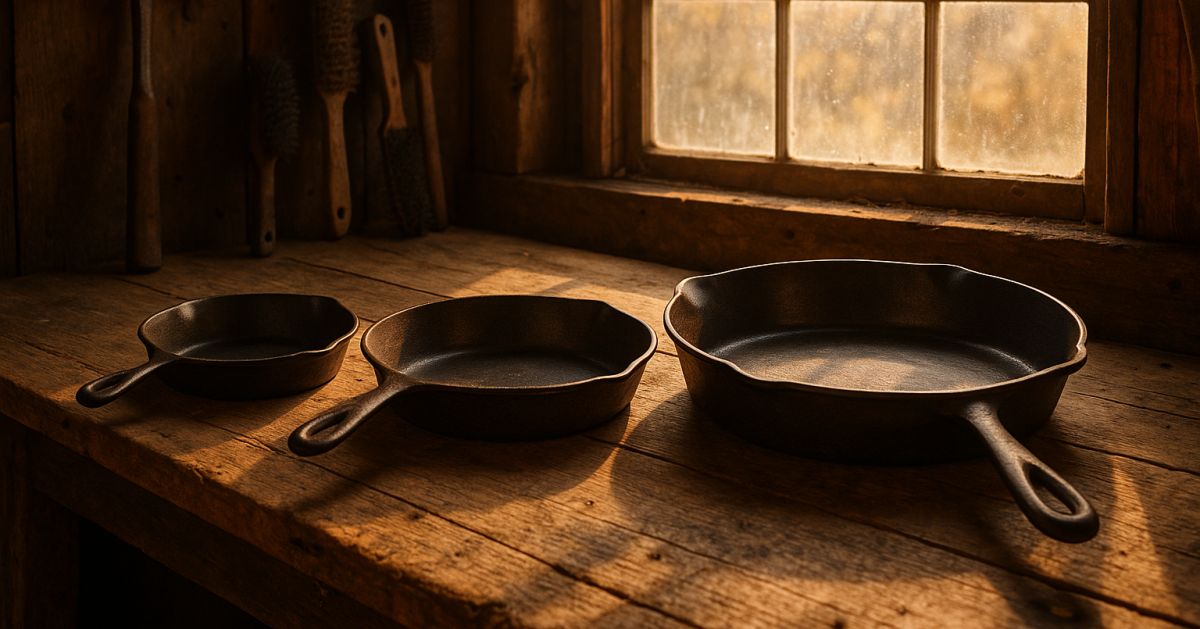
Spend an hour in any antique shop between Brattleboro and Bellows Falls and you will almost certainly stumble across a piece of old American cast iron with a foundry name pressed into its base. Griswold. Wagner. Erie. The names carry real weight among collectors, but if you are a home cook rather than a collector, you may be wondering whether any of it matters when you are actually standing over a hot burner. The short answer is: yes, it matters, but probably not in the ways the internet hype suggests.
This post lays out the real history, the real physical differences, and the real practical implications of each foundry, so you can make a smart decision whether you are buying, restoring, or simply trying to understand what you already own.
A quick map of the family tree
The three names are closely related, and that surprises a lot of people.
Erie came first. The Erie Stove Works started producing cast iron cookware in Erie, Pennsylvania in the 1870s. In 1884, brothers Matthew and Samuel Selden Griswold purchased that business and reorganized it as the Griswold Manufacturing Company, still based in Erie. So when you see a skillet stamped "ERIE" with no other markings, you are almost certainly looking at an early Griswold product made before the company fully adopted its own name on cookware. The Erie name continued to appear on some pieces well into the early twentieth century.
Wagner Manufacturing was founded in Sidney, Ohio in 1891 and operated independently throughout its most productive years. Wagner and Griswold were the two dominant American cast iron producers for decades and competed directly. In 1957, Wagner acquired Griswold. Both brand names continued to appear on cookware for some years after that, but the manufacturing was consolidated.
Knowing this family tree helps you date a piece and understand why some "Griswold" skillets feel noticeably heavier or lighter than others - they were literally made at different times, under different ownership, with different tooling.
What "smooth machined cooking surface" actually means
One of the most frequently cited differences between the foundries is the cooking surface finish, and this one is real and worth understanding.
From roughly the 1920s through the 1940s, both Griswold and Wagner ground and polished the interior cooking surfaces of their skillets to a near-glassy smoothness. This was done by machine after casting. The result is a surface with almost no visible pore texture - when you run a thumb across it, it feels similar to modern stainless steel.
Why does this matter? A smoother surface has less mechanical tooth for seasoning layers to grip, which means early seasoning requires a bit more patience and care. However, once a proper seasoning is established on a smooth surface, it tends to feel more naturally non-stick than the rougher surfaces found on most modern cast iron. The physics here are straightforward: fewer micro-peaks and valleys means food has fewer places to catch.
Griswold's smooth finish is especially consistent on their "large block" and "slant Erie" logo pieces from the 1920s through around 1940. Wagner pieces from the same era are similarly smooth but can vary more by product line and year. Later post-war pieces from both foundries, and especially pieces made after the 1957 merger, show a coarser, sandier surface more like what you find on new Lodge skillets today.
Erie-stamped pieces (the true pre-Griswold era) generally have a slightly heavier wall thickness and a somewhat coarser surface than the classic mid-century Griswolds, because machining technology in the 1870s and 1880s was less refined.
Weight, wall thickness, and heat behavior
This is where the practical cooking differences become most tangible.
Griswold, particularly pieces made between roughly 1920 and 1940, is well known for being notably lighter than comparable Wagner pieces of the same diameter. A #8 Griswold skillet from that era typically weighs noticeably less than a #8 Wagner of the same period, and both weigh substantially less than a brand-new Lodge of the same size. This is not an accident - Griswold invested heavily in precision molding technology that allowed thinner, more uniform walls without structural weakness.
What does thinner mean for cooking? Thinner walls heat up faster and respond more quickly when you adjust the burner. If you pick up a pan, carry it to the table, and set it down, a lighter pan is simply more comfortable. On the other hand, thinner walls also cool faster and provide slightly less thermal mass for searing. Neither is objectively better; they are different tools that suit different styles of cooking.
Wagner skillets tend to have slightly thicker walls and a bit more heft. That extra mass is an advantage for tasks like searing a thick steak or holding heat during a long braise. Wagner also produced a wide range of specialty pieces - bread pans, gem pans, corn stick pans - and those specialty items are often easier to find at accessible prices than comparable Griswold specialty pieces, simply because Wagner made more of them.
Erie pieces sit in their own category. Their thicker walls and heavier weight make them behave more like modern cast iron, and they tend to be more forgiving of uneven stovetop heat.
Logo variations and what they tell you about age
If you want to date a piece, the logo stamped on the bottom is your primary tool.
Griswold logos, roughly in chronological order:
- "ERIE" with a spider web or cross logo (1880s - early 1900s, pre-Griswold branding)
- "ERIE" with Griswold's name appearing (transitional, early 1900s)
- Slant Erie logo (early to mid 1900s)
- Small block logo (1920s - 1930s)
- Large block logo (1930s - 1940s, considered the sweet spot by many collectors)
- Small logo, no heat ring (late 1940s - 1957, quality begins to decline by some accounts)
Wagner logos:
- "WAGNER'S" arc stamp (1890s - early 1900s)
- Wagner Sidney O USA (various configurations, 1900s - 1950s)
- Post-merger pieces that carry both names or neither cleanly
The logo matters because it is a proxy for manufacturing era, and manufacturing era correlates with wall thickness, surface finish, and overall quality control. If you are evaluating a piece at an antique store in Newfane or at an estate sale in Grafton, flipping it over and reading the logo carefully can tell you a lot before you even pick it up.
For a deeper look at how to evaluate any of these pieces when you find one, see our guide on how to tell whether an old cast iron skillet is worth anything.
What condition actually determines value - and cookability
Here is a truth that gets lost in foundry brand debates: condition matters more than the name on the bottom.
A cracked Griswold large block is worth very little and is dangerous to use. A clean, smooth, uncracked Wagner Sidney in excellent condition will outperform a pitted, warped Griswold every single time. The foundry name sets a ceiling on what the piece could be. Condition determines what it actually is.
The problems to look for in any piece, regardless of brand, include:
- Cracks - visible as a line across the cooking surface or sidewall; always a disqualifier for use
- Warping - the pan rocks on a flat surface; it will never heat evenly
- Pitting - deep rust erosion that leaves a cratered surface; can sometimes be restored, but severe pitting is very difficult to fully correct
- Prior repairs - look for welding marks or filled areas, especially near the handle
A piece with only rust and old polymerized seasoning is almost always restorable. That is a surface problem, not a structural one. Our cast iron restoration services cover exactly these situations: stripping decades of built-up gunk, addressing rust, re-seasoning to a proper cooking finish, and returning a piece to actual daily use.
The Erie question: is it Griswold?
A question that comes up constantly in owner forums is whether an Erie-stamped piece "counts" as Griswold for collecting or value purposes.
The honest answer is: it depends on who you ask and why you are asking. From a historical standpoint, the Griswold family purchased the Erie business, so there is a direct corporate lineage. From a practical standpoint, true pre-Griswold Erie pieces were made by a different management team with different tooling, so calling them Griswold feels like a stretch.
For cooking purposes, the question is almost irrelevant. An Erie piece that is structurally sound, smooth, and properly seasoned is a wonderful skillet. The logo on the bottom does not affect how eggs slide across the surface.
For collecting purposes, transitional pieces that carry both the Erie mark and some Griswold association tend to attract collector interest precisely because they sit at the edge of two eras. But rarity and collector interest do not always translate to better cookware. Keep that distinction clear in your own mind.
Which foundry should you actually seek out?
If you are in the Windham County area - shopping estate sales in Wilmington, poking through antique shops in Putney, or attending barn sales in Dummerston - here is practical guidance on what to prioritize:
For everyday cooking on a gas or electric range: A smooth-surface Griswold large block in a #8 or #10, or a clean Wagner Sidney of the same era, will both serve you beautifully. The Griswold will be lighter and a bit more responsive; the Wagner will have slightly more thermal mass. Either is far superior to most new cookware for the money, once properly restored and seasoned.
For wood stove or camp cooking: The extra thickness of an Erie piece or a post-merger, heavier Wagner is actually an advantage. Thicker walls handle the uneven, intense heat of wood fires better than thinner precision-cast pieces.
For induction cooktops: All three foundries' cast iron works on induction. The flat, machined bottom of a classic Griswold or Wagner piece often makes better induction contact than the slightly convex bottoms found on some cheaper modern skillets. Do check for warping before buying - a warped base will give you uneven induction heating.
For specialty pieces (corn stick, gem, muffin): Wagner made these in high volume and they turn up regularly. Griswold specialty pieces are rarer and command higher prices. If you want to actually bake with a corn stick pan rather than display it, a clean Wagner is the sensible choice.
Our locations page covers all the towns we serve, and if you are anywhere from Athens and Guilford up through Halifax and Dover, we are close enough to help you evaluate or restore what you find.
Restoration: what changes and what does not
Whether you have a Griswold, a Wagner, or an Erie piece, the restoration process follows the same principles. The goal is to return the metal itself to its best original condition, then build seasoning from scratch.
What changes by foundry is mostly the target. With a smooth-surface Griswold, the goal during stripping is to preserve that machined smoothness - aggressive mechanical abrasion that is appropriate for a rough-surfaced pan can remove material you actually want to keep on a Griswold. With a heavier Erie piece, you have more latitude because the surface was never as refined to begin with.
Seasoning chemistry does not care what name is stamped on the pan. Polymerized fats bond to iron the same way regardless of whether the iron was poured in Erie, Pennsylvania or Sidney, Ohio. Per guidance from the U.S. Department of Agriculture on safe cookware use, properly seasoned cast iron is a safe, durable cooking surface, and the seasoning process is the same across all iron cookware types.
If you have inherited or found a piece that you are not sure about, the FAQ page covers a lot of the common questions we hear, or you can reach out directly through our contact page. Sometimes a five-minute conversation is all it takes to figure out whether what you have is a diamond in the rough or a piece that has simply reached the end of its useful life.
The bottom line
Griswold, Wagner, and Erie each represent a distinct chapter in American manufacturing history, and the physical differences between them are real. Griswold's thinner walls and smooth finish make it the precision instrument of the three. Wagner's extra heft and wide variety make it the workhorse. Erie's heavy construction makes it the durable generalist. None of the three is universally superior.
What they share is more important than what separates them: all three were made from quality iron, with craftsmanship that modern mass production rarely matches, and all three can be restored to excellent cooking condition if the metal itself is sound.
The next time you are at an estate sale in Brookline or flipping through a box at an antique market in Bellows Falls, you now have the context to pick up a piece, read the logo, check the surface, check for cracks, and make a genuinely informed decision. That is worth more than any brand hierarchy.
Explore the full range of what we do at Cast Iron Restoration, or browse the blog for more guides like this one.
Start a restoration
Tell us what you have
Send a couple of photos and the markings you can read on the bottom. We will tell you what the piece is, what it needs, and what it costs before anything ships. Identification and assessment are free, and stay free if you decide to do nothing.
Would rather just talk it through? (802) 348-1550