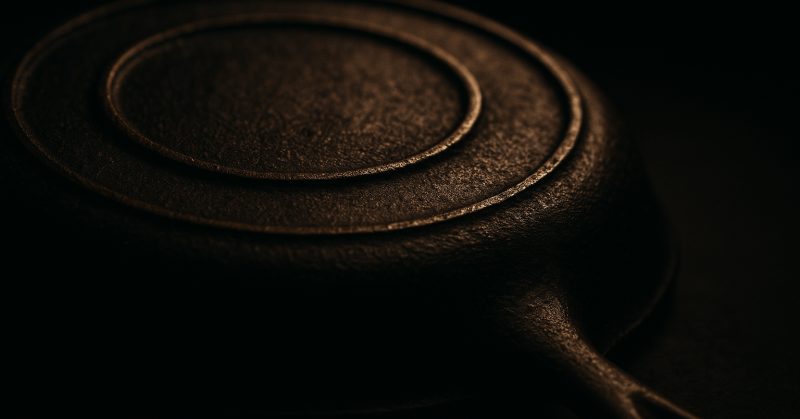
Most vintage cast iron can be identified, or at least narrowed to a short list of candidates, without any mark at all. The casting itself carries evidence: the shape of the gate scar, the presence or absence of a heat ring, the size number and what it actually means, the handle profile, the pour spout geometry, the wall thickness, the surface finish, and the faint impressions that survive even aggressive cleaning. None of these clues is conclusive on its own. Taken together, across a clean, well-lit piece, they usually point somewhere specific. What follows is a practical method for working through them in order, from the first thing you should do to the honest admission that some pieces simply cannot be pinned down and that this matters less than collectors sometimes act like it does.
Start by getting the casting readable
Before you interpret anything, the piece needs to be clean enough to see. A skillet caked in carbonized grease or heavily rusted will hide gate scars, soften embossed numbers, and make surface texture impossible to judge. You do not need the piece fully restored. You need it clean enough that bare iron is visible across most of the surface. A round of electrolytic rust removal or a careful session with a lye bath will do it without abrading the casting. Soap and a scrub pad will not be sufficient on a heavily fouled piece. If the piece came to you already stripped, proceed. If not, cleaning first is not optional.
Once clean, use raking light. A single bare bulb held low and to the side, or a flashlight laid nearly flat against the casting surface, will throw shallow embossing into relief that vanishes under overhead light. Embossed letters, size numbers, pattern numbers, and ghost marks all read better this way. Work around the piece, changing the direction of the light, because a mark that is invisible from one angle can be perfectly clear from another.
Photograph the underside before you do anything else. The bottom of the pan holds most of the identification evidence: the gate scar, the heat ring or its absence, any embossed numbers or logos, and surface texture. Photograph it dry, in raking light, from directly above and from two or three oblique angles. These photographs give you something to compare against reference images in the collector literature and let you consult someone else without physically shipping the piece. They are also a record. If you later refinish the piece, some surface evidence will be altered or lost.
The gate mark
Cast iron is poured into a sand mold through a gate, and when the casting is removed, a scar remains where that gate was cut off. The location, shape, and finish of that scar is one of the most useful brackets in identifying vintage cookware.
A gate mark running across the bottom of the pan, usually in a straight or slightly curved line, indicates an older method of molding in which the iron was poured into the bottom of the mold. This style of gate mark is associated with the earlier decades of American cast iron production, broadly the middle and latter part of the nineteenth century, before the side-gate method became standard. A piece with a bottom gate mark is almost certainly not a twentieth-century product from one of the major industrial foundries. It does not tell you who made it, but it tells you roughly when, and it rules out a large number of makers immediately.
The side gate mark - a small round or oval scar on the rim, the side of the skillet, or the handle junction - became the dominant method as foundry practice modernized. Most pieces you encounter from the major American makers of the late nineteenth and early twentieth centuries will have a side gate scar. Its exact position varies by maker and by era within a maker's production. Some foundries finished the gate scar smooth; others left it rough. That detail is worth noting but should not be over-weighted, since gate scars are sometimes dressed after the fact by owners or by dealers preparing a piece for sale.
A complete absence of a visible gate mark usually means one of two things: the piece has been ground, or the gate scar was dressed to invisibility at the foundry. Heavy grinding is detectable by other means, covered below. Foundry dressing was common on higher-grade pieces. Neither situation is a problem in itself, but both require you to weight other evidence more heavily.
The heat ring
The raised ring on the bottom of most vintage skillets and many other pieces is called the heat ring. It is a concentric raised ridge, set in from the outer edge of the base, that allowed the pan to sit over the opening of a wood or coal burning stove eye without rocking. The outer edge rested on the stove surface and the ring dropped into the eye opening, keeping the pan centered and stable over direct flame.
The presence of a heat ring is genuine supporting evidence that a piece was made for, or at least during the era of, wood and coal stoves. That era runs roughly from the mid-nineteenth century through the early-to-mid twentieth century, with significant overlap. Many foundries continued to include heat rings into the 1930s and even the 1940s on some lines, because the stoves that needed them were still in use in rural households long after gas and electric ranges had become common in cities. The absence of a heat ring on a piece that is otherwise consistent with early production does not mean the piece is modern; some foundries dropped the feature sooner than others, and some pieces within a maker's line never had one.
What the heat ring does not do is prove a date of manufacture by itself. It is a stove-compatibility feature, not a timestamp. A piece with a heat ring was made to work with a certain kind of stove, but that stove era was long, the feature persisted past its practical need in some catalogs, and reproductions of early forms sometimes include heat rings because the design being copied had one. Treat the heat ring as one piece of evidence, not as a conclusion.
Size numbers and what they actually mean
The number embossed on the handle or the bottom of a vintage skillet is not a measurement. It is a foundry size number, and it corresponds to the size of stove eye the pan was intended to fit, not to the diameter of the pan. This confuses collectors regularly. A No. 8 skillet from one maker will not have the same top diameter as a No. 8 from another maker, and within a single maker's production the diameter associated with a given number could shift across decades.
The table below gives approximate top-rim diameters for the most common skillet numbers as they appear across the major American makers of the late nineteenth and early twentieth centuries. The figures are approximate, the variation between makers is real, and measuring your specific piece in millimeters and then comparing carefully against reference data for a suspected maker is the only reliable approach.
| Skillet Number | Approximate Top Diameter (inches) | Notes |
|---|---|---|
| No. 2 | 6 to 6.5 | Uncommon; varied significantly by maker |
| No. 3 | 6.5 to 7 | Common small size; ranges overlap with No. 2 in some lines |
| No. 4 | 7 to 7.5 | Frequent in early production runs |
| No. 5 | 7.5 to 8 | Varies noticeably between makers |
| No. 6 | 8.5 to 9 | Common household size |
| No. 7 | 9 to 9.5 | One of the most common surviving sizes |
| No. 8 | 10 to 10.5 | Extremely common; the workhorse size of most collections |
| No. 9 | 10.5 to 11 | Diameter overlaps with No. 8 in some maker lines |
| No. 10 | 11.5 to 12 | Larger household or commercial size |
| No. 12 | 13 to 13.5 | No. 11 exists but is less common; No. 12 is the next frequent step |
If the size number on your piece does not match these ranges, that is useful information. It may indicate an unusual maker, a commercial line, or an export piece. It may also mean you are misreading the number, which is easy to do on a worn casting. Raking light and a magnifier will usually resolve ambiguity between a 6 and an 8, or between a 9 and a 0.
Pattern numbers and maker-specific markings
Separate from the size number, many foundries embossed a pattern number or a part number on the bottom of the casting. These are foundry-internal references to the wooden or metal pattern used to make the mold. They are not size numbers and they are not model names. Griswold used a pattern numbering system that collectors have documented extensively, and cross-referencing a Griswold pattern number against published references is one of the more reliable identification paths for that maker. Wagner used part numbers on some pieces. Many smaller or regional foundries used no secondary numbering at all, and the absence of a pattern number does not disqualify a piece from being the product of a significant maker.
Where a logo or maker name is present but illegible, raking light and photography are again the right tools. Embossed text on cast iron tends to survive better than it looks under flat light. What appears as a smooth, featureless area often resolves into readable letters under a light held at a low angle. If you can read even a fragment - a distinctive letter form, the arc of a logo, a partial word - the makers reference on this site can help you match it.
Handle profile and the helper hole
Handle shape is maker-specific enough to be genuinely useful. The cross-section profile of the handle shank - whether it is flat, rounded, oval, or T-shaped - varies between foundries and across periods within a foundry. The length of the handle relative to the pan diameter, the angle at which it meets the pan body, and whether it curves upward, stays flat, or droops slightly are all details worth recording and comparing.
The hole at the tip of the handle, when present, was a practical feature: a place to hang the pan on a nail or hook above the stove. Some makers included it consistently, some omitted it on certain lines, and some changed their practice at different points in production. The presence of a hole is not definitive by itself, but a handle without a hole on a piece that is otherwise consistent with a maker who always included one is a detail worth noting. It may indicate a different maker, a different period within that maker's production, or a handle that has been replaced or heavily repaired, which is not common but does happen.
Pour spouts
Most vintage skillets have two small pour spouts cast into opposite sides of the rim. Their shape, depth, and symmetry vary. Some makers produced a rounded, shallow spout; others cut a deeper, more angled channel. A few pieces have asymmetric spouts by design; asymmetry that looks unintentional - one spout clearly shallower or differently shaped than the other - may indicate a casting defect, a pattern mismatch, or a repair. Pour spout geometry rarely identifies a maker on its own, but it adds to the picture and can rule out certain attributions when a claimed maker's known pieces consistently show a different form.
Wall thickness, weight, and the feel of the piece
Older American cast iron, from the mid-nineteenth century through roughly the first two decades of the twentieth, tends to be thinner-walled and lighter than the heavier, thicker pieces that came to dominate mid-century production. This is a generalization with real exceptions, but it is well-supported in the literature. A piece that feels noticeably heavier than expected for its size is more likely to be a later product or a commercial-grade casting. A piece that feels surprisingly light and rings clearly when tapped is more likely to be from the earlier, thinner-casting tradition.
Measure and weigh if you want to compare against documented references. A kitchen scale accurate to the ounce and a set of calipers are sufficient. Measure wall thickness at the rim and at the bottom, because some foundries varied the thickness deliberately across the pan. Documenting these numbers gives you something concrete to match against known examples of a suspected maker.
Cooking surface finish: machined versus as-cast
The cooking surface of most vintage American cast iron was machined smooth after casting. This is the polished, almost glassy surface that people associate with quality vintage pieces. The machining was done on a lathe or with a mill, and the resulting surface is visibly and tactilely different from an as-cast surface: it is smoother, more reflective, and under magnification shows the fine circular or spiral tool marks of the machining process.
As-cast surfaces are rougher. They show the texture of the sand mold, a slightly pebbly or granular finish. Some makers used as-cast surfaces on the exterior of the pan while machining the interior. Others, particularly on lower-grade or later production pieces, left the cooking surface as-cast entirely. Modern cast iron is almost universally as-cast on the cooking surface. If a piece is presented as vintage but has an as-cast cooking surface with no signs of age or wear, that is a detail worth investigating before attributing it to an early American foundry.
Ghost marks
A ghost mark is a faint impression visible on the surface of the casting where a mark, letter, or design element was present on an earlier version of the pattern and was subsequently removed or filled, but not completely erased. The iron preserves the slight depression or raised area even after the pattern was modified, because the modification was never perfectly flush. Ghost marks are most common on pieces from foundries that went through branding changes or that updated their logo designs, and they can sometimes reveal that a piece is from a transitional period in a maker's production. They are almost never visible under flat overhead light and almost always visible under raking light on a clean casting. A ghost mark is not a defect and not a sign of a problem with the casting. It is a record of the pattern's history.
Reading a piece that has been ground, buffed, or otherwise interfered with
A significant number of vintage pieces on the market have been worked over. Grinding to remove pitting, buffing to create a polished surface, welding or brazing to repair cracks, and aggressive wire-wheel cleaning that removes metal from high points are all common. Each of these interventions destroys some evidence.
Ground pieces often show a slightly uneven bottom surface when viewed in raking light, with areas of different reflectivity where the original casting skin has been removed to different depths. The heat ring, if present, may show flat spots where a grinder touched it. Embossed marks are sometimes partially or fully removed by grinding. A completely smooth, mark-free bottom on a piece that is otherwise consistent with a marked maker's production should raise the question of whether marks were present and removed, rather than the assumption that the piece was unmarked from the foundry.
Buffed pieces can look superficially like machined-surface vintage pieces, but the tool marks are different. Buffing produces a random, swirling scratch pattern; lathe or mill machining produces the fine parallel or concentric lines of a cutting tool moving in a fixed path. Under magnification, the difference is usually clear. A piece that has been buffed to simulate a machined surface is not automatically a fraud - people restore things, and this is one of the things they do - but it means the surface finish cannot be used as identification evidence.
If a piece has been heavily interfered with, you are working with less evidence. Rely more heavily on the shape, the proportions, the handle profile, and the overall form. Sometimes that is enough. Sometimes it is not.
The limits of identification
Some pieces cannot be identified. This is not a failure of method. Thousands of American foundries produced cast iron cookware over the course of roughly a century of peak domestic production, and many of them made pieces with no marks at all, with marks that are now completely illegible, or with marks that have never been systematically documented because the maker was small, short-lived, or simply understudied. The collector literature is extensive but not complete, and new information continues to surface as more pieces are examined and compared.
A piece that resists identification after careful examination should be recorded accurately - dimensions, weight, photographs, every detail you can capture - and set aside. The dating guide on this site can help narrow the production era even when the maker is unknown. The identification tool is a practical starting point for matching physical details against documented maker characteristics. If you want a second opinion from someone who has handled a wide range of pieces, the contact page describes how to reach us.
What an anonymous piece cannot tell you is who made it. What it can tell you, through its construction and its condition, is roughly when it was made, how it was made, and whether it is well-made. A genuinely anonymous skillet with thin walls, a well-machined cooking surface, good balance, and solid construction is excellent cookware regardless of whether it carries a name. Attribution matters to collectors and to value, and there is nothing wrong with wanting to know. But the piece does not become better or worse depending on the answer. If you are restoring it for use, the casting is the thing. Our restoration services treat an unmarked piece exactly the same as a marked one, because the iron does not know the difference.
Questions
Common questions
Can you identify a pan with no markings at all?
Usually, yes. Handle profile, the shape of the pour spouts, the presence or absence of a heat ring, wall thickness and the size number style are all foundry-specific. A completely unmarked pan is rarely anonymous; it is just not signed.
Does the number on the bottom mean inches?
No. It is a foundry size number that traces back to the stove eye the piece was made to sit in. A number 8 skillet is roughly ten and a half inches across the top, not eight, and the relationship differs slightly between makers.
Is a gate mark a defect?
It is a casting scar from the gate the molten iron was poured through, and on a piece that has one it is evidence of age rather than damage. Gate marks generally disappear from American cookware by the 1890s.
My pan sits unevenly. Is it ruined?
Not necessarily. A slight rock is common in pieces that have been overheated, and some of it can be corrected. A pan that spins freely on a flat surface is a different problem, and we will tell you honestly which one you have.
Are unmarked pans worth less?
Usually, but not always, and the gap is smaller than collectors assume. A clean, flat, well-cast unmarked skillet cooks exactly as well as a signed one, and for anybody buying cookware rather than a collection that is the whole question.
Start a restoration
Tell us what you have
Send a couple of photos and the markings you can read on the bottom. We will tell you what the piece is, what it needs, and what it costs before anything ships. Identification and assessment are free, and stay free if you decide to do nothing.
Would rather just talk it through? (802) 348-1550