A cracked hinge arm on a waffle iron: why it's still worth
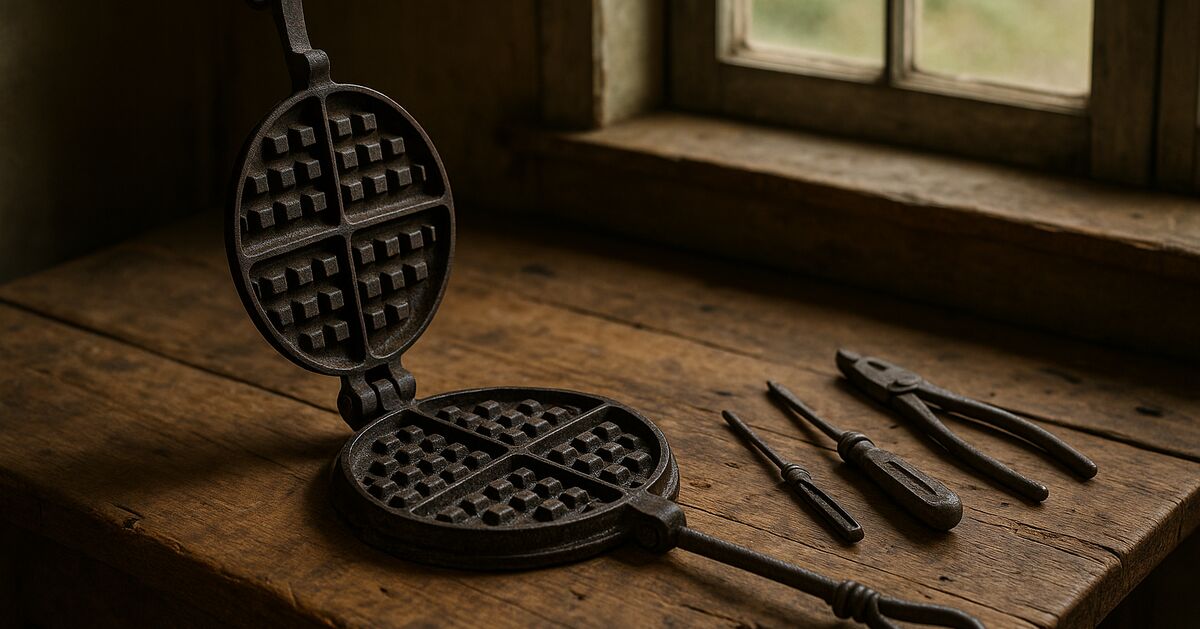
A cracked hinge arm stops many people cold. They pick up a beautiful old waffle iron at an estate sale in Newfane or a barn cleanout in Grafton, turn it over, and there it is: a fracture running through the cast iron arm that connects the two halves. They set it back down and walk away, assuming the piece is scrap. That instinct is understandable, but in a good number of cases, it is wrong.
Vintage waffle irons are among the more mechanically complex pieces of cast iron cookware ever made. They have grids, frames, hinge assemblies, and sometimes a rotating base. That complexity means more parts that can fail over a century of use, but it also means that one failed part does not automatically doom the whole piece. This post walks through why a cracked hinge arm is not automatically a fatal flaw, what the actual repair options look like, and how to think about whether your particular iron is worth the effort.
What the hinge arm actually does
The hinge arm (sometimes called the hinge bracket or bail arm, depending on the maker) connects the top grid plate to the bottom grid plate and holds them in alignment while the iron is opened and closed. On most American vintage irons from the early to mid-twentieth century, this arm is a separate cast piece that attaches to the frame through a pin, bolt, or integrated cast post.
Because it is cast iron and not wrought iron or steel, it is hard but brittle. It handles compressive loads well. It handles sudden lateral force, a pan dropped on its side, a hinge forced open past its stop, a hundred years of thermal cycling, poorly. Cracks tend to appear at the narrowest cross-section of the arm, right near the pivot point, because that is where bending stress concentrates.
The good news is that a crack in the hinge arm does not damage the cooking surfaces. The grids themselves, which are the part that actually touches your food and represents the majority of the iron's monetary and cooking value, are often completely intact. You are looking at a structural problem in one supporting component, not a problem with the heart of the piece.
Why people assume it's hopeless (and why that's often wrong)
Cast iron has a reputation for being impossible to repair once cracked, and that reputation is partly earned. Welding cast iron is genuinely difficult. It has a high carbon content, which makes it prone to further cracking during and after welding if the process is not done carefully. A botched weld attempt can turn a minor crack into a shattered arm.
But "difficult" is not the same as "impossible," and the blanket dismissal of cracked cast iron ignores several practical realities.
First, a hinge arm that is cracked but not yet separated can often be stabilized before it fails completely. If you caught it early, you have options that someone with a fully snapped arm does not.
Second, for many vintage waffle iron models, the hinge arm is a discrete, replaceable component. If a donor iron with a good arm can be found, a mechanical transfer of the arm solves the problem entirely, with no welding required. Matching donor parts for common makers like Griswold, Wagner, and several Sears and Rome models turn up regularly in estate sales across this part of Vermont, from Brattleboro and Bellows Falls up through Putney and into the hills around Wilmington and Dover.
Third, the right kind of welding repair, done properly, can restore structural integrity to a cast iron hinge arm. It is not a job for a hobbyist with a wire-feed welder, but skilled cast iron repair is a real trade, and the result, when done well, is a hinge arm that will outlast the person doing the cooking.
The actual repair options, explained
Option 1: Mechanical stabilization of a partial crack
If the arm is cracked but the two halves are still in contact and the crack has not widened to a gap, the first question is whether the iron can function safely as-is. A crack that runs parallel to the length of the arm and away from the pivot point may not be structural at all. A crack across the narrowest section near the pin is more serious.
For partial cracks that are genuinely structural, one option is mechanical pinning: drilling through the crack perpendicular to its path and inserting a steel rod or bolt to hold the faces together. This is not invisible, but it is strong, it is reversible, and it does not require heat. Done by someone who knows cast iron, it preserves the iron for cooking use.
Option 2: Donor arm replacement
This is often the cleanest solution. A matching donor iron with a broken grid but an intact hinge assembly gives you the part you need. The arm is removed from the donor, cleaned, and fitted to the iron being restored. Because the arms were cast to consistent dimensions within a model run, the fit is usually exact.
Finding the right donor takes patience. But if you bring your iron to someone who works with vintage cast iron regularly and serves areas like Athens, Newfane, and Guilford, they will often know where to look or have parts already on hand from previous restorations.
Option 3: Brazing or welding
This is the option that makes people nervous, and for good reason if it is done carelessly. But when cast iron is properly preheated, welded or brazed with the right filler material, and then cooled slowly, the repair can be structurally sound.
Brazing (using a bronze or brass filler at lower temperatures than welding) is often preferred for cast iron repairs because it puts less thermal stress on the surrounding material. The joint will not be as strong as a full fusion weld, but for a hinge arm that sees moderate loads, it is usually adequate.
Proper welding uses a nickel-bearing electrode (commonly called "nickel rod") designed specifically for cast iron. The piece needs to be preheated to several hundred degrees Fahrenheit to reduce thermal gradient during the weld, and it needs to cool slowly, ideally wrapped in insulating material. Skipping the preheat is a common mistake in casual repair attempts, and it is why so many home repair attempts end in a worse crack than the one they started with.
Our full restoration services include assessment of structural damage before any work begins, so nothing is attempted that is likely to make the situation worse.
How to evaluate whether your iron is worth it
The honest answer is: it depends on the iron, not just the arm. A few things to weigh:
- Grid condition. If the grids are pitted, warped, or show signs of metal loss from rust that was left too long, the cooking performance will be compromised regardless of what you do with the hinge. Clean, smooth, well-defined grid patterns are the sign of an iron worth saving.
- Completeness. Does the iron have both grid plates, the full hinge assembly (even if damaged), and any base or handle it was made with? Missing components that cannot be sourced from donor irons reduce the case for a full restoration.
- The maker and model. Some vintage waffle irons were made by foundries with exceptional metallurgy and tight casting tolerances. These irons make genuinely better waffles than their modern counterparts, and they are worth restoring on cooking merit alone, apart from any collector value. Our blog has covered some of the foundry differences and what they mean for actual cooking performance.
- The nature of the crack. A hairline crack caught early is very different from a fully separated arm with displaced fragments. Have someone who knows cast iron look at it before deciding.
- Your attachment to the piece. An iron that belonged to a grandparent in Grafton or Brookline carries a value that does not show up in any price guide, and that is a completely legitimate reason to restore something that a pure cost-benefit calculation might not support.
For a straightforward look at how to read a piece's value before committing to restoration, our post on how to tell whether an old cast iron skillet is worth anything covers the evaluation framework well, and most of it applies to waffle irons too.
What the restoration process looks like, start to finish
Assuming the decision is made to restore, here is a realistic picture of what happens:
Assessment. The iron is examined closely: crack location, crack width, whether it is through the full thickness of the arm, grid condition, seasoning condition, and completeness of all components.
Stripping. Before structural work begins, the iron needs to be stripped of old seasoning and rust so the metal can be inspected clearly. This is also where you learn whether the grids have underlying pitting that was hidden under buildup. Our post on lye, electrolysis, and the self-cleaning oven covers the major stripping methods and what each one does to the metal, which is worth reading if you are curious about the chemistry.
Structural repair. Whichever method suits the specific crack, this is done after stripping, when the metal is clean and fully visible.
Rust treatment and surface prep. Any remaining rust is addressed, and the surface is brought to a clean, uniform state.
Seasoning. Multiple thin layers of oil are applied and polymerized at high heat. A waffle iron has deep recesses and a lot of surface area, so seasoning it thoroughly takes care and time. Done right, the first waffle out of a restored iron should release cleanly.
Function test. The hinge is tested through its full range of motion. The two halves should close evenly and with consistent pressure across the grid. If they do not, that points to alignment issues that need to be addressed before the iron goes back to a kitchen.
A note about safety during use
Vintage waffle irons were designed for wood stove, coal stove, or early gas range use. They sit directly on the burner and need to be flipped manually. The hinge is under no load when the iron is flat on the stove or when it is flipped closed for cooking. The load on the hinge comes during opening, when the weight of the top plate is cantilevered against the pivot point. A properly repaired hinge arm that felt shaky before should feel noticeably more solid afterward, though you should still have a knowledgeable restorer confirm it before regular use.
If you are in the Brattleboro area or anywhere across the southern Vermont service area, and you have a waffle iron with a damaged hinge sitting in a barn or a box in the attic, it is worth getting an honest assessment before writing it off. Bring it in, or reach out through our contact page to describe what you have. The worst outcome is that someone with experience tells you the crack is too severe to repair safely, and you know for certain. The better outcome, which happens more often than people expect, is that a piece you thought was finished turns out to be a few hours of careful work away from making waffles again.
Vintage cast iron waffle irons, particularly the double-grid flip styles from the first half of the twentieth century, produce a waffle with a crust and interior texture that modern non-stick appliances cannot replicate. The mass of the iron holds and distributes heat in a way that thin stamped plates simply do not. That cooking quality is why the restoration is worth the trouble, and a cracked hinge arm is, in many cases, the last thing standing between a beautiful old iron and the breakfast table.
If you have questions about a specific piece before committing to anything, the FAQ page covers a range of common concerns about the restoration process, and we are always glad to talk through what you have.
Sources & further reading
- Cast Iron Welding and Repair Metallurgy Overview (American Welding Society)
- Properties of Cast Iron and Carbon Content Effects (ASM International)
- Brazing and Soldering of Cast Iron (American Welding Society)
- Thermal Stress and Brittle Fracture in Cast Iron (ASM International)
Revision history (1)
- Sep 11, 2026 - Pre-publish editorial QA: 3 flagged, 3 softened; claim audit: 7 claims, 1 rewritten
Claim-by-claim audit (7 checked)
- “It has a high carbon content, which makes it prone to further cracking during and after welding if the process is not done carefully.” (cited → asminternational.org)
- “Because it is cast iron and not wrought iron or steel, it is hard but brittle.” (cited → asminternational.org)
- “Proper welding uses a nickel-bearing electrode (commonly called "nickel rod") designed specifically for cast iron.” (cited → aws.org)
- “The piece needs to be preheated to several hundred degrees Fahrenheit to reduce thermal gradient during the weld, and it needs to cool slowly, ideally wrapped in insulating materia…” (cited → asminternational.org)
- “Brazing (using a bronze or brass filler at lower temperatures than welding) is often preferred for cast iron repairs because it puts less thermal stress on the surrounding material…” (cited → aws.org)
- “Skipping the preheat is a common mistake in casual repair attempts, and it is why so many home repair attempts end in a worse crack than the one they started with.” (reasoning shown in the article)
- “A properly repaired hinge arm that felt shaky before should feel noticeably more solid afterward, though you should still have a knowledgeable restorer confirm it before regular us…” (rewritten to what the article can stand behind)
Start a restoration
Tell us what you have
Send a couple of photos and the markings you can read on the bottom. We will tell you what the piece is, what it needs, and what it costs before anything ships. Identification and assessment are free, and stay free if you decide to do nothing.
Would rather just talk it through? (802) 348-1550