What a heat ring is, and what it tells you about a
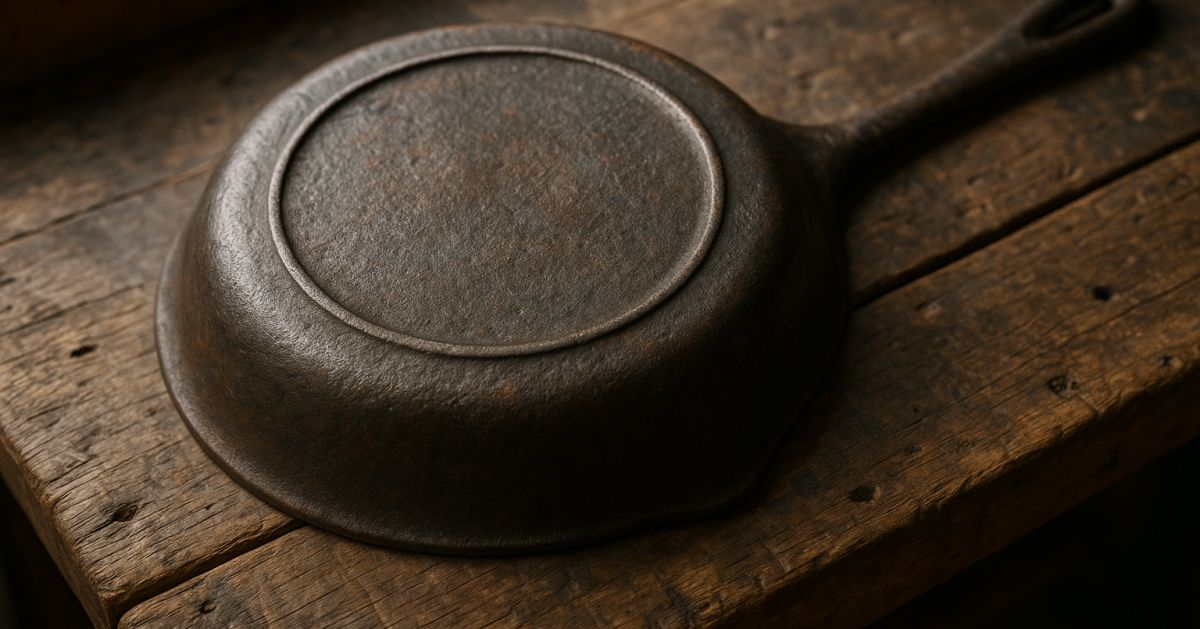
That raised ring on the bottom of an old skillet stops a lot of people cold the first time they notice it. Is it damage? A defect? Some kind of maker's mark? It is none of those things. It is called a heat ring, and once you understand why it exists, you will read the bottom of a pan with much more confidence.
What a heat ring actually is
A heat ring is a raised concentric ridge cast directly into the bottom of a skillet, running around the outer edge of the flat cooking surface. It sits proud of the surrounding iron by a few millimeters, forming a low circular wall. On some pans it is barely perceptible. On others, especially older examples, it is quite pronounced and you can feel it clearly when you run your thumb across the base.
The ring is not decorative and it is not accidental. It is a functional feature, and the function it was designed to serve tells you a great deal about the cooking technology that was common when those pans were made.
Why foundries put heat rings on pans in the first place
Through much of the 19th century and into the early 20th century, the dominant home cooking appliance in the United States was the wood-burning or coal-burning range. These stoves had flat cast iron cooking surfaces with removable circular lids, called stove eyes or stove lids, that could be lifted out one at a time. The heat ring on a skillet was sized to drop down snugly into one of those stove-eye openings.
This mattered for two reasons. First, it kept the pan from sliding around on a slick, flat iron surface while the cook was stirring or flipping. Second, and more importantly, it positioned the pan directly over the firebox opening so that heat could rise up and make direct contact with the flat bottom of the cooking surface. On a wood stove, this arrangement could make a real difference in how evenly and quickly the pan heated.
When gas ranges became common in American kitchens, beginning roughly in the early decades of the 20th century and spreading widely through the 1920s and 1930s, the stove-eye design became irrelevant. Gas burners heat from below with an open flame, and a flat-bottomed pan sits on a grate perfectly well. The heat ring served no purpose on a gas stove and, in fact, created a slight disadvantage: it rocked a little if the grate was not perfectly level, and it made the pan harder to clean around. Foundries gradually dropped the feature as their customer base shifted to gas cooking.
This general timeline is well documented in the historical record of American foundry production and in period Sears and Montgomery Ward catalogs that show the transition in cookware design.
So does a heat ring tell you the skillet is old?
Yes and no, and this is where people go wrong.
A heat ring is a strong suggestion that the pan was made before gas cooking became dominant in American homes. If you are holding a pan with a pronounced heat ring, there is a reasonable chance it was cast somewhere in the late 1800s or the first two or three decades of the 1900s. That is genuinely useful information.
But a heat ring alone is not proof of age, and it is not a reliable date stamp. Here is why:
- Foundries did not switch overnight. The move from wood stoves to gas ranges happened gradually across different regions of the country. Rural areas, including parts of Vermont like Grafton, Halifax, and the hill towns around Newfane and Brookline, held onto wood-burning ranges well into the mid-20th century. A foundry serving those markets had good reason to keep making heat-ring pans longer than a foundry serving urban buyers.
- Reproductions and later reissues exist. Some 20th-century foundries reintroduced heat rings for reasons that had more to do with aesthetics or a perceived vintage appeal than any functional cooking need. A heat ring does not automatically mean the pan predates 1920.
- The absence of a heat ring does not mean a pan is modern. Plenty of excellent early pans were made without them, particularly skillets intended from the start for gas or electric stoves.
- Heat rings vary in size and profile. Collectors and researchers have noted that different foundries used slightly different ring diameters and heights, because they were matching different stove manufacturers' eye sizes. This variation can help narrow down a foundry's intended market, but it is a nuanced reading that requires familiarity with specific foundry production records.
The heat ring is one data point. Good cast iron identification uses several at once: the gate mark or absence of one, the style and placement of any text, the size markings, the surface finish, the handle style and hang hole, and the overall weight and wall thickness. If you want to go deeper on what those features collectively mean, our post on how to tell whether an old cast iron skillet is worth anything walks through the full checklist in plain terms.
How heat rings affect cooking today
If you live in Brattleboro, Bellows Falls, Putney, or anywhere else in the region and you are using an old heat-ring skillet on a modern stove, here is what you need to know practically.
On a gas stove, a heat ring pan will work fine. The ring sits up on the grate, the burner heats the bottom, and you may not notice any difference at all compared to a flat-bottomed pan.
On a smooth-top electric or induction cooktop, a heat ring can be a genuine problem. The ring raises the center of the pan's bottom away from the glass surface, reducing the contact area and creating uneven heating. On an induction cooktop, reduced contact can mean reduced power transfer. This is not a safety hazard, but it can frustrate you if you are trying to use high heat or need an even sear. Some cooks work around this by using a cast iron griddle as an intermediary surface, though that adds complexity. If induction cooking is important to you, a flat-bottomed pan is a better everyday choice.
On a wood or pellet stove or a vintage wood-burning range, a heat ring skillet is exactly what it was designed for. If you have a stove with removable eyes, you might even find that the ring drops satisfyingly into place, just as it would have in a farmhouse kitchen in Wilmington or Dover a hundred years ago.
Common misreadings worth clearing up
A question that comes up regularly in online cast iron forums is whether a deep or wide heat ring indicates an older pan than a shallow or narrow one. The honest answer is: not reliably. Ring geometry varied by foundry design and by the stove-eye standards a given foundry was targeting, not simply by date. A very early pan might have a modest ring; a pan from two decades later might have a pronounced one if the foundry was chasing a particular market.
Another persistent misconception is that the heat ring is the same thing as a gate mark. It is not. A gate mark is a raised line or scar running across the bottom of the pan, left where molten iron entered the mold during casting. Gate marks on the bottom of a pan (as opposed to a heat ring) are a genuine age indicator because that casting method was phased out as foundry technology improved. You can read more about how individual foundries approached these details in our piece on Griswold, Wagner and Erie: what the foundry differences really mean.
A third mix-up involves the "spider" skillet, which has three or four small feet instead of a heat ring, and was designed for open-hearth cooking over coals rather than stove-top use. Feet and heat rings served different eras and different fire technologies. If your pan has legs, it is a different animal entirely and likely quite old.
What condition the heat ring can reveal
The heat ring's contact with a stove surface over many years sometimes tells its own story. A heat ring that is worn flat on one side, or that shows heavy scaling on the underside, can indicate a pan that saw decades of hard use. Conversely, a heat ring that is perfectly sharp and crisp with no wear at all on its contact face raises reasonable questions about whether the pan was heavily used or whether it is a later casting.
None of this is definitive. But when you are trying to assess a pan at an estate sale in Athens or a flea market in Dummerston, running your finger around the heat ring is a fast and useful step in the overall picture you are building.
When to bring in a restoration perspective
If you have acquired a pan with a heat ring and you are not sure what you have, the best approach is to look at it as a whole. Check the text style, the size numbering, the gate mark situation, the handle, and the surface condition together. A pan that has been sitting in a barn in Guilford for fifty years will tell a different story than one that has been displayed on a kitchen wall.
If the pan is in rough shape, whether it is rusted, pitted, or carrying decades of polymerized grease buildup, professional restoration can bring it back to cooking condition regardless of its exact age. Our cast iron restoration services cover the full process from stripping to re-seasoning, and if you have questions about a specific pan, the FAQ page covers the questions we hear regularly. You are also always welcome to get in touch directly if you want a straightforward opinion on whether a pan is a good candidate for restoration.
The heat ring is a small detail, but it opens up a whole chapter of American domestic history. A pan that dropped into a wood stove eye in a Newfane farmhouse kitchen more than a century ago traveled a long road to end up in your hands. Understanding what that ring was built to do is a good first step toward deciding what you want to do with it.
For more background on how we think about old cast iron and what makes certain pieces worth the effort of restoring, visit our blog index where we cover everything from stripping methods to foundry history in the same plain-spoken way.
Start a restoration
Tell us what you have
Send a couple of photos and the markings you can read on the bottom. We will tell you what the piece is, what it needs, and what it costs before anything ships. Identification and assessment are free, and stay free if you decide to do nothing.
Would rather just talk it through? (802) 348-1550