How to identify a spider skillet
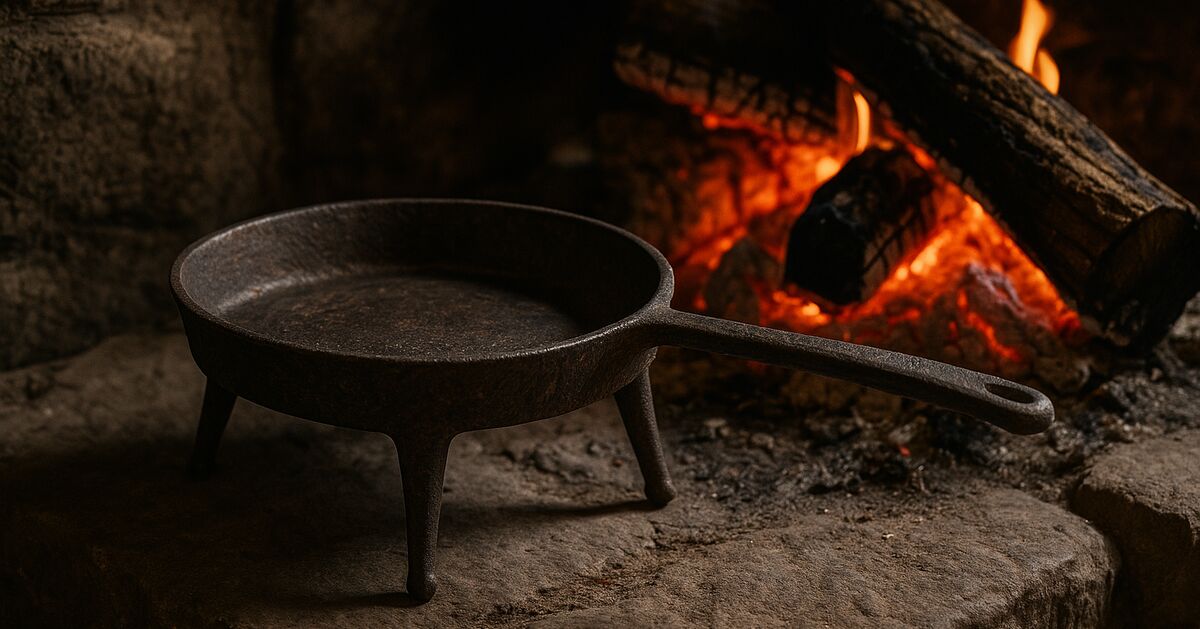
Three short legs and a long handle tell you something important the moment you pull a piece out of an old barn or estate sale box: you are holding a spider skillet, one of the oldest forms of cast iron cookware made in America. Before wood stoves became common in the mid-1800s, the spider was the everyday pan of the open hearth. Its legs lifted the pan above the coals, its long handle kept the cook's hand away from the fire, and its heavy walls distributed heat in a way that thinner wrought-iron pans simply could not. Finding one in a pile of rusty scrap is genuinely exciting. Deciding what to do with it requires a careful look at several things: the casting marks, the leg geometry, the condition of the iron, and the specific damage pattern that years of open-fire use can leave behind.
What makes a skillet a "spider skillet"
The word "spider" comes from the look of the piece when you set it down: three splayed legs radiating from the pan bottom, with a long handle extending outward, gives the whole thing an unmistakable arachnid silhouette. The legs are functional, not decorative. They allowed the pan to stand steadily on uneven hearthstones or directly in a bed of coals, with air circulating beneath the pan floor to moderate the heat.
True spider skillets typically have three legs rather than four. Three points define a plane, so the pan sits without rocking on irregular surfaces. Four-legged pieces exist but are far rarer and tend to be later reproductions or specialized roasters. If the piece in your hands has four legs, look more carefully: it may be a camp Dutch oven (which uses legs on the lid rather than the pot) or a waffle iron base rather than a true spider skillet.
The handle on a genuine antique spider is typically cast as one piece with the pan, long and slightly upswept, sometimes with a hanging hole or loop at the tip. Handles that are bolted, riveted, or obviously welded on after the fact are a red flag that someone has repaired or heavily modified the piece.
Dating a spider skillet by its physical features
Because spiders predate the large commercial foundries by decades, you will rarely find a foundry logo or a model number on one. That puts dating squarely in the territory of physical clues.
Gate marks. A raised seam running across the bottom of the pan is a gate mark, the scar left where molten iron was poured into a two-part sand mold. Our post on how to read a gate mark to date a cast iron skillet covers this in depth. On a spider, expect to find a gate mark if the piece was made before roughly 1890. Gate marks on spiders run straight across the pan floor in most cases, though early pieces sometimes show an arc mark near the center. A spider with no gate mark and no casting number is either very early (pre-mold-number era) or a later reproduction: you need to weigh all the other clues together.
Wall and floor thickness. Older, small-foundry iron tends to be thicker and heavier relative to pan diameter than the later Griswold or Wagner machine-age pieces. If a nine-inch spider feels surprisingly heavy, that weight is consistent with pre-Civil War production. Lighter pieces in the same diameter more often date to the later 1800s or are twentieth-century reproductions made for the camping market.
Leg shape and taper. On early pieces, the legs taper gracefully from a wide base at the pan floor to a narrower foot. The foot itself is often slightly splayed outward, adding stability. Legs that are uniform in diameter all the way down, or that look machined rather than sand-cast, suggest a later or reproduction piece. Run your fingers along the legs: you should feel a gentle texture from the sand mold, not a smooth, uniform surface.
Heat ring presence or absence. A heat ring is a raised ring on the bottom of the pan that concentrates heat on a wood-stove lid ring. Spiders that were made purely for hearth use will not have a heat ring, because the legs do the work of positioning the pan over the fire. If you find a spider with both legs and a heat ring, it likely dates from the transition period when open-hearth cooking was giving way to wood stoves, or it is a reproduction made to look older than it is. You can read more about what a heat ring is and what it tells you in our dedicated post.
Casting numbers and maker's marks. A small number pressed into the sand mold and cast into the pan, usually on the handle or gate, can sometimes be traced to a specific foundry. Spider skillets made by Pennsylvania Dutch foundries in the 1700s and early 1800s occasionally carry simple numerical stamps. If you find text, look carefully: letters that look hand-stamped rather than cast-in are almost certainly a later addition and should be treated skeptically.
Open-fire damage: what it looks like and why it matters
Campfire and hearth use leaves a specific signature on cast iron that is different from what you see on a pan that spent its life on a kitchen stove. Understanding these damage patterns is the most important step in deciding whether your spider is a restoration candidate or something closer to a display piece.
Carbon buildup. Years of cooking over wood fires coats a pan with thick, uneven carbon deposits that are harder and more chemically complex than ordinary cooking residue. This carbon often appears as a matte, grayish-black crust on the exterior and a lumpy, pitted layer on the cooking surface. It is not rust; it feels hard and dry. The good news is that heavy carbon responds well to the stripping methods covered in our post on lye, electrolysis, and the self-cleaning oven. The question is always what the iron looks like underneath.
Thermal cycling cracks. Open fire produces rapid, extreme, and very uneven temperature swings. A cold pan placed directly on a hot wood fire, or a hot pan dunked in a stream to cool it quickly (a habit frontier cooks sometimes practiced), creates thermal shock. Cast iron is brittle; it does not flex. Repeated thermal shock causes hairline cracks, usually radiating outward from the pan floor near the center, or running along the inside base of a leg where stress concentrates. These cracks start small and are easy to miss under a layer of carbon. Always strip a spider before you make a final judgment on structural integrity.
Warping. Sustained high heat from an open fire, especially uneven heat from flames concentrated on one side, can warp the pan floor over many decades of use. Set the stripped pan on a flat surface and check whether it rocks. A slight rock is sometimes acceptable for a decorative piece. A pan that rocks significantly will never cook evenly and is difficult to restore to functional use.
Leg damage. The legs on a spider take physical abuse: they sit in coals, they crack if the pan falls, and they can be worn down by decades of scraping on stone hearths. Examine each leg carefully. A leg that is cracked at the joint with the pan floor is a serious structural problem. A leg tip that is worn smooth or slightly shortened is purely cosmetic. A missing leg is a hard problem: welding or brazing cast iron is possible but specialist work, and the repair will always be visible.
Pitting from acidic foods. Early American cooks made a lot of bean dishes, stews with tomatoes or vinegar-based sauces, and fruit preserves. Prolonged contact with acidic foods eats into the iron surface over years, leaving a pitted texture that no amount of seasoning will fully hide. Light pitting is normal and does not affect function. Deep pitting, where the bottom of the pan looks like the surface of the moon, will cause food to stick in the valleys and is very difficult to remedy without machining.
How to decide: restoration candidate or loss?
Bring the piece to a good light source, clean off loose debris with a stiff brush, and work through this checklist.
- No cracks visible before stripping: proceed with hope but verify after stripping.
- Cracks at leg joints: consult a professional before investing in a full restoration.
- Missing one leg: display only, or weigh the cost of a specialist repair.
- Pan floor warped and rocking: functional restoration is unlikely; decorative restoration is fine.
- Heavy carbon, no visible cracks, flat floor: strong restoration candidate.
- Deep pitting across the cooking surface: honest assessment needed. Light pitting? Cook on. Severe pitting? Display piece.
Our services page explains in detail what a professional restoration involves for pieces like this. If you are unsure where your spider falls, bringing it in for an assessment is always worth the trip. We see pieces from across Windham County and Cheshire County regularly, including from estate sales in Newfane, Grafton, and Guilford, where old farmsteads turn up hearth pieces that have not seen a kitchen in a hundred years. Folks in Putney, Dummerston, and Athens bring in spiders found in woodsheds and barn lofts, and the condition varies enormously even among pieces from the same decade.
What restoration can and cannot do for a spider skillet
A professional restoration will strip the carbon and rust, reveal the true condition of the iron, address surface pitting to the extent the iron allows, and apply a proper seasoning. What it cannot do is fill structural cracks, straighten a badly warped floor, or replace missing metal. Those limitations are important to understand before you commit to the process.
If your spider is sound, the result of a good restoration is a piece you can actually cook with over a campfire or in a hearth, exactly as it was intended. The legs make it stable on grill grates and fire rings too, which is one reason spider skillets have developed a following among serious outdoor cooks in Vermont and beyond.
If your spider has issues that rule out functional use, restoration for display purposes is still worth considering. A clean, properly oiled spider skillet hung above a fireplace in a Dover or Wilmington farmhouse is a genuine piece of American material history. It deserves better than a coat of spray paint and a nail.
Where spiders show up in southern Vermont and southwestern New Hampshire
Estate sales in older agricultural communities are the first place to look. Farming families in this region likely cooked over open hearths well into the 1850s in some households, and their tools may have ended up in attics and outbuildings rather than the dump. Antique dealers in the region sometimes identify spiders correctly; sometimes they are labeled simply as "old cast iron skillets" without recognizing the legs or their significance.
Auction houses running farm and estate liquidations in Newfane and Grafton turn up hearth pieces a few times a year. If you attend these sales, bring a small flashlight and run it across the pan floor at a low angle: this raking light reveals cracks, warping, and casting marks that are invisible in flat overhead lighting.
Flea markets along Route 30 and Route 9 are another source, though prices vary wildly depending on whether the seller knows what they have.
Bringing your spider in for a look
If you have found a spider and want an expert opinion before deciding what to do, we are happy to take a look. Our contact page has everything you need to reach us. We cover all the towns in our service area, from Wilmington up through Putney and across to Brattleboro, so getting your piece to us is usually straightforward.
The frequently asked questions page covers what to expect from the assessment process, what information to bring with you, and how we think about pieces that are on the fence between restoration and display.
Spider skillets are among the oldest domestic artifacts you are likely to find in ordinary circulation in this part of New England. They deserve a careful look, an honest assessment, and, when the iron is sound, a return to actual use.
Sources & further reading
- Hearth, Patio & Barbecue Association: open-fire cooking history (Hearth, Patio & Barbecue Association)
- USDA Forest Service: open fire safety and thermal hazards (U.S. Forest Service)
- Vermont Division for Historic Preservation: agricultural heritage resources (Vermont Agency of Commerce and Community Development)
Revision history (1)
- Sep 18, 2026 - Pre-publish editorial QA: 1 flagged, 1 softened; claim audit: 6 claims, 1 rewritten
Claim-by-claim audit (6 checked)
- “Before wood stoves became common in the mid-1800s, the spider was the everyday pan of the open hearth.” (reasoning shown in the article)
- “Farming families in this region likely cooked over open hearths well into the 1850s in some households, and their tools may have ended up in attics and outbuildings rather than the…” (rewritten to what the article can stand behind)
- “Cast iron is brittle; it does not flex.” (reasoning shown in the article)
- “Repeated thermal shock causes hairline cracks, usually radiating outward from the pan floor near the center, or running along the inside base of a leg where stress concentrates.” (reasoning shown in the article)
- “Prolonged contact with acidic foods eats into the iron surface over years, leaving a pitted texture that no amount of seasoning will fully hide.” (reasoning shown in the article)
- “A missing leg is a hard problem: welding or brazing cast iron is possible but specialist work, and the repair will always be visible.” (reasoning shown in the article)
Start a restoration
Tell us what you have
Send a couple of photos and the markings you can read on the bottom. We will tell you what the piece is, what it needs, and what it costs before anything ships. Identification and assessment are free, and stay free if you decide to do nothing.
Would rather just talk it through? (802) 348-1550