How to read a gate mark to date a cast iron skillet
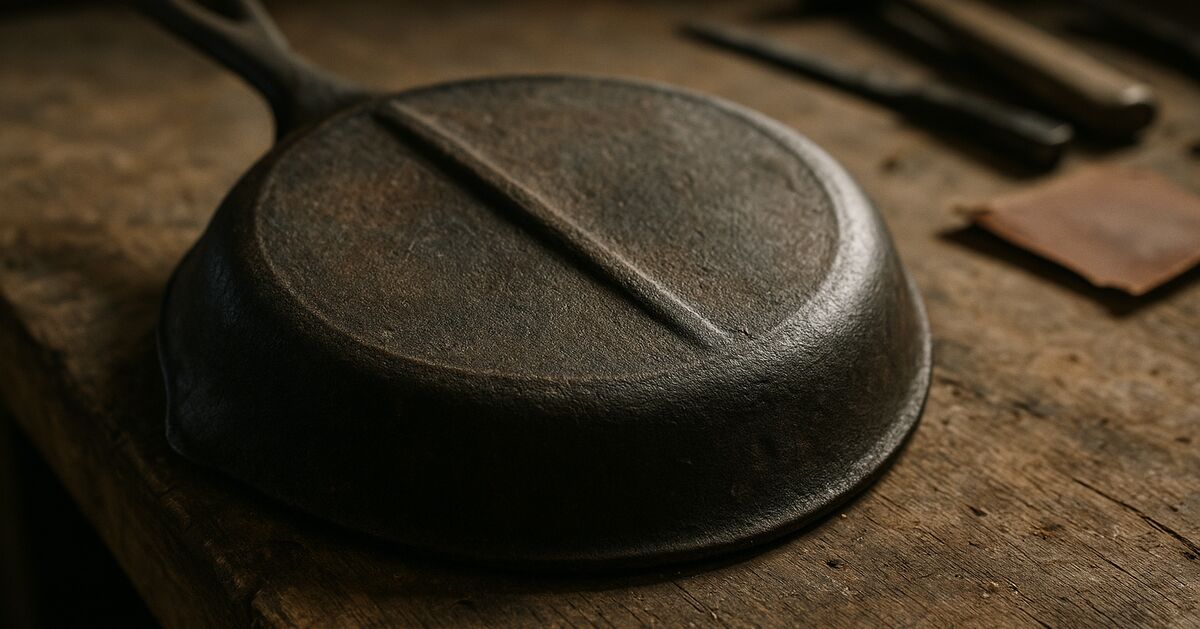
A raised ridge cuts straight across the bottom of the skillet you just pulled from the barn sale box, and you have no idea what it means. That line is a gate mark, and it is one of the most reliable clues you can find when trying to date a piece of vintage cast iron.
Understanding what you are looking at requires knowing a little about how iron was poured in the nineteenth century. Once you grasp the process, the mark makes immediate sense, and you can place your pan in a rough time window with real confidence.
What a gate mark actually is
When molten iron is poured into a sand mold, it has to enter the mold cavity through a channel called a gate. In early foundry practice, that gate was cut directly into the bottom of the mold, which meant the iron flowed in from below or from the side of the base rather than from a sprue positioned off to the side or at the top of the mold stack.
When the casting cooled and the mold was broken away, the iron that had hardened inside that gate channel stayed attached to the pan. Foundry workers would knock or grind most of it away, but a low ridge always remained. That ridge is the gate mark.
The gate-in-the-base approach is generally understood to have been the common method used by American foundries roughly before 1890 to 1900. After that period, foundries seem to have adopted improved molding technology that moved the gate to a less obtrusive location, typically the handle or a side runner, which could be cut away without leaving a mark on the cooking surface. So a gate mark on the bottom of a skillet is a strong indicator that the piece was made sometime in the nineteenth century, and very likely before about 1890.
The shape and position of the mark matters
Not all gate marks look identical, and paying attention to the details can narrow your date window further.
Straight, centered ridges running from one side of the base to the other, roughly through the middle, are the form you will see on the oldest examples. Some run the full diameter of the bottom flat; others stop a little short of each edge. The foundry worker's grinding technique and the mold design both influenced the final appearance.
Off-center or slightly arced marks can appear on pans from foundries that were already experimenting with modified gating in the 1870s and 1880s. If you see a mark that sits to one side or curves slightly, the pan is likely transitional, made in that late-nineteenth-century window when methods were changing.
Thickness of the ridge is worth examining too. A pronounced, sharp ridge that rises several millimeters from the base suggests minimal finishing work, which was common in the earliest pieces. A flatter, smoother remnant that you can feel more than see suggests the foundry was putting more effort into grinding, or that the mark has been worn down by generations of use and scrubbing.
What a gate mark does not tell you
A gate mark confirms approximate era, but it does not tell you the foundry. That part of the identification puzzle comes from the pan's overall design, any raised or incised text or numbers on the surface, the shape of the heat ring (if present), the style of the handle, and the weight and finish of the iron itself. Our post on what a heat ring is, and what it tells you about a skillet's age walks through that separate marker in detail, and reading both posts together will give you a much richer picture.
A gate mark also does not guarantee quality in either direction. Some of the finest-cooking pans ever made carry gate marks; so do some rough, utilitarian pieces that were never meant to be prized. Condition, iron composition, wall thickness, and surface smoothness are what determine how a pan performs, not the presence or absence of a foundry artifact on its base.
Common mistakes in reading gate marks
A mistake that comes up again and again in owner forums is confusing a gate mark with a crack. A gate mark is a raised ridge. A crack is a depression or a gap, and it typically runs irregularly, following a stress line rather than crossing the base in a deliberate straight path. If you run your fingernail across the mark and feel material rising above the surface, you have a gate mark. If your nail drops into a groove or catches on a jagged edge, look more carefully because a crack in cast iron is serious and makes the pan unsafe to use over heat.
A second common confusion involves grinding marks. Some pans were machine-ground on the base after casting to improve flatness for use on early cookstoves, and those grinding arcs can superficially resemble a gate mark. The difference is that grinding marks are typically shallow parallel arcs or concentric circles, while a gate mark is a single linear ridge with a more abrupt profile.
A third point worth making carefully: not every old pan has a gate mark. Foundries in different regions adopted new gating methods at different rates. A pan made in 1885 at a progressive foundry may show no gate mark, while a pan cast in 1895 at a smaller or more conservative operation might still carry one. The presence of a gate mark is strong evidence of pre-1900 origin; the absence of one does not rule out an old pan.
How this fits into a broader identification process
Dating a cast iron skillet well means reading several markers at once rather than relying on any single feature. The gate mark gives you a floor on the date. The foundry markings, if present, can name the maker. The design of the rim, the handle hang, the depth of the sidewalls, and the machining or lack of it on the cooking surface all speak to the specific era and factory. Our broader look at foundry differences between Griswold, Wagner, and Erie explains how those makers evolved their designs over time, and cross-referencing that with a gate mark can sometimes get you within a decade.
If the pan came from an estate in Bellows Falls or Newfane or one of the older farmhouses around Grafton or Guilford, there is a reasonable chance it has been sitting unused for generations, which actually works in your favor for dating. Heavy use and repeated scrubbing erodes the gate mark ridge over time, so a sharp, clear mark on a pan in otherwise rough condition suggests long storage rather than heavy cooking history.
Does having a gate mark affect restoration?
Practically speaking, a gate mark does not change the restoration process much, but there are a couple of things to keep in mind.
First, the gate mark area is slightly raised, which means it can be a spot where seasoning builds up unevenly if the pan is stored sitting flat on its base. This is rarely a functional problem, but it is worth knowing if you notice any unevenness in the seasoning on the base exterior.
Second, if you are having a pan stripped as part of a professional restoration, make sure whoever is doing the work knows the pan is pre-1900 before they begin. Very old iron can have different metallurgical characteristics from twentieth-century castings, and the stripping method chosen matters. Our in-depth post on what lye, electrolysis, and the self-cleaning oven each do to a pan covers those trade-offs in plain language. An experienced restorer will read the gate mark as useful context, not just a curiosity.
What to do with this information
If you have a gate-marked pan sitting in your collection, take a few minutes to photograph the mark clearly, preferably under raking light from one side so the ridge shows up well. Note the position, the length relative to the base diameter, and the height of the ridge. Then look at the rest of the pan: any raised numbers, letters, a size numeral on the top of the handle, the profile of the rim, whether the heat ring is present, and the overall weight versus size.
Owners in Brattleboro, Putney, Athens, and the surrounding towns often bring pans to us that have been in families for four or five generations, with no records of where they were purchased. The gate mark is frequently the first firm anchor point we can offer them: this pan was almost certainly made before 1900, which already places it in a meaningful category.
From there, the full identification and restoration services we offer can take the process further, cleaning the pan down to bare iron so that maker's marks hidden under decades of carbonized grease can be read clearly. A mark that looked like a smudge under old seasoning sometimes turns out to be a clear size numeral or a partial foundry name once the surface is properly revealed.
If you are in the Dover, Wilmington, Dummerston, Halifax, or Brookline area and have a pan you are trying to place, our locations page has the details on how to reach us. And if you have questions before committing to anything, the FAQ covers what the process looks like from drop-off to pick-up.
The gate mark in context
The gate mark is a small physical record of how American manufacturing worked in the decades before industrialized molding changed the foundry floor. Every pan that carries one passed through a process where a worker knocked away the sprue, ground down the ridge as smoothly as the job called for, and sent the skillet out to a hardware store or general goods supplier to be cooked in for the next century.
Reading the mark correctly will not make the pan cook better, but it does change how you relate to the object. A gate-marked skillet in good condition, still flat and smooth on the cooking surface, is a working piece of nineteenth-century craft. Knowing what the mark means is the first step toward deciding whether it deserves to keep cooking, and what it needs to get there.
Browse the blog for more on reading specific features of vintage cast iron, from Dutch oven identification to the details that separate a restoration-worthy pan from one that has crossed a point of no return.
Sources & further reading
- Cast Iron Founding and Molding Processes (American Foundry Society)
- History of American Foundry Technology and Sand Casting (American Foundry Society)
- Metallurgy of Cast Iron: Properties and Historical Development (National Institute of Standards and Technology (NIST))
- Sand Casting Process Overview (U.S. Department of Commerce, Manufacturing.gov)
Revision history (1)
- Sep 16, 2026 - Pre-publish editorial QA: 1 flagged, 1 softened; claim audit: 3 claims, 2 rewritten
Claim-by-claim audit (3 checked)
- “The gate-in-the-base approach is generally understood to have been the common method used by American foundries roughly before 1890 to 1900.” (rewritten to what the article can stand behind)
- “After that period, foundries seem to have adopted improved molding technology that moved the gate to a less obtrusive location, typically the handle or a side runner, which could b…” (rewritten to what the article can stand behind)
- “If your nail drops into a groove or catches on a jagged edge, look more carefully because a crack in cast iron is serious and makes the pan unsafe to use over heat.” (reasoning shown in the article)
Start a restoration
Tell us what you have
Send a couple of photos and the markings you can read on the bottom. We will tell you what the piece is, what it needs, and what it costs before anything ships. Identification and assessment are free, and stay free if you decide to do nothing.
Would rather just talk it through? (802) 348-1550