Identifying a cast iron Dutch oven with a mismatched lid
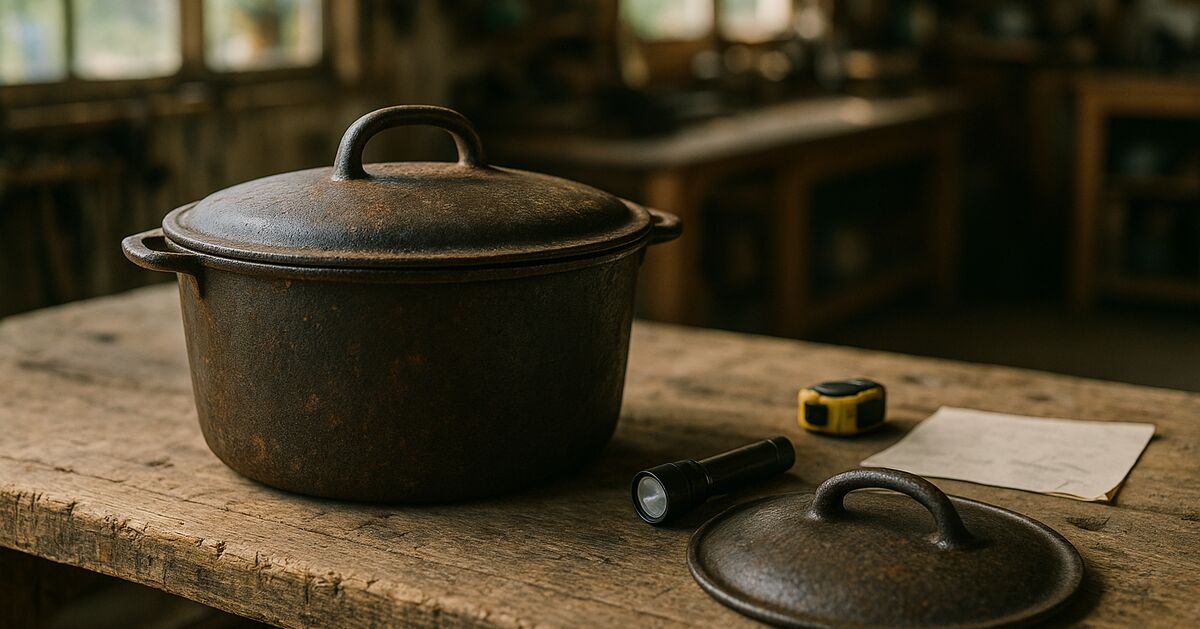
A vintage Dutch oven with a mismatched lid sitting on the shelf at an antique shop in Brattleboro or Newfane is easy to overlook. The two pieces look close enough - similar color, similar heft, similar diameter. But pick them up, flip them over, and the markings tell completely different stories. Knowing how to read those stories is the difference between a confident restoration project and a frustrating guessing game.
This post walks through exactly how to identify the manufacturer of each piece independently, what physical clues to look for when the stampings are worn or absent, and what a mismatch actually means for the pan's value and its path through restoration.
Why Dutch oven lids and pots get separated in the first place
Cast iron Dutch ovens were workhorses. In farm kitchens across southern Vermont, from Guilford up through Grafton and across to Dover, these pots moved from woodstove to oven to root cellar and back again for decades. Lids cracked. Pots cracked. Pieces were handed down through families, sold at estate sales, or donated to rummage sales where someone grabbed whichever lid fit well enough and called it a set.
Foundries also sold replacement lids. Griswold, Wagner, and several smaller operations actively marketed interchangeable parts, so a "matched" set sitting in a barn in Halifax or Dummerston might have been mismatched since the 1940s and nobody ever noticed. On top of that, many Dutch ovens share a nominal size designation (No. 8, No. 9, No. 10) across brands, and the dimensional differences between foundries are small enough that a lid from one maker will sit on a pot from another - not perfectly, but close enough that it stayed in service.
The result is that mismatched pairs are genuinely common on the antique and estate-sale circuit. Understanding that is the first step. The second step is figuring out exactly what you have.
Start with the markings: where to look on the pot
Turn the Dutch oven upside down and look at the bottom. On a well-preserved piece you will find some combination of the following:
- Foundry name or logo. Griswold used the familiar cross logo with "GRISWOLD" arched above and "ERIE, PA." below. Wagner used a slanted script "Wagner Ware" or, on earlier pieces, simply "WAGNER" in block letters. Sidney Hollowware, Martin Stove and Range, Wapak Hollow Ware, and Lodge all used distinct text layouts.
- Size number. This is cast into the iron, not stamped after the fact. A raised "8" or "9" near the center or edge tells you the foundry's own size designation, which does not always correspond to the same measurement across brands.
- Pattern number. Many foundries included a secondary number that refers to the specific casting pattern. On Griswold pieces, this appears alongside the size number and can help date the piece to a specific production era.
- Gate scar location and shape. The gate scar is where molten iron entered the mold. Griswold typically placed a small, clean scar near the outer edge of the bottom. Wagner pieces often show a rougher, slightly larger scar in a different position. If the casting name is completely worn away, the scar's character can still point you in a direction.
- Heat ring presence and style. A raised ring on the bottom was used to seat the pot on a woodstove's burner opening. What a heat ring is and what it tells you about a skillet's age applies equally to Dutch oven bottoms - and the ring's profile, height, and width varied by foundry and era.
When the bottom text is so worn or rusted that you cannot read it directly, try raking light across the surface. Hold a flashlight at a very low angle and move slowly. Letters that are invisible in overhead light will cast faint shadows under raking light. This technique works on pots that have been buried in rust and on pieces where a previous owner sanded the bottom flat.
Now look at the lid independently
The lid needs to be treated as a completely separate identification project. Flip it over so the inside faces up. Look for:
- Foundry markings on the underside. These are often smaller and shallower than the ones on the pot, because the underside of a lid is a harder area to cast with deep relief. They may also be more worn because the lid's underside contacts steam and acidic cooking vapors throughout its life.
- The lid's own size number. Compare it to the pot's size number. If they match numerically, that is a hopeful sign, but it does not confirm they came from the same foundry, because different foundries used the same numbers to mean slightly different things.
- The knob style. Early Griswold lids used a plain disc-style knob. Later Griswold lids used a more ornate raised-ring knob. Wagner knobs tend to have a slightly more tapered profile. Lodge knobs are generally blockier. If the knob style does not match what you see on lids known to belong with the pot's brand, that is a clue worth noting.
- The lid's rim profile. Look at the edge where the lid sits into the pot. A lid designed to fit one foundry's pot will have a specific drop depth and rim angle. A mismatched lid will often rock slightly or sit visibly high. Our earlier post on why your Dutch oven lid fits loosely after restoration covers the dimensional reasons for that movement in detail.
- Gate scar on the lid top. Many foundries placed the lid's gate scar on the top surface, near the outer edge, where it would be hidden once the knob was in place. The character of that scar can confirm or complicate what the underside markings suggest.
When one piece has no markings at all
Unmarked cast iron is genuinely frustrating, but it is not a dead end. A few approaches help:
Cross-reference dimensions carefully. Measure the pot's inner diameter at the rim, the depth of the pot, and the outer diameter of the base. Then measure the lid's outer diameter and the depth of its rim drop. Compare these to documented dimensions available through cast iron collector references and foundry catalogs that have been archived by collector communities. The numbers narrow the field quickly.
Look at the casting texture. Foundries had different finishing practices. Griswold pieces from the 1920s through the early 1950s are often described by collectors as having a notably smooth cooking surface. Wagner pieces from the same era are sometimes noted as having a somewhat coarser interior texture, though this can vary. Unmarked pieces with a glass-smooth interior are more likely to be Griswold than Wagner, though there were exceptions in every era.
Consider the weight. Weigh both pieces on a kitchen scale. Some collectors report that Griswold pots often feel lighter than comparable Lodge or Martin pieces, though this varies by piece and shouldn't be relied on alone. This is a soft clue only, but it is useful when combined with other evidence.
Consult collector resources. The FAQ page on this site covers some of the basics of identification, and collector communities have published detailed comparison charts that go brand by brand and decade by decade. These are worth spending time with before drawing a firm conclusion.
What a confirmed mismatch means for restoration value
Here is the honest answer: a mismatch reduces collector value, but it does not necessarily reduce cooking value, and the impact on restoration cost is minimal.
For a collector focused on original matched sets, a Griswold pot paired with a Wagner lid (or vice versa) is simply not a matched set. It will not command the price a verified original pair would. The gap varies depending on the specific pieces involved, but collectors who pay top dollar for marked pieces are paying in part for documented provenance, and a mismatch breaks that chain.
For someone who wants a Dutch oven to use, the calculation is completely different. A mismatched pair that is structurally sound, properly seasoned, and correctly sized to fit together is a perfectly functional cooking tool. The pot heats food. The lid holds in steam. Both do their jobs regardless of which foundry made each one.
For restoration purposes, the mismatch changes almost nothing about the process itself. Both pieces still need to be stripped to bare iron, inspected for cracks (a black light may help reveal hairline cracks that are hard to see under normal light, though this isn't foolproof), and reseasoned. Our cast iron restoration services treat lid and pot as individual pieces through the stripping and inspection phases anyway, because they need to be handled separately to ensure every surface is reached. Whether they are matched or mismatched, the workflow is the same.
Where a mismatch does affect restoration planning is in the decision about whether to invest in a professional restoration at all. If you found the pair at an estate sale in Putney or Bellows Falls and paid very little for it, a full restoration makes good sense even if the pieces are from different makers, because you are building a functional cooking tool at a reasonable total cost. If someone is considering paying a significant sum for a "matched" pair only to discover during restoration that the pieces are actually from different foundries, that changes the math. Identification before purchase is valuable.
How to document what you find
Once you have identified each piece as clearly as the markings allow, write it down. A simple note taped inside the lid (removed before any heat is applied) or a photograph of each marking with a ruler for scale is enough. This documentation matters for three reasons.
First, it protects you if you ever sell or pass down the pan. A future owner deserves to know what they have. Second, it helps a restoration professional understand the pieces without having to start from scratch on identification. When you bring a Dutch oven to us serving the communities of Athens, Wilmington, Brookline, and the surrounding area, that documentation saves time and helps us flag anything unusual. Third, it contributes to the broader body of knowledge about these foundries. Cast iron collector communities rely on documented examples to refine their catalogs.
If you want to understand more about how foundry differences actually show up in the iron itself, the post on Griswold, Wagner, and Erie foundry differences goes deeper into the manufacturing history that produced all these variations.
A practical identification checklist
Before you bring a Dutch oven in for assessment or decide whether to pursue restoration, work through these steps:
- Photograph every marking on both pieces, using raking light for worn areas
- Note the size number on each piece and whether they agree
- Measure inner diameter of the pot rim and the outer diameter of the lid, and check the fit
- Weigh each piece separately
- Note the gate scar position and character on each
- Note knob style and any foundry marks on the lid underside
- Check for any foundry-specific design details (heat ring style, handle shape, pour spout if present)
- Record your findings in writing or in a labeled photo set
This process takes about twenty minutes and gives you a solid foundation for every decision that follows, whether that is a restoration, a sale, or simply knowing what heirloom is sitting in your cabinet.
Getting help with a tricky identification
Some pieces genuinely resist identification. A pot that spent forty years outdoors in Grafton or Newfane may have a bottom that is more rust than iron at first glance. A lid that was sanded by a well-meaning previous owner may have lost its markings entirely. In those cases, a trained eye that has handled hundreds of pieces is worth more than any reference chart.
We are happy to look at pieces that are proving difficult to identify. See the full list of communities we serve on the locations page, or reach out directly through the contact page to describe what you have. Sometimes a photograph and a few measurements are enough to get a confident answer without any travel at all.
Cast iron Dutch ovens, matched or not, are durable, repairable, and worth understanding. A mismatch is not a disqualifier. It is just a piece of the pan's history, and history is most of what makes these pieces worth caring for in the first place.
Revision history (1)
- Sep 14, 2026 - Pre-publish editorial QA: 1 flagged, 0 softened; claim audit: 4 claims, 4 rewritten
Start a restoration
Tell us what you have
Send a couple of photos and the markings you can read on the bottom. We will tell you what the piece is, what it needs, and what it costs before anything ships. Identification and assessment are free, and stay free if you decide to do nothing.
Would rather just talk it through? (802) 348-1550