Why your Dutch oven lid fits loosely after restoration
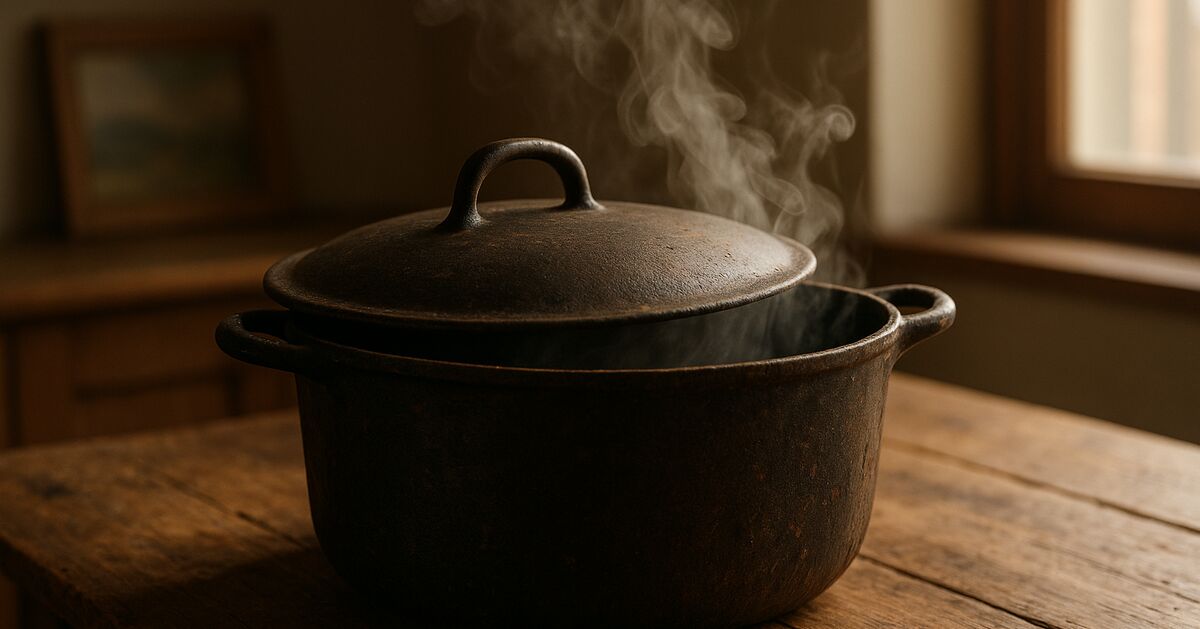
A Dutch oven lid that suddenly seems loose after restoration is one of those things that makes a careful cook stop and wonder whether the pan was ruined in the process. It wasn't. But the question is worth answering properly, because the answer touches on some real physics, some genuine cooking science, and a few things that do actually matter depending on how you use the pot.
What "loose" really means on a cast iron lid
First, a calibration check. Cast iron Dutch oven lids are not precision-machined to form an airtight seal. They never were, not even when they left the foundry in the nineteenth century. The rim of the pot and the underside of the lid are both cast surfaces, which means they have a slight texture and they were only ever intended to sit close, not to lock together like a rubber gasket.
A small amount of play, meaning you can rotate the lid a quarter turn and feel a slight wobble, is normal on many vintage pieces. If your lid fits that way, you likely had a normal lid before restoration too and simply didn't notice.
What people notice after restoration is almost always one of three things:
- The seasoning build-up is gone. Before stripping, many old pots had layers of carbonized grease that had essentially filled in micro-gaps between lid and pot rim. Once those layers are removed, the raw casting tolerances become visible again. The lid hasn't changed; the filler has been removed.
- A warp has been corrected, or revealed. Heat cycling over decades can warp both pot rims and lids very slightly. Sometimes an old warp on the lid happened to match an old warp on the pot, and the two fitted together by coincidence. Strip and re-season both separately and the original mismatch becomes apparent.
- The seasoning layers themselves add measurable thickness. Multiple coats of polymerized oil on the rim of a pot, applied over years, can add a small but real amount of thickness. New seasoning is much thinner, so the lid sits lower and feels less snug.
Understanding which of these three situations you're in tells you whether you need to do anything at all.
Does a loose lid actually hurt cooking performance?
For most things you cook in a Dutch oven, a small gap between lid and pot matters very little. Here's why.
Braising relies on steam. When liquid inside the pot heats up, steam rises and condenses on the inside of the lid, then drips back down onto the meat or vegetables. That cycle continues whether the lid is perfectly snug or has a small gap. A small gap does allow some steam to escape, but the volume of liquid in a typical braise is large enough that losing a modest amount of moisture over a two-hour cook makes almost no practical difference to the finished dish. Home cooks have been producing excellent braises in loosely-fitted pots for as long as cast iron has existed.
Slow braising over a wood stove, which is common in older Vermont farmhouses around Grafton, Newfane, and Putney, actually benefits from a lid that isn't perfectly sealed, because some evaporation helps concentrate the cooking liquid rather than diluting it.
The one situation where a genuinely loose lid can matter is campfire or hearth cooking where coals are placed on top of the lid. In that style of cooking, a tight-fitting lid with a flanged rim helps trap heat from above. If you're doing serious Dutch oven camp cooking and the lid has a pronounced wobble rather than a gentle looseness, that's worth addressing. But for stovetop and oven use, even a lid that rocks slightly performs fine.
Baking in a Dutch oven is another area where the lid question comes up. Many people bake sourdough bread by placing the loaf inside a preheated Dutch oven so that steam from the dough creates the crisp crust. A small lid gap is genuinely harmless here. The goal is simply to trap enough steam during the first fifteen to twenty minutes of baking that the crust can expand before it sets. A small leak doesn't defeat that purpose.
Why stripping methods can affect the fit differently
If you've read about lye, electrolysis, and the self-cleaning oven as stripping methods, you already know that each approach removes material differently. It's worth connecting that knowledge to the lid-fit question.
Lye and electrolysis both strip seasoning and rust without removing any iron. The bare metal dimensions of the casting are unchanged. If the lid feels looser after lye stripping, the explanation is purely the removal of built-up carbonized seasoning.
The self-cleaning oven reaches very high temperatures, and some people worry about stress in the iron at that heat, but the amount of material removed is effectively zero. Again, any perceived change in fit comes from the stripped surface, not from dimensional changes in the metal itself.
Aggressive mechanical methods are a different matter. Wire wheels, angle grinders, and especially sandblasting can remove measurable amounts of iron from raised surfaces like pot rims and lid flanges. If your piece was professionally sandblasted by someone who was heavy-handed, it is theoretically possible to open up the tolerance between lid and pot. This is uncommon with careful restoration work, but it's a real mechanism. Our cast iron restoration services rely on stripping methods that clean the iron without eating into it, which is one reason the question of lid fit rarely comes up after we've handled a piece.
How to tell whether your lid gap is normal or excessive
A reliable way to check: lay the lid on the pot and press one side of the rim down lightly with one finger. If the opposite side of the lid lifts noticeably (more than roughly a millimeter or two), you have a meaningful warp somewhere. If the lid just rotates and wobbles slightly but sits roughly level, you have normal cast iron tolerance.
You can also do a simple steam test. Put an inch of water in the pot, bring it to a simmer on the stovetop, put the lid on, and watch. If steam is escaping evenly around the entire circumference, you have a uniform small gap that is normal. If steam jets out from one specific point on one side while the opposite side is tight, that points to a warp in either the lid or the pot rim.
A warped lid or pot rim is often a pre-existing condition. Cast iron can warp from being dropped, from being heated dry over very high heat repeatedly, or from rapid thermal shock such as being plunged into cold water while hot. In practice, a warp that developed over decades of use is not something a restoration process is meant to correct. Restoration removes rust and old seasoning; it does not re-machine castings.
When does it actually make sense to address the fit?
There are a few situations where closing the gap is genuinely worth the effort.
Matched lids and pots: Many vintage pots, particularly older Griswold and Wagner pieces (if you want to understand the foundry differences, our post on Griswold, Wagner, and Erie is a good read), were made with lids that were individually fitted at the foundry. If the lid on your pot is not the original, you may have a mismatch that no amount of seasoning will fully fix. The solution is simply to find a correct matching lid, not to try to force-fit the wrong one.
Campfire cooking: If you cook outdoors with coals on top of the lid regularly, a snugger fit is genuinely useful. Some camp cooks wrap a thin strip of aluminum foil around the pot rim to take up the gap. It works, it's reversible, and it costs nothing.
Seasoning build-up over time: The simplest answer to a lid that feels slightly too loose is to cook with the pot. Each use adds a thin polymerized layer to all surfaces including the rim. Over months of regular cooking, the fit will naturally tighten to something close to what it was before stripping. This is not a workaround; it is exactly how the fit was established on old pots in the first place.
A note for collectors in our area
For people around Brattleboro, Athens, Dover, and Wilmington who are acquiring vintage cast iron at estate sales and auctions, it's common to find lids that were separated from their original pots at some point in their history. A lid that fits well enough for display or light cooking is probably fine. A lid that is badly mismatched or severely warped is worth noting when assessing a piece's value, particularly if you intend to actually cook with it. For a broader look at how to assess whether a vintage piece is worth investing in at all, the post on how to tell whether an old cast iron skillet is worth anything applies the same logic to pots.
If you're somewhere in our service area and you have a Dutch oven or any vintage piece you're unsure about, our frequently asked questions page covers a lot of the common concerns, or you can simply get in touch and describe what you're seeing. Sometimes a quick description is enough to tell us whether a loose lid is a non-issue or something worth looking at more closely.
The short version, without the shortcut phrase
A Dutch oven lid that feels looser after restoration is usually the result of stripped seasoning build-up, not damage to the iron. For everyday braising, stovetop cooking, and bread baking, a small gap has no meaningful effect on results. The rare situations where the fit genuinely matters (campfire cooking with top heat, or a badly warped piece) have straightforward solutions that don't require any re-machining or heat-treatment.
Cast iron is forgiving in ways that modern cookware isn't. A pot that wobbles its lid on the shelf will still turn out excellent pot roast, bean stew, or a loaf of sourdough, just as it did for whoever owned it before you. The gap between lid and pot is mostly a cosmetic concern, and one that often resolves on its own as you keep cooking.
If you want to learn more about the work we do across Windham County and the surrounding towns, the full list of locations we serve is a good starting point, or visit the home page to see what restoration actually looks like from start to finish.
Sources & further reading
- Thermal Properties of Cast Iron and Heat Transfer in Cookware (National Institute of Standards and Technology (NIST))
- Home Food Preservation and Cookware Safety Guidance (National Center for Home Food Preservation, University of Georgia)
- Metals and Alloys: Thermal Expansion and Stress (ASM International)
Revision history (1)
- Sep 4, 2026 - Pre-publish editorial QA: 3 flagged, 3 softened; claim audit: 3 claims, 3 rewritten
Claim-by-claim audit (3 checked)
- “The self-cleaning oven reaches very high temperatures, and some people worry about stress in the iron at that heat, but the amount of material removed is effectively zero.” (rewritten to what the article can stand behind)
- “Multiple coats of polymerized oil on the rim of a pot, applied over years, can add a small but real amount of thickness.” (rewritten to what the article can stand behind)
- “In practice, a warp that developed over decades of use is not something a restoration process is meant to correct.” (rewritten to what the article can stand behind)
Start a restoration
Tell us what you have
Send a couple of photos and the markings you can read on the bottom. We will tell you what the piece is, what it needs, and what it costs before anything ships. Identification and assessment are free, and stay free if you decide to do nothing.
Would rather just talk it through? (802) 348-1550