Gem and muffin pans
Gem pans and muffin pans are cast iron baking pans with multiple individual cups molded into a single frame. Made from roughly the 1880s through the 1950s, they come in a bewildering range of cup shapes, sizes, and configurations. Collectors care about them because some configurations are genuinely hard to find, because the variety is enormous, and because they remain practical baking tools when the casting is sound.
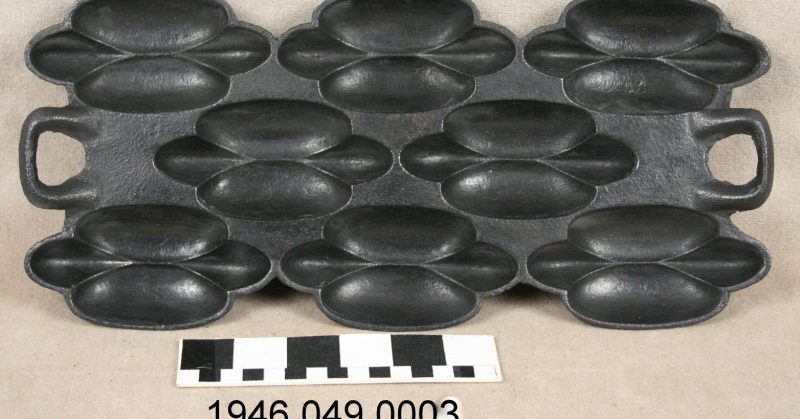
What to check, and what it tells you
| Where to look | What you see | What it means |
|---|---|---|
| The top frame surface | Gate marks, casting seams, or rough texture between cups | Normal on earlier examples. Heavy, unground gates that stand proud of the frame can indicate a lower-quality casting or a piece that was never finished to a cooking standard. |
| The underside of the frame | Raised foundry name, size number, or pattern number | The most useful identifier. Record the full text and compare against maker references. Many pans carry only a pattern number, which may or may not be traceable to a specific foundry. |
| Inside each cup | Pitting, cratering, or deep rust channels following the contour of the cup wall | Cup interiors are harder to restore than flat surfaces. Surface rust is manageable; deep pitting in the cup bowl affects release and is difficult to eliminate fully. |
| The frame corners and between cups | Cracks, especially hairline cracks radiating from a cup rim toward the frame edge | This is the most common structural failure point in muffin and gem pans. Cracks here are not repairable for cooking use. Inspect with strong raking light. |
| The flat frame rails | Warping visible when the pan is set on a flat surface - one corner lifts or rocks | A warped pan bakes unevenly and is difficult or impossible to correct. Set the pan on a known-flat surface before buying. |
| The cup rims | Chipped or broken cup rims, missing sections of the cup wall | Chips on cup rims are common from stacking. Minor chips do not affect baking but reduce value. A missing section of cup wall means the cup will not hold batter. |
| The overall frame | A pan with cups of noticeably uneven depth or alignment | Can indicate a casting that was poorly made originally, or that the pan has been warped and straightened imperfectly. Check that all cups sit at the same plane. |
What gem pans and muffin pans actually are
Cast iron baking pans with multiple individual cups go by several names that are used inconsistently in both period sources and among collectors today. Gem pan is the oldest and most specific term: it referred originally to a small, individual quick bread - a "gem" - that was popular in American households from roughly the 1870s through the early twentieth century. The gem was a simple bread made without yeast, baked in a small, deep cup, and intended to be served hot. The cup shape made the crust-to-crumb ratio high, which was the whole point.
Muffin pan is the broader and more durable term, still in common use. In the cast iron era, muffin pans covered a range of cup sizes and shapes, some intended for yeast muffins, some for quick breads, some for individual corn breads, and some for small cakes. The line between a gem pan and a muffin pan in period catalogs is not consistent.
Popover pans have deeper, narrower cups intended to trap steam and produce the high, hollow rise that defines a popover. They are less common in cast iron than shallow muffin cups and generally worth more to collectors.
Turks head molds are a distinct cup shape: round with a fluted or ridged interior that produces a small bundtlike cake. These appear both as individual molds and as multi-cup pans, and the name comes from a fancied resemblance to a turban. They were made by several foundries and vary considerably in quality.
French roll pans have elongated, oval or rectangular cups intended for individual rolls. These are among the less common configurations and can attract serious collector interest when marked and in good condition.
Sizes, configurations, and naming
The variation within this family is genuinely wide, and it is one of the things that makes collecting gem and muffin pans either fascinating or frustrating, depending on your temperament.
Cup count ranges from as few as six cups to as many as fourteen or more. The most common configurations found today are six-cup and twelve-cup pans. Eleven-cup pans are among the configurations that attract collector attention because they are unusual enough to prompt questions about why that number was chosen. No settled answer exists.
Cup diameter varies from roughly two inches for a small gem to four inches or more for a large muffin or corn bread cup. Depth varies independently of diameter. A shallow, wide cup produces a different bread than a deep, narrow one, and period bakers treated these as distinct tools.
Some pans were sold with matching lids, intended to trap steam during baking. Lidded examples are uncommon today and generally command a premium over unlidded versions of the same pan.
Pattern numbers on the pan underside sometimes correspond to known foundry records, but documentation is inconsistent. Many pattern numbers are not traceable. Size numbers on the pan - indicating cup count or cup size - do not follow a universal standard across foundries.
Whose to look for
Several foundries produced gem and muffin pans of consistently good quality. Griswold, made in Erie, Pennsylvania, produced a wide range of cup configurations with good casting quality and clean interior finishing. Erie marked pans are generally sought after. Wagner Ware, from Sidney, Ohio, also made muffin and gem pans and is similarly well regarded. Both foundries produced pans in configurations that are now uncommon, and marked examples from either maker are worth the added effort to find.
Lodge, still operating in South Pittston, Tennessee, made and continues to make muffin pans, though their cast iron era pieces have less collector interest than Erie or Sidney examples.
Several smaller and regional foundries produced gem and muffin pans that are unmarked or carry only a pattern number. These can be perfectly good cooking tools and occasionally include unusual configurations that a Griswold or Wagner collector would not have, but they are harder to research and attribute. See the makers directory for individual foundry notes.
Unmarked pans with rough interior finishing, uneven cup depth, or a porous-looking casting surface are best avoided for cooking use regardless of who made them.
Checking one before you buy
The inspection process for a multi-cup pan is more involved than for a skillet, because there are more surfaces to check and the geometry creates more opportunities for hidden damage.
Start with the frame on a flat surface. Look for rocking. A warped muffin pan cannot be corrected at home and bakes unevenly. This is a disqualifying flaw for cooking use and significantly reduces value.
Next, examine each cup individually with strong raking light held low and to the side. Look for:
- Hairline cracks at the cup rim or radiating from the rim toward the frame edge. These are the most common structural failure and they are not safe to cook in or possible to repair.
- Deep pitting inside the cup bowl. Surface rust that has been cleaned will leave light texture. Deep pitting - where you can feel distinct craters with a fingernail - is harder to season over and affects food release.
- Missing sections of cup wall or chipped cup rims. Minor rim chips do not prevent use. A missing wall section means the cup cannot hold batter.
Check the frame rails and corners for cracks. Pans that have been dropped are prone to cracking at corners and along the thin sections of the frame between cups.
Look at the underside for any text, numbers, or marks, and record exactly what is there. A pan that appears unmarked on top may carry a foundry name or pattern number on the bottom.
For more on what to look for, the dating guide covers how frame construction and finishing changed across the cast iron era.
How these break
Gem and muffin pans fail in ways that flat pans do not. The frame holds multiple thin-walled cups, and the thin walls are structurally more vulnerable than the thick base of a skillet.
Cracking at the cup rim is the most common failure. It happens from thermal shock - putting a cold pan into a very hot oven, or setting a hot pan on a cold surface - and from mechanical impact. Once a crack is present, it propagates under heat.
Warping happens when the frame heats unevenly. Muffin pans with many cups can develop a bow across the frame over decades of use. On a modern oven, a warped pan will sit unevenly on the rack and some cups will be higher than others.
Interior pitting in the cups is more serious here than on a flat skillet because the curved surface of the cup concentrates any rust damage in a bowl that food has to release from cleanly. On a flat pan, a small pit is a minor annoyance. In a gem cup, it becomes a sticking point that is hard to season past.
Restoration Considerations
Restoring a gem or muffin pan involves the same basic steps as any cast iron piece - cleaning, rust removal, and re-seasoning - but several details are harder.
Getting into each cup for cleaning and seasoning requires narrower tools and more deliberate application. A brush that works well on a skillet may not reach the lower third of a deep gem cup cleanly. Lye-based stripping (the most thorough cleaning method) works well on these pans, but rinsing and drying every cup thoroughly matters more than it does with a flat pan. Water that sits in the bottom of a cup during drying will re-rust quickly.
Seasoning the interior of each cup evenly takes more passes. Thin coats applied multiple times work better than heavy applications, which can pool at the cup base and polymerize unevenly.
For a full walkthrough of the restoration process and what is involved in sending a pan in, see the services page or request a quote.
Behavior on a modern stove and in the oven
Gem and muffin pans are oven tools, not stovetop tools. They were designed to go into a hot oven and they work well there. On a modern gas or electric stove, the multi-cup frame heats very unevenly because only parts of the frame sit over a burner. Do not attempt to preheat a muffin pan on a burner.
In the oven, cast iron muffin pans benefit from preheating the pan before adding batter. This is the same principle as preheating a skillet: the hot metal sears the batter immediately on contact, which sets the crust and improves release. Preheat the pan in the oven at baking temperature for at least ten minutes before filling.
Modern ovens with convection settings can create very uneven browning on a multi-cup pan if the fan is strong. Conventional bake mode tends to give more even results.
The cups retain heat well after leaving the oven, and bread or muffins will continue to cook in the pan for a minute or two after you pull it. Account for this when judging doneness.
Where people go wrong
The most common mistake is treating all pans in this family as interchangeable. A Turks head mold, a popover pan, and a shallow corn bread muffin pan look superficially similar but are different tools that produce different results. Batter formulated for a shallow muffin cup will not behave the same way in a deep gem cup. It is worth understanding what the specific cup shape was designed for before baking.
The second common mistake is underestimating structural damage. Collectors familiar with skillets know that surface rust and old seasoning are easy to address. They sometimes carry that assumption to muffin pans and overlook hairline cracks at cup rims, which are genuinely disqualifying. The identification guide has notes on what to look for, but the key point is simple: inspect each cup individually and in good light. A crack that hides in a photo will be obvious in hand.
The third mistake is overpaying for pattern or configuration rarity without confirming structural integrity. An eleven-cup pan in an unusual configuration is interesting only if the frame is flat and the cups are sound.
What one is worth
Gem and muffin pans cover a wide range. Common configurations from well-known makers in good condition are still affordable relative to comparable skillets, in part because demand is narrower. Unusual configurations, marked examples from Erie or Sidney, and lidded pans all command a premium. Turks head and French roll pans in good condition from identifiable foundries attract the most serious collector interest and reflect that in price.
Condition matters more here than with flat pans because the failure modes are harder to correct. A cracked or warped muffin pan is worth very little regardless of the maker name on it. A sound, flat pan in any common configuration is useful and reasonably priced. The value guide has more context on how condition and rarity interact in this category.
Looking for one?
Stock here is one piece at a time and it moves. Say what you are after and we will write to you when a muffin or gem pan is listed. Nothing else, ever, and one click stops it.
Questions
About Gem and muffin pans
How do I tell a gem pan from a muffin pan?
The terms overlapped in period catalogs and are used inconsistently by collectors today. As a working distinction: gem pans generally have smaller, deeper cups intended for a specific quick bread called a gem, while muffin pans cover a broader range of cup sizes and shapes. In practice, the two terms are often used interchangeably, and the distinction matters less than knowing what cup size and shape you actually have and what it was designed to bake.
Why does my muffin pan rock on a flat surface?
The frame has warped, most likely from repeated thermal cycling over decades of use. A warped pan bakes unevenly because some cups sit higher than others on the oven rack. Minor rocking can sometimes be tolerated in oven use if you know which end to shim, but significant warping is a structural issue with no reliable home fix. When evaluating a pan to buy, always set it on a known-flat surface and check for rocking before committing.
Can I season a muffin pan the same way I season a skillet?
The same principles apply - thin coats of oil, baked at high temperature, repeated several times - but the cup geometry requires more attention. Oil tends to pool at the base of each cup if applied too heavily, leading to uneven seasoning or sticky spots. Use a narrow brush or a folded cloth to coat the interior walls of each cup individually, then wipe out any excess before baking. Expect to do more passes than you would on a flat pan before the surface is fully built up.
Are there configurations that are particularly hard to find?
Yes. Popover pans with deep, narrow cups are less common than shallow muffin cups. French roll pans with elongated oval cups are similarly uncommon. Pans with eleven cups attract attention because the number is unusual. Lidded examples in any configuration are rare. Within common configurations, marked examples from Erie, Pennsylvania or Sidney, Ohio foundries are harder to find than unmarked pans of the same shape. The rarity of a configuration does not guarantee quality, so always inspect structure before prioritizing scarcity.
Can I use a vintage gem or muffin pan in a modern oven?
Yes, and they work well. Preheat the pan in the oven at your baking temperature for at least ten minutes before adding batter. The hot iron sets the crust immediately and improves release. Avoid strong convection settings, which can brown cups unevenly depending on pan position. Do not attempt to preheat the pan on a stovetop burner - the multi-cup frame heats very unevenly on a burner, and the thermal stress can cause cracking. After baking, set the pan on a dry cloth or wooden surface rather than a cold counter.
Start a restoration
Tell us what you have
Send a couple of photos and the markings you can read on the bottom. We will tell you what the piece is, what it needs, and what it costs before anything ships. Identification and assessment are free, and stay free if you decide to do nothing.
Would rather just talk it through? (802) 348-1550