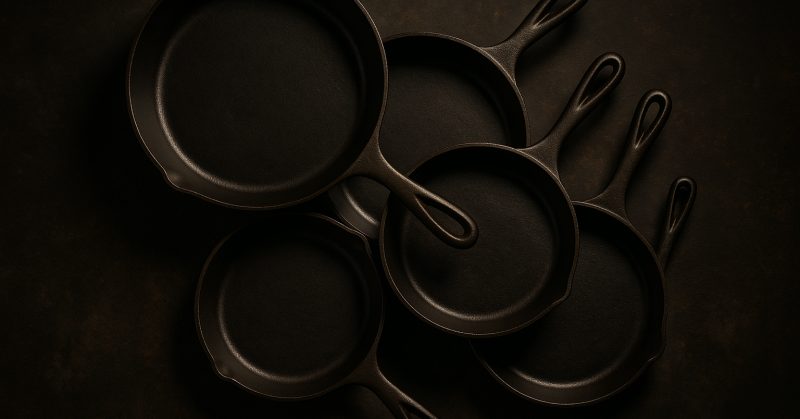
The short answer is that most vintage cast iron is worth less than sellers hope and more than buyers admit. A piece of cast iron cookware acquires value from a specific combination of factors, and age is the weakest of them. A skillet cast in the 1880s with a warped cooking surface, significant pitting, and a hairline crack running from the heat ring to the sidewall is worth very little to anyone who plans to cook with it, and not much more to a collector. That same decade produced pieces that are nearly flat, smooth as finished stone, and structurally sound - and those command real attention. The calendar year a piece left the foundry explains almost nothing on its own. Condition, maker identity, and size rarity do the actual work, roughly in that order, and understanding each one separately is the only way to read a piece honestly.
Condition is the dominant variable
When collectors and dealers say condition, they mean something more precise than whether a skillet looks clean or dirty. Rust, seasoning buildup, and cosmetic surface grime are all recoverable. A thorough restoration process removes them without touching the underlying iron. What matters underneath is the state of the iron itself.
Flatness is the first test. A cooking surface that has warped from thermal abuse - most often from being plunged into cold water while still hot, or used at sustained extreme heat - will rock on a flat reference surface. A small amount of concavity is common in older pieces and does not necessarily disqualify one from use. A significant rocker, or a surface that has twisted rather than dished uniformly, is far harder to remedy. Machine resurfacing can address moderate warping but removes material, and on thinner vintage pieces there is not much to spare. A piece that has already been ground once may be getting close to a thickness where further work is not advisable. When you examine a skillet and the cooking surface looks matte and slightly uneven in a way that does not match casting texture, there is a reasonable chance it has been on a surface grinder at some point. That matters both structurally and for collectors who value originality.
Pitting comes next. Surface rust that is caught reasonably early leaves almost no trace after proper electrolytic or lye-based stripping. Rust that has been allowed to penetrate deeply into the iron over years or decades, or that has been accelerated by moisture trapped under failed seasoning, leaves pits. Shallow pitting on a cooking surface affects the cooking experience but not structural integrity. Deep pitting, particularly if it is widespread rather than isolated, is a meaningful defect. It cannot be filled, and it cannot be ground out without making the surface geometry worse. On a collectible piece, widespread pitting drops value substantially regardless of what else is going for it.
Cracks are the most serious condition issue and the one that ends a piece as functional cookware outright. Cast iron does not flex. A cracked skillet used over heat is a skillet waiting to fail, and no restoration process repairs a crack. This is not a matter of opinion or of how small the crack is. A cracked piece can still have display value if the maker and pattern are significant enough, but it will never recover its value as a usable cooking vessel, and sophisticated collectors discount cracked pieces heavily even for display purposes.
The complication is that cracks are not always obvious, and not everything that looks like a crack is one. Casting seams - the faint lines left where sections of the mold met - can run in directions and at lengths that read as cracks to an inexperienced eye. The difference usually shows up under good raking light and sometimes by feel. A casting seam sits proud of the surrounding surface or is flush with it. A crack is a break in the material, and if you run a fingernail across it, you feel a distinct interruption rather than a raised line. On very old pieces with heavy seasoning buildup, the distinction can be genuinely difficult, and stripping the piece first is the only way to be certain. If you are buying a piece and the seller cannot tell you whether a particular line is a seam or a crack, that uncertainty belongs in the price.
For lidded pieces, completeness matters more than many people account for. A Dutch oven, a bailed kettle, or a deep fryer that retains its original lid is a more complete object than one without, and the premium for the matched set is real. This is especially true when the lid and the base share a maker's mark or pattern that confirms they left the foundry together. A lid that fits well but came from a different piece of the same line is better than no lid at all but is not the same as a documented match.
Why orphaned lids have surprising value
It follows from the above that orphaned lids - lids sold without their original base - are worth more than most people expect. The collector or restorer who has a complete Dutch oven minus its lid needs that lid badly. Lids break and get lost at a much higher rate than bases, because lids bear the brunt of careless handling and of stacking. A lid in good condition from a desirable maker, in a size that matches a sought-after base, is a genuinely scarce object. People often undervalue lids at estate sales and online listings because a lid without context looks incomplete. That undervaluation is an opportunity for buyers who know their sizes and their makers.
Sizing matters for lids in the same way it matters for the pieces discussed below. An orphaned lid in a common middle size will find a home more easily but will not command as much as one in a large or very small diameter that corresponds to a scarce base.
Maker identity and why it is complicated
Foundry names carry real weight in the collector market. Griswold, Wagner, Lodge, Sidney Hollow Ware, Wapak, Martin, Birmingham Stove and Range, and a handful of others have documented histories, distinctive pattern families, and bodies of reference literature that allow confident attribution. Within each of those makers, specific eras of production are more desirable than others. Griswold's large block logo pieces from the early-to-mid twentieth century are more sought after than later small logo production. Wagner's Sidney, Ohio pieces from the same general era have their own following. The details of those attributions - what changed when, which marks correspond to which factory periods - are covered in the dating guide and the makers reference on this site.
The honest caveat is that maker attribution is harder than it looks. A pan without a clear mark, or with a mark that has been partially obscured by pitting or grinding, is speculative. Collectors and restorers who handle large volumes of iron develop pattern recognition for characteristics like gate mark placement, heat ring profile, and handle geometry that can support a reasonable attribution even without a clear mark. But reasonable is not certain, and attributions based on physical characteristics alone should be priced accordingly. A pan confidently marked is worth more than the identical pan with an obscured mark and a plausible attribution.
Unknown makers are not worthless. An unmarked skillet with excellent cooking surface flatness, no pitting, and good thickness is still a highly functional piece of cookware that can be restored and used. Its value is just cookware value rather than collector value, and those are different numbers.
The size problem at both ends of the range
Cast iron cookware was made in a wide range of numbered sizes, roughly corresponding to diameters from small egg pans up through very large restaurant and commercial pieces. The middle of that range - the sizes that were most commonly produced because they were most commonly used - are the most available today. Availability suppresses value in markets, and the common sizes are genuinely common.
The very large sizes, particularly number 12 skillets and above, and the very small sizes, number 2 and below, were produced in smaller quantities and survive in smaller numbers. A number 14 or number 20 piece from a named maker in good condition is a scarce object. So is a number 2 or a miniature toy piece. Both ends of the size range attract collector attention and command premiums that the middle of the range does not.
The practical complication at the large end is condition. Large pieces are heavy, they were used hard in commercial settings, and they are more prone to warping from thermal stress over a large cooking surface. Finding a very large piece that is also flat and pit-free is genuinely difficult. When those conditions coincide with a named maker and a clear mark, you have something.
Asking prices are not prices
This is one of the more important practical points in any honest treatment of value. An asking price on an online marketplace, or a price tag at an antique mall, reflects what a seller hopes to receive. It tells you almost nothing about what the market will actually pay. The only price that reflects reality is a realized price - a transaction that actually closed.
The discipline of reading completed sales rather than active listings takes some practice. On major online auction platforms, completed and sold listings can be filtered separately from active ones. When you apply that filter, you will sometimes find that a category of pieces that looks valuable based on active listings is actually moving at a significant discount to those asking prices, because sellers who price optimistically simply do not sell. You will also occasionally find that certain scarce pieces are moving above what anyone is currently asking, because the active supply is thin.
Pattern matters in completed sales too. One outlier transaction, high or low, is noise. A consistent range across multiple closed sales in similar condition is signal. When you are trying to understand what something is worth, you want at least several data points, not one exceptional result in either direction.
The value guide on this site discusses how to read the market for specific maker and size categories without quoting prices that would be stale the moment they were published.
When restoration raises value and when it does not
For the overwhelming majority of vintage cast iron - pieces intended for use, from named mid-tier makers, in common to moderately scarce configurations - proper restoration raises value relative to unrestored condition. A piece encrusted with carbon buildup and rust, with the original surface obscured, is harder to evaluate and harder to sell. Stripping it, addressing any structural concerns, and bringing the cooking surface to a functional state makes it a complete, usable object. Buyers pay more for that than for the raw project.
There is a narrower set of cases where this logic reverses. Certain very early pieces, and certain rare pattern variants, carry collector value that is partly tied to evidence of original foundry finish. The machined cooking surface of a Griswold Erie piece from the early production era, for example, still showing its original tooling marks without any subsequent grinding or resurfacing, is more meaningful to a specialist collector than the same surface after machine restoration. Heavy intervention on a piece like that - aggressive resurfacing, sandblasting, any treatment that removes or homogenizes the original surface texture - is irreversible and costs you with the collectors who care most.
The practical guidance is that before sending any piece through an aggressive restoration process, it is worth knowing whether it falls into the category where original surface matters. The identification resources on this site can help you place a piece in the right context, and the restoration guides discuss which approaches are reversible and which are not. If you are uncertain, starting with the gentlest effective method and reassessing is always the right sequence.
The emotional value question
People bring cast iron to the value question from many different starting points, and one of the most common is inheritance. A skillet that came from a grandparent's kitchen carries a weight that has nothing to do with foundry marks or cooking surface flatness, and that weight is entirely real and entirely legitimate. Emotional value is not a lesser category of value that needs to be overcome. It is just a different category, and it does not trade in the same market.
The honest version of this is that a piece can simultaneously have modest collector or resale value and extraordinary personal significance. Those two facts coexist without contradiction. What tends to cause problems is when someone needs the piece's monetary value to match its emotional weight, and looks for a collector opinion or a restoration estimate to confirm a number they have already decided on. That is a setup for disappointment, and the respectful thing is to say so plainly rather than find soft ways to agree.
If a piece has been in the family and cooking on it is the point, then its value is the cooking, and restoration to a functional state is straightforward. If the question is whether to sell, understanding the realistic market value first - through completed sales and honest condition assessment - is the only way to make that decision with clear eyes. The selling information on this site explains how this shop evaluates pieces it buys and is specific about the cases where you would do better taking a piece elsewhere or selling it yourself. There are pieces we will pass on entirely and pieces where an individual collector through a specialist auction will pay significantly more than a general buyer. Saying so is more useful than buying everything at any price.
Putting it together
Value in vintage cast iron is a product of several variables working together, not any single one in isolation. A crack disqualifies a piece from the cookware market regardless of its maker. Perfect condition on an unmarked piece from an unknown foundry is worth far less than the same condition on a clearly marked desirable maker. A common size in perfect condition from a great maker still competes with abundant supply. The cases where multiple favorable factors coincide - documented maker, clear mark, desirable era, scarce size, excellent structural condition, no prior grinding - are the cases where real collector value accumulates.
For everything else, which is most of what exists, the honest answer is that vintage cast iron is excellent cookware at very accessible price points for the middle of the market, that restoration can bring almost any structurally sound piece to full function, and that the pieces worth serious money as collectibles are a small fraction of what circulates. Knowing which category a piece falls into before you buy, sell, or restore it is worth the time it takes to find out. The quote process on this site starts with condition assessment, and we will tell you what we see before work begins - including if a piece is not a good candidate for the investment.
Questions
Common questions
How much is my grandmother's skillet worth?
For the great majority of family pieces, somewhere between modest and moderate as an object, and considerably more than that as cookware you will actually use for another fifty years. We will give you a straight assessment either way.
Does restoring a piece increase its value?
For cookware, yes, substantially, because a clean flat pan is usable and a crusted one is not. For a small number of collector pieces, original surface matters and heavy intervention can cost you. We flag that before we touch anything.
Are the prices I see on auction sites real?
Asking prices are not sale prices. Look at what actually sold, over a period, and ignore the listings that have sat unsold for months at aspirational numbers.
Is a cracked pan worth anything?
As cookware, no, and we will not sell one as usable. As a wall piece or a parts donor it has some value, and an experienced eye can sometimes tell a crack from a casting seam, which is a much better outcome.
Do you buy pieces outright?
Yes. Send photographs and we will make an offer, or tell you plainly if you would do better selling it yourself.
Start a restoration
Tell us what you have
Send a couple of photos and the markings you can read on the bottom. We will tell you what the piece is, what it needs, and what it costs before anything ships. Identification and assessment are free, and stay free if you decide to do nothing.
Would rather just talk it through? (802) 348-1550