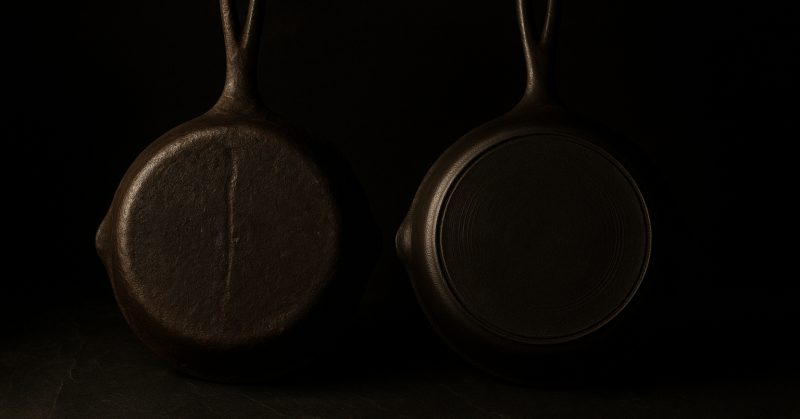
A cast iron skillet does not have a birthday. It has a bracket - a span of years, sometimes a decade, sometimes two or three, within which the evidence places it. Anyone who tells you a skillet was made in a specific year is telling you something that the piece itself cannot support. The foundry records that would settle the question are almost entirely gone. What survives are the physical signals baked into the iron: the gate mark or its absence, the presence or absence of a heat ring, the quality of the machining, the shape of the logo, the pattern number, the weight of the casting, the character of the pour. Each signal brackets the piece against a span of industrial and commercial history. Stack the signals together and the bracket tightens. It rarely tightens to a year, and when someone says it does, they are confusing confidence with evidence. This page explains how to read those signals honestly, what each one rules in and rules out, and where the traps are.
Why a single year is almost always wrong
Foundries were manufacturing businesses, not archivists. When they changed a logo, they did not destroy the old patterns on the day the new design was approved. Old patterns stayed in the molding room and kept being used until they wore out or were retired for some practical reason. New patterns were introduced into the same production run. That means any given logo change produces a transition period - sometimes a few years long - during which both the old mark and the new mark appear on otherwise identical pans. The change brackets a range, not a moment.
The same logic applies to finished inventory. A pan cast in one year might sit in a warehouse and be sold years later. A retailer might hold stock for a long time. A pan that reached a household in 1935 might have been cast in 1930 or cast in 1934. The casting date and the acquisition date are not the same thing, and neither one survives on the iron.
Collector guides sometimes present logo change dates as if they were hard timestamps. A few of those dates are reasonably well established from trade publications or surviving catalogs. Most are estimates that collectors have refined over decades by comparing large numbers of pieces. They remain estimates. When the literature says a logo change happened "around" a given decade, that word is doing real work and should not be silently dropped. Our own dating guide holds to ranges throughout and explains the reasoning behind each one.
The broad sequence of American casting practice
Even without knowing a maker, you can place a piece roughly in American industrial history by reading its construction. The signals below are not airtight on their own - they overlap, and exceptions exist - but together they form the backbone of any honest date estimate.
Gate marks
Early sand-cast iron cookware was poured through a gate, and the sprue left a raised scar on the bottom of the piece. On skillets, this typically appears as a raised line running across the bottom or base ring. Gate-marked pieces come from the earlier era of American cast iron production, broadly the nineteenth century and the years around the turn of the twentieth. The industry moved away from top-gating as foundry methods improved and as the market demanded cleaner-bottomed pieces. A gate mark does not tell you the piece is from a specific decade, but it does place it in the earlier portion of the casting tradition. A piece with no gate mark is consistent with production from roughly the late nineteenth century onward, when side-gating and other improvements became more common. The absence of a gate mark therefore brackets less tightly than its presence.
Be aware that the gate mark's location and character vary by foundry and by the type of piece. A spider or early deep skillet may show it differently than a flat-bottom pan made for a flat-top stove. Read the feature, but read it in context.
Heat rings
The raised ring on the bottom of many skillets - called a heat ring or fire ring - was a functional feature designed to keep the pan seated over the opening of a wood or coal stove. As gas ranges became common and as stove-top design changed through the mid-twentieth century, the heat ring became less necessary. Foundries dropped it from their designs at different times and at different rates, but its general decline tracks the broader shift in American kitchen stoves across the first half of the twentieth century. A deep, well-formed heat ring is more consistent with earlier production. A shallow ring, a vestigial ring, or no ring at all is more consistent with mid-century and later production. This is a bracket, not a rule: some makers kept the heat ring longer than others, and some lines within a single foundry had it while other lines did not.
Surface finish and machining
The interior cooking surfaces of American cast iron went through a clear general evolution. Early pieces were hand-finished: workers used grinding wheels, emery, and hand tools to smooth the cooking surface. The result, when done well, is a surface with a subtle, almost silky texture - not perfectly flat in a machined sense, but refined. During the early-to-mid twentieth century, the leading foundries invested in lathe and machine finishing that produced the famously smooth cooking surfaces that collectors prize today. This era of machined interiors is well within living memory for older collectors, but it ended. As production costs rose and as the market for cast iron softened in the latter half of the twentieth century, foundries reduced or eliminated machine finishing. The cooking surfaces became rougher, with a more pronounced pebbled texture from the sand casting itself. A rough, pebbled interior surface is consistent with later production or with lower-grade lines from any era. A smooth, glassy interior is consistent with the peak machining period, roughly the first half of the twentieth century, though the exact window varies by maker.
Weight and casting quality
The general trend across American cast iron production runs from heavier, thicker-walled early pieces through a refinement period of lighter, well-proportioned casting, and then toward a later coarsening. The best-regarded pieces from the major foundries are neither the heaviest nor the lightest: they hit a balance that reflects mature foundry practice and deliberate design. Very thick, uneven walls often suggest either very early production or a lower-tier foundry at any period. Unusually thin walls with rough finish often suggest later production as the industry declined. Weight alone is not a dating tool, but combined with finish, logo evidence, and construction details, it contributes to the bracket.
How to read logo evolution as evidence
Every major American foundry changed its marks over time. The changes were driven by corporate ownership changes, marketing decisions, foundry mergers, regulatory requirements, and manufacturing convenience. The general principle is the same across makers: logos started simpler, became more elaborate or more standardized as the foundries professionalized their branding, and then in many cases simplified again or disappeared as the industry contracted.
The useful skill is not memorizing a table of dates for a single maker but learning to read what a logo's character tells you. A hand-lettered, slightly irregular mark suggests earlier production when patterns were made by hand. A precisely cast, uniform logo suggests a later pattern made with more controlled tooling. Country-of-origin marks - particularly those reading "Made in USA" or equivalent - become more common after trade legislation in the early twentieth century made such marks commercially or legally expected. Their presence rules out the very earliest production. Their absence does not confirm early production, since some makers were inconsistent.
Where a foundry's logo history is well documented from trade catalogs and surviving records, the sequence of mark styles can bracket a piece fairly well. Where the documentation is thin, the bracket widens. Be skeptical of any source that assigns a logo variant to a specific year rather than a span. The collector community has spent decades correlating pieces to documentation, and the honest consensus almost always lands on ranges. The makers index on this site covers the major American foundries and notes where the dating evidence is solid and where it is genuinely uncertain.
Pattern numbers and what they do and do not tell you
Many foundries cast a number into their pieces that refers to the size or the pattern - the mold from which the piece came. These are size numbers, not date codes. A number 8 skillet tells you the nominal size within that foundry's system. It does not tell you when the piece was made. Collectors sometimes misread pattern numbers as production codes, especially when a number appears in an unusual position or format. Cross-reference the number against what is known about that maker's size system before drawing any conclusion.
Some foundries did use additional codes that can help narrow a bracket when the full mark is read together. But these are maker-specific, and applying one foundry's coding logic to another foundry's piece is a common error. When you are working through the identification process, establish the maker first, then apply that maker's known conventions.
What lids, bails, and hardware tell you
A matching lid is a meaningful piece of evidence, but only if it is genuinely original to the piece. Lids were produced in large numbers and have been mixed and matched across generations of use and resale. A lid that fits does not prove it was cast at the same time as the skillet. Look for consistency in surface finish, logo style, and casting character between the two pieces. A lid with a more worn or more refined finish than the base piece is a signal that the pair may not be original.
Bails - the wire or rod handles on Dutch ovens and kettles - can be original or replaced. Original wire bails on early pieces were typically hand-twisted or simply formed. Later bails were more standardized. The attachment ears, cast into the pot, are more durable evidence than the bail itself. Look at whether the ears are integral to the casting and whether their style matches what is known about the maker's production in a given period. A replaced bail on an otherwise early piece does not change the bracket for the pot, but it matters if you are evaluating completeness.
Lid knobs and handle styles follow the same logic as logos: they changed over time and the changes bracket rather than pinpoint. A wafer-style lid knob, a loop handle versus a solid handle, an offset versus an inline pour spout - each has a general history that narrows the range when read against the rest of the evidence.
Broad casting-era signals at a glance
| Signal | What it suggests | What it rules out | Caveats |
|---|---|---|---|
| Gate mark present on bottom | Earlier production, consistent with nineteenth century through early twentieth | Late twentieth century production | Location and form vary by foundry; some side-gate marks are easy to miss |
| No gate mark | Consistent with late nineteenth century onward | Does not rule out early production; many foundries moved away from visible gate marks while still in the early era | Absence alone brackets very little |
| Deep, well-formed heat ring | Earlier production, designed for wood or coal stove | Does not rule out mid-century; some makers retained heat rings longer | Ring dimensions varied by size of pan and by maker's line |
| No heat ring | Consistent with mid-twentieth century onward, or with a line designed for flat-top stoves | Does not rule out earlier production in all lines | Some very early pieces also lacked heat rings |
| Smooth, machined cooking surface | Peak production era, broadly first half of the twentieth century for major foundries | Very late twentieth century production at low-tier foundries | Hand finishing could produce a similar result in earlier pieces; machine finish quality varied |
| Rough, pebbled cooking surface | Later production, or lower-tier line at any period | Does not rule out mid-century for budget lines | Some early pieces were also rough; finish quality was never uniform across all makers |
| Country-of-origin mark present | Consistent with post-early-twentieth-century production when such marks became common | Rules out the very earliest production for most makers | Adoption was gradual and inconsistent across foundries |
| Handmade-looking, irregular logo | Earlier pattern-making practice | Does not rule out a later foundry with old-fashioned methods | Condition and wear can make a later mark look cruder than it was cast |
| Uniform, precisely cast logo | More modern pattern-making, broadly mid-twentieth century onward | Very earliest production at major foundries | Some foundries upgraded their patterns earlier than others |
The traps
Reproduction pieces
Reproduction cast iron has been in the market for decades. Some reproductions were sold honestly as reproductions; others were not. The clearest physical tells are casting quality and weight. Reproductions typically have rougher surfaces, slightly blurred or overly deep logo impressions, and casting seams that are less cleanly dressed than the originals. The iron often feels different in the hand - not always lighter, but less refined in its construction. A piece that matches an early logo but has a rough, pebbled surface warrants close attention. Cross-reference it against documented originals. Our reference guides cover the most commonly reproduced pieces and what to look for.
Deliberately faked marks
Faked marks exist. They range from crude additions applied after the fact to sophisticated re-castings. A mark that sits in a slight depression, as if added to a surface that was not originally cast with it, is suspicious. Original marks are integral to the casting: they rise or sit flush as part of the same pour, with no visible join or boundary between the mark and the surrounding iron. An added mark may also show different surface oxidation or a different texture from the rest of the bottom. When something is wrong with the way the mark relates to the iron around it, trust that instinct and look closer.
Parts pieces
Decades of use, garage sales, estate sales, and flea markets have produced many skillets that are no longer entirely original. A handle broken off and re-welded. A gate mark ground away to make the bottom sit flat. A heat ring reduced by someone who wanted the pan to work on a modern cooktop. A lid paired with a base it was never made with. None of these things are dishonest in themselves - a repaired or modified piece may still cook perfectly well - but they matter for dating and for understanding value. Date the evidence you can actually read, note what appears altered, and adjust your confidence accordingly.
The most commonly misread parts piece is the skillet where the bottom has been dressed on a grinder. A smooth bottom is sometimes taken as evidence of machine finishing, when in fact it is evidence of later intervention. Look at whether the smoothness extends uniformly to where it would have been machined originally, or whether it has a slightly different character - flat in the wrong plane, or showing grind marks under good light.
Building your bracket
Work through the signals in order. Identify the maker first, because maker-specific logo and pattern knowledge is more precise than the general signals. If the maker is uncertain, work with what you can establish. Note every physical signal - gate mark, heat ring, surface finish, logo character, hardware - and write down what each one brackets. Then look for the overlap: the span of years that is consistent with all the signals together. That overlap is your bracket.
A bracket of twenty years is an honest answer. A bracket of thirty or forty years is also an honest answer if the signals are ambiguous. A claim of a specific year is almost never an honest answer. If you are preparing a piece for sale or for the sell or trade page, describing it honestly within its bracket is more credible than a false precision that any knowledgeable buyer will immediately discount. If you want a second set of eyes on the evidence, the quote and assessment request is the place to start.
Questions
Common questions
Can a pan be dated to an exact year?
Almost never. Foundries used the same patterns for years and changed marks gradually, often running old and new side by side while stock ran down. A careful answer is a range.
Does a heat ring prove the pan is old?
It proves the pan was designed for a stove with an open eye, which puts it in a broad window running from the late nineteenth century into the 1930s. Some later pieces carry one too, so it is supporting evidence rather than proof.
What does a pattern number tell me?
On the makers who used them, it identifies the specific pattern the piece was cast from, and pattern changes can sometimes be tied to a period. It narrows things down; it does not date a piece on its own.
Is an older pan a better pan?
Not automatically. Some of the best-cooking American cast iron was made in the 1940s and 1950s, and some early pieces are thick, heavy and unevenly cast. Age is a fact about a pan, not a grade.
Do you date pieces you are not restoring?
Yes. Send photographs and we will tell you what we think it is and how confident we are, including when the honest answer is that the evidence does not settle it.
Start a restoration
Tell us what you have
Send a couple of photos and the markings you can read on the bottom. We will tell you what the piece is, what it needs, and what it costs before anything ships. Identification and assessment are free, and stay free if you decide to do nothing.
Would rather just talk it through? (802) 348-1550