Sad irons, kettles and other non-cookware
Cast iron cookware gets most of the attention, but foundries from the nineteenth century through the mid twentieth century made a wide range of household iron objects that had nothing to do with cooking. Sad irons, kettles, boot scrapers, mortars, and similar pieces turn up regularly alongside skillets and Dutch ovens. Understanding what they are, how they were made, and how they differ from cookware matters before you buy, restore, or use one.
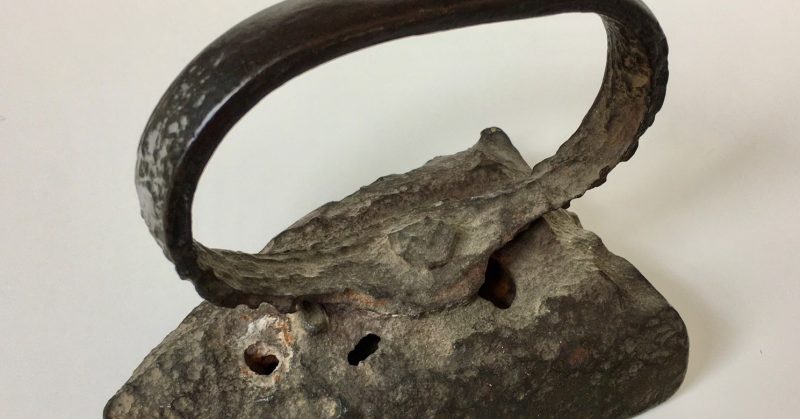
What to check, and what it tells you
| Where to look | What you see | What it means |
|---|---|---|
| The sole plate or base | Deep pitting or a cratered surface | On a sad iron, heavy pitting means the sole cannot be made smooth enough for fabric without professional re-machining, which is rarely worth doing. On a boot scraper base, pitting is cosmetic only. |
| The handle attachment point | A crack running from the hole or slot where the handle connects | Sad irons and kettles both take stress at handle mounts. A crack here is a structural failure. On a sad iron it rules out any use under heat; on a kettle it is a safety concern regardless. |
| The spout or pour lip of a kettle | A hairline crack or a repaired break visible in raking light | Kettle spouts crack from impact and from thermal shock when cold water meets a hot casting. A spout repair with epoxy or filler is common and disqualifies the piece for any heat use. |
| The interior of a mortar bowl | Smooth, darkened, slightly concave wear pattern at the center | Normal use wear. Confirms the piece was used as intended. Check that the wear is even; sharp gouges suggest the pestle was dropped or the wrong material was ground. |
| Any flat decorative panel or finial | A filled or smoothed-over area where detail has been ground down | Earlier owners sometimes ground off a maker's mark or a date. This reduces collector interest but does not affect function. Check with a light held low and at an angle. |
| The entire outer surface | Flaking, powdery orange-red rust covering large areas | Surface rust on decorative pieces like boot scrapers is almost always treatable. On a sad iron sole plate or inside a kettle, heavy rust can mean metal loss that affects fit and function. |
| The lid seat or rim of a kettle | Warped or uneven rim that rocks when set on a flat surface | A warped kettle rim usually means the piece was heated unevenly or quenched. The lid will not seat properly and the distortion is generally permanent. |
What non-cookware cast iron actually is
The term cast iron cookware covers skillets, Dutch ovens, griddles, and similar pieces designed to hold or cook food. But the same foundries that made those pans - and many smaller shops that never made a skillet at all - also cast a long list of household objects that had nothing to do with the kitchen in the modern sense. Sad irons, flat irons, kettles, boot scrapers, door stops, mortar-and-pestle sets, trivets, match holders, and smoothing tools were all standard foundry work from roughly the mid-nineteenth century through the mid-twentieth century.
These pieces come through restoration shops and estate sales constantly, often in boxes alongside the pans. They are worth understanding on their own terms rather than assuming they can be handled the same way as a No. 8 skillet.
Sad irons and flat irons
The sad iron - the word "sad" here derives from an old English term meaning solid or heavy, not from any emotional association - was the standard household clothes iron before electric irons became widely available. A typical sad iron is a wedge-shaped casting with a flat polished sole plate, a pointed front, a rounded heel, and a fixed or detachable handle.
They were made in sets. A common arrangement was two or three iron bodies and a single detachable handle, so one body could heat on the stove while the other was in use. The irons were heated directly on a wood stove or coal range, tested by holding them near the face or spitting on the sole, and then pressed over fabric. This cycle of heating, cooling, and reheating made them hard users.
Sizes were typically numbered, with higher numbers indicating heavier irons. Smaller irons were used for ruffles and collars; larger ones for sheets and heavy fabric. Some makers produced specialty shapes - pointed at both ends for pleating, or with a curved sole for sleeves. Detachable-handle models, sometimes called "Mrs. Potts" irons after a patent of that type (though not all detachable-handle irons are of that pattern), were generally considered a domestic improvement because the handle stayed cool while the iron head heated.
Makers of sad irons include many of the same foundries that made cookware - Enterprise, Sensible, and various regional shops - but also a large number of small foundries that produced only hardware and household iron. Attribution is often impossible without a clear mark, and many sad irons carry no mark at all.
Kettles
Cast iron kettles - generally meaning open or lidded vessels intended for boiling water, as distinct from the enameled cast iron Dutch ovens sold today under the same name - were common throughout the nineteenth and early twentieth centuries. They came in round-bottomed versions designed to sit in a fireplace crane or over coals, and flat-bottomed versions for use on a range top.
Sizes ranged from small household kettles holding a few quarts to large farm and rendering kettles holding many gallons. The large outdoor rendering kettle, also called a wash kettle or lard kettle, is a distinct form: a heavy hemispherical pot on three cast legs, used outdoors for laundry, soap-making, or processing lard. These are large, heavy pieces and are frequently found in farm and rural estate sales.
A household range kettle is a more modest object, more closely related to cookware, and can generally be treated like a Dutch oven in terms of restoration. A large rendering kettle is an outdoor piece and is generally not restored for cooking use.
Boot scrapers, door stops, and decorative pieces
Boot scrapers were set into thresholds or mounted beside doorways. They range from simple utilitarian bars mounted in a cast bracket to elaborate ornamental pieces cast with scrollwork, animal figures, or patriotic motifs. They are among the most commonly found non-cookware cast iron objects and are generally the most forgiving to restore because they were never subjected to heat and the iron tends to be thick and stable.
Door stops in cast iron were made in an extraordinary range of forms. Figural doorstops - cast as dogs, cats, lighthouses, figures, ships, and hundreds of other shapes - were popular household objects. Their collectibility is a subject in its own right and beyond the scope of this page, but it is worth noting that the market for decorative cast iron doorstops is active and that reproductions have been made since at least the mid-twentieth century. If you are buying a figural doorstop as a collectible rather than as a decorative object, dating guidance applies.
Mortars and pestles in cast iron were kitchen and apothecary tools. Cast iron mortars are heavy, thick pieces, usually uncoated, and intended for grinding dry or semi-dry materials. They were not used for wet grinding in the way a stone mortar is, and most should not be used for food preparation today without thorough inspection and seasoning, as old residue and rust can contaminate what is ground in them.
How to inspect non-cookware cast iron before buying
The inspection checklist for non-cookware pieces overlaps with cookware in some ways and diverges sharply in others.
For any piece:
- Hold a strong light low and at an angle across all flat surfaces to reveal cracks, fills, and grinding marks.
- Check every handle attachment point, hinge, or joint. These are the most common failure locations.
- Run a finger along the inside of any spout or pour lip. Cracks here are dangerous on any piece that will hold liquid over heat.
- Look at the bottom. Cratering, heavy pitting, or an uneven surface on a sad iron sole means the piece is functionally compromised.
For sad irons specifically, the sole plate condition matters most if you intend to use the iron. A sole that is heavily pitted or that has been ground unevenly cannot be made smooth at home. For display purposes, surface condition matters less. Check that detachable handles engage and release cleanly; broken or bent engagement tabs are a common problem.
For kettles, check the rim for warping by setting the kettle on a known-flat surface and looking for rocking. Check the interior for thick rust scale that may indicate significant metal loss. A kettle that held standing water for years can lose measurable wall thickness on the inside while looking sound from the outside.
For boot scrapers, the main concern is whether the mounting bracket or feet are intact, and whether any decorative elements are broken off or have been welded or filled. Welded repairs on cast iron are almost always visible under good light; they appear as irregular rippled lines and the surrounding surface often shows heat discoloration.
How these pieces fail
Non-cookware cast iron fails in ways that differ from cookware in a few important respects.
Sad irons were heated and cooled repeatedly, often rapidly. This thermal cycling causes internal stress. Cracking at the heel, around the handle mount, and at the point of the sole is common. Many sad irons also show sole plates that have been lapped or ground at some point in their working life, because a perfectly smooth sole was important for use on fine fabric.
Kettles fail most commonly at spouts, rims, and handles. The spout is a thin, projecting feature and is vulnerable to impact. Rims warp from uneven heating. Bail handles on kettles wear at the ears - the cast lugs where the bail pivots - and the ears themselves can crack under load, especially if the kettle was filled and carried repeatedly.
Boot scrapers and decorative pieces fail through impact damage - broken scrollwork, missing feet, snapped finials - and through mounting damage where screws or bolts have been overtightened into the cast iron, cracking the surrounding material.
Restoring non-cookware cast iron
Restoration of non-cookware pieces broadly follows the same physical steps as cookware: electrolytic rust removal or tank treatment, inspection, surface work, and finishing. But several things are different.
Sad iron sole plates require a smooth, flat surface that is not required of any cookware piece. Achieving this at home, beyond removing rust and seasoning, is not realistic. If a sole is pitted, that pitting will remain. For display, this does not matter. For use, it does.
Kettles, particularly large rendering kettles, are very heavy and difficult to fit into standard restoration tanks. Electrolytic treatment of a full-sized rendering kettle requires equipment sized for it. This is worth knowing before shipping a large kettle for restoration - check current services and ask in advance.
Decorative pieces with elaborate surface relief need careful work to avoid losing detail. Wire wheel grinding and aggressive mechanical methods will round off crisp detail that is part of the piece's character. Gentle electrolytic removal is much better for figural or ornamental surfaces.
Seasoning non-cookware pieces is a question worth thinking through. A sad iron that will be used should be seasoned lightly on the sole to prevent rust between uses, but the sole cannot carry a built-up seasoning layer the way a skillet interior can. Boot scrapers and decorative pieces do not need seasoning in the culinary sense; a light coat of oil or wax applied after rust removal is sufficient to slow re-rusting.
The mistakes we see most
The most common mistake with non-cookware cast iron is assuming it can be treated exactly like a skillet. It usually cannot, for several reasons.
People frequently season sad irons to a full cooking finish, which creates a layer on the sole that then transfers to fabric. A sad iron that will be used should be treated with oil only after the last use and wiped down before the next.
People also routinely attempt to use old kettles and mortars for food without adequate inspection and preparation. An old rendering kettle may have been used for soap or lard processing with residue that cannot be fully removed. An old mortar may have ground materials that left chemical residue. If the history of a piece is unknown, caution is appropriate.
A third common error is treating cracks in non-cookware pieces as cosmetic when they are structural. A crack across the rim of a kettle that will hold boiling water, or a crack at the handle mount of a sad iron that will be placed on a stove, is a safety issue, not an appearance issue.
Finally, some people assume that a piece with no maker's mark is less interesting or less well-made. Many of the best non-cookware cast iron pieces were made by small regional foundries that marked their work inconsistently or not at all. Identifying unmarked pieces is often inconclusive, and that is simply the honest state of the record.
Value
Non-cookware cast iron spans an enormous range in terms of what collectors and users are willing to pay for it. Figural boot scrapers and doorstops with strong detail and confirmed age can command significant premiums. Plain sad irons in average condition are still broadly affordable and common. Large rendering kettles, while heavy and difficult to move, have a steady rural and farm-decor market.
Condition matters more for pieces intended for display than for pieces intended for use. A boot scraper with original paint traces or exceptional detail will attract more interest than a plain one in the same physical condition. A sad iron in sound, usable condition is worth more to someone who wants to use it than to a collector. The value guide covers condition grading in more detail. As with cookware, honest inspection always serves a buyer better than optimistic assumptions.
Looking for one?
Stock here is one piece at a time and it moves. Say what you are after and we will write to you when a piece is listed. Nothing else, ever, and one click stops it.
Questions
About Sad irons, kettles and other non-cookware
Can I use an old sad iron for actually pressing clothes?
Yes, if the sole plate is smooth and free of pitting, the handle is sound, and there are no cracks at the heel or handle mount. Heat it on a gas or electric burner and test on scrap fabric first. The main practical issue is sole condition: a pitted or uneven sole will snag fabric. If the sole is rough and you still want to use the iron, that is a machine-shop problem, not a home restoration problem, and is usually not worth the cost.
Is an old cast iron kettle safe to use for boiling water?
A household range kettle that inspects well - no cracks, no spout repair, no warped rim, sound walls with no significant metal loss from rust - can generally be used for boiling water. A large outdoor rendering kettle has usually been used for non-food purposes and has a less predictable history. For rendering kettles specifically, if you do not know what it held, caution is warranted. Any kettle with a repaired crack or a spout fix should not be used over heat regardless of how the repair looks.
How do I tell if a cast iron doorstop or boot scraper is old or a reproduction?
Reproductions have been made since at least the mid-twentieth century and are common. Genuine older pieces tend to show wear consistent with their claimed use - worn contact points, paint in recesses rather than on surface edges, and casting seams that have been lightly dressed rather than machined smooth. Reproductions often have very uniform surface texture and casting seams that are either too clean or oddly placed. No single test is definitive. The dating guide covers surface and casting characteristics in more detail, and honestly, some pieces simply cannot be dated with confidence.
Can a cast iron mortar be used for grinding food?
Possibly, but with conditions. Cast iron mortars were used historically for dry spices and some apothecary work. The concern with an old mortar is residue from previous grinding - particularly if the piece was used in a pharmacy or for non-food materials - and rust that has penetrated the surface. If the interior shows no signs of chemical staining beyond normal rust, and if it can be cleaned, seasoned, and inspected to your satisfaction, it can be used for dry grinding. Do not use it for wet grinding or acidic ingredients. If the history is unknown, conservative caution is reasonable.
My sad iron has no maker's mark. Does that affect what it is worth or how I restore it?
Most sad irons were not prominently marked, and many carried no mark at all. Unmarked examples are the rule rather than the exception. Lack of a mark reduces collector interest in attribution but does not affect the piece's usability or structural quality. Restoration is the same regardless of marking. For value purposes, specific maker attribution on a sad iron is a secondary factor; condition of the sole plate and handle, and whether the set is complete, matter more to most buyers. See the identify page if you want to pursue attribution further.
Start a restoration
Tell us what you have
Send a couple of photos and the markings you can read on the bottom. We will tell you what the piece is, what it needs, and what it costs before anything ships. Identification and assessment are free, and stay free if you decide to do nothing.
Would rather just talk it through? (802) 348-1550