Trivets and stands
A trivet is a cast iron stand designed to hold a hot pot, lid, or flat-iron above a surface, protecting it from scorching or keeping food warm at the edge of a stove or hearth. Stands range from plain rings to ornate open-lattice designs. Readers care because this is one of the few categories of vintage cast iron where reproductions and outright fakes genuinely flood the secondhand market, making an informed eye essential before any purchase.
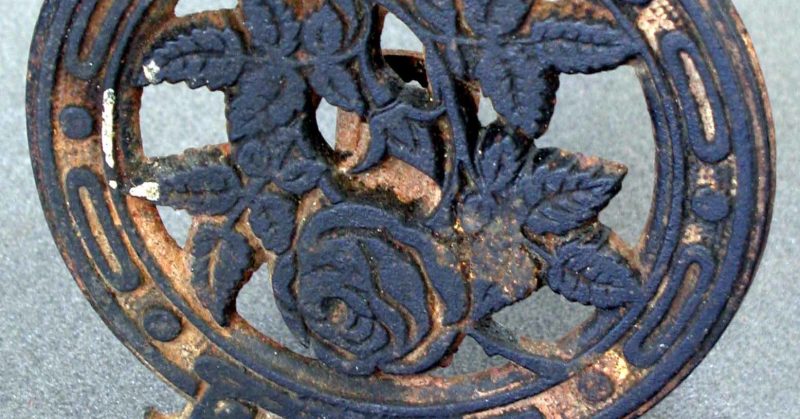
What to check, and what it tells you
| Where to look | What you see | What it means |
|---|---|---|
| The flat feet | Feet that are perfectly uniform, sharp-edged, and machine-smooth on the bottom | Reproduction trivets are frequently sand-cast from sharp modern patterns. Old feet show some wear and slight rounding from use on hard surfaces. Perfectly crisp feet on a piece claimed to be pre-1950 deserve closer scrutiny. |
| The open lattice or decorative face | Fine, hair-thin lines in the relief pattern, sometimes with faint mold-release ridges | Reproduction casting patterns are often copied from originals but cast with less hand-finishing. Look for flash - thin fins of metal in the openings of lattice work. Original pieces were cleaned up by hand; many reproductions were not. |
| The overall surface | Uniform, slightly grainy texture with no variation across the piece | Genuine old trivets usually show some variation in surface texture from years of use, seasoning, and exposure. A perfectly uniform surface, especially with a slightly orange-peel look, is common on import reproductions cast after the 1970s. |
| Any maker's name or logo | Lettering that appears soft, slightly sunken, or hard to read clearly | Authentic maker marks on old American trivets are generally crisp and raised. Copied marks on reproductions - especially those copying Griswold or Wagner designs - tend to be softer and may show doubling or blur at the edges. |
| The weight and ring | Noticeably light weight for the size, or a dull thud rather than a clear ring when tapped | Old American cast iron trivets have a characteristic ring when tapped with a finger. Reproductions, especially those made from lower-grade alloys or thinner castings, often produce a flat, dead sound. Weight that feels low for the size is a related warning sign. |
| The underside and rim | Rough, unfinished casting marks, large gate scars, or circular grinding marks inconsistent with the age claimed | Many 20th-century American trivets were cleaned up on the underside before sale. Large rough gate scars on the bottom that look fresh or unweathered, or grinding marks that cut across old patina, suggest later manufacture or heavy intervention. |
What a trivet actually is
A trivet is a raised platform, almost always three-legged or footed, designed to sit between a hot object and a surface that could be damaged by heat. The word comes from the Latin for three feet, though many cast iron trivets have more than three contact points. In American domestic use from roughly the 1880s through the mid-20th century, trivets served several distinct purposes: holding a flat-iron while it heated or rested between strokes on a shirt, keeping a Dutch oven or pot lid from scorching a table or countertop, and sitting at the edge of a wood stove or range to keep food warm without cooking it further.
The term "stand" is sometimes used interchangeably, and "heat ring stand" refers specifically to a ring-shaped base used beneath a round-bottomed vessel. These distinctions are not always observed consistently in collector literature, so a piece described as a stand in one source may be called a trivet in another.
Despite being small and relatively inexpensive when first made, trivets are now among the most studied and most faked objects in American cast iron collecting. Understanding why requires understanding what makes them attractive to counterfeiters: they are small enough to cast cheaply, they have always been decorative as well as functional, and demand from collectors who want a specific maker's name on the piece is steady.
Sizes, shapes, and variants
Trivets come in a wide range of sizes, from small flat-iron rests roughly four inches across to large pot stands nine or ten inches in diameter intended to support a full Dutch oven. The size generally correlates with original function: smaller pieces were made for flat-irons or individual lids, while larger ones were meant for heavy cooking vessels.
Shape varies considerably. The simplest trivets are plain rings or rectangular frames with feet. The most elaborate are open-lattice designs with hearts, stars, eagles, scrollwork, or text woven into the pattern. Patriotic and floral motifs were common in the late 19th century. Some trivets carry a maker's name, a city of manufacture, or advertising text for a stove company or general store.
Spider trivets - named for their resemblance to a spider's legs radiating from a center - are a recognized variant with long, thin legs and an open center. These are particularly prone to breakage at the leg joints and should be inspected with extra care.
Gate-marked trivets, meaning pieces with a visible scar on the underside from where molten iron entered the mold, are generally dated to before the early 20th century, when foundry practices shifted toward cleaner finishing. A gate mark on the bottom of a trivet does not guarantee age but is consistent with earlier manufacture.
Names worth knowing
Several major American foundries produced trivets alongside their cookware lines, and pieces from those makers are generally more reliable and more sought after. Griswold and Wagner both made trivets, and their marked examples are identifiable by the same crisp lettering collectors look for on skillets. Unmarked trivets from the same period often came from smaller regional foundries whose names are now lost, and these can be perfectly good pieces even without a famous name on them.
Stove manufacturers also produced trivets and stands as accessories for their ranges, and these are sometimes marked with the stove brand rather than the foundry that cast them. The quality of stove-manufacturer trivets varies widely.
Collectors generally avoid trivets that cannot be attributed and that show the surface characteristics associated with post-1970s import reproduction. See the section on fakes below.
Inspecting a trivet before buying
Because reproductions are genuinely common in this category - more so than in almost any other area of cast iron collecting - the inspection process matters more here than it does with a plain skillet. Use the check table on this page as a starting point, but the following points deserve specific attention.
Hold the piece and feel its weight relative to its size. Old American trivets are not necessarily heavy, but they have a solidity that many reproduction pieces lack. An unusually light trivet with sharp, clean edges everywhere is worth treating with suspicion.
Tap it. Cast iron in good condition produces a clear, sustained ring when tapped with a knuckle or a metal tool. A flat, dead sound can indicate a crack, a low-quality alloy, or both. This test is not infallible, but a piece that thuds should be examined for cracks before purchase.
Examine the open sections of any lattice work under good light. Flash - thin fins of excess metal in the openings - is common on reproductions and was generally removed from original American production pieces before sale. Some flash is acceptable and not a fake-indicator on its own, but combined with other signs it matters.
Look at the feet. Wear patterns consistent with actual use on a hard surface - slight rounding, scratching, loss of sharp edges - are normal on old pieces. Feet that are perfectly uniform and machine-crisp on a piece claimed to be 80 years old are less convincing.
If a maker's name is present, compare the lettering carefully to documented examples in collector references or on our identification guide. Copied marks on reproduction trivets are common enough that the presence of a famous name should increase scrutiny rather than reduce it.
How trivets fail and get damaged
The failure modes for trivets differ from those for flat cookware. The most common damage is broken legs or feet: trivets were dropped, knocked off shelves, and subjected to the same stresses as any small object kept near a working stove. A broken leg cannot be repaired in any practical sense and makes the piece unstable for use, though collectors sometimes keep them for display.
Lattice-work trivets can crack through the delicate sections of the pattern. These cracks are easy to miss because they may follow the lines of the design. Running a finger across the surface and feeling for a change in plane, or using a strong light at a low angle to cast shadows across the piece, can reveal cracks that are not obvious at first glance.
Rust on a trivet is generally surface rust and is not a serious structural concern unless the piece has been left wet for a very long time. However, pitting under heavy rust can undercut the detail in decorative sections, which affects both appearance and completeness.
Some trivets have been painted, either decoratively or to cover rust or repairs. Paint in recessed areas of lattice work is particularly hard to remove without damaging detail, and this is worth factoring into a buying decision.
Restoring a trivet
The restoration process for a trivet follows the same basic steps as for any cast iron piece - electrolytic or chemical stripping, wire brushing, drying, and seasoning - but the geometry makes each step harder. Open lattice work traps lye solution, traps rinse water, and traps seasoning oil. Pieces must be rinsed very thoroughly and dried completely before any oil is applied, and even then moisture can remain in tight recesses.
Seasoning a trivet requires patience. Thin, even coats of oil applied and baked repeatedly produce better results than a single heavy application, which will pool in the lattice and bake into a sticky, uneven mess. Because trivets are rarely used for cooking, they do not develop seasoning naturally over time the way a skillet does, so this manual process is the only way to protect the surface.
If you are sending a trivet through our mail-in service, note that the open geometry affects shipping: lattice trivets should be wrapped individually and not nested with other pieces, as the raised sections are the first thing to break when pieces shift in transit. See our shipping guide for packing recommendations.
Trivets in actual use
On a modern gas or electric range, a trivet functions about the same way it did a century ago: it keeps a hot pot or lid off the counter, and it protects a wooden table from a Dutch oven brought directly from the oven. Cast iron trivets retain heat longer than silicone trivets and will themselves become warm if left under a very hot vessel, so touching one without checking first is not advisable.
Trivets are not used directly on a burner and are not suited to it. Their function is entirely passive. They do not require seasoning to function, though a lightly seasoned surface resists rust better than bare iron.
An honest word on value
Trivets span a very wide range of collector interest. A plain, unmarked ring stand in good condition is still affordable and practical. An elaborately decorated late-19th-century piece with a verified maker's mark and crisp detail can command a meaningful premium. The problem is that reproductions and genuine old pieces sometimes sell for similar prices simply because sellers and buyers alike cannot always tell them apart. An informed buyer willing to inspect carefully can still find genuine old trivets at reasonable prices, particularly in categories where the maker is unknown. Pieces with famous names attached should be evaluated with extra care, because the premium those names command is exactly what makes faking them worthwhile. Our value guide covers relative pricing in more detail.
The usual misunderstandings
The single most common mistake with trivets is assuming that age and authenticity are obvious from appearance. A trivet that looks old, feels old, and has a well-known name on it may still be a reproduction. Conversely, a plain, unmarked trivet with no famous name may be a perfectly genuine 19th-century piece.
Collectors also frequently assume that a gate mark on the underside guarantees early manufacture. It is a useful data point, but it is not proof. Some reproduction makers have included deliberate gate marks on their castings, and the feature should be evaluated alongside everything else.
Finally, people underestimate how much damage can hide in lattice work. A crack that follows a design line is easy to overlook. Buying without a close physical inspection - or buying from photos alone without asking for specific detail shots of the underside and all joints - is a genuine risk in this category more than in most others. Our dating guide covers the broader markers of age across American cast iron, and those principles apply here too.
Looking for one?
Stock here is one piece at a time and it moves. Say what you are after and we will write to you when a trivet is listed. Nothing else, ever, and one click stops it.
Questions
About Trivets and stands
How do I tell an old trivet from a reproduction?
No single test is reliable on its own. The most useful combination is weight relative to size, the sound it makes when tapped, the sharpness and uniformity of the feet, and the quality of any lettering. Reproduction trivets are often lighter than their size suggests, produce a flat sound when tapped, and show either excessive flash in the lattice work or unusually crisp, machine-perfect edges on features that would have worn on a genuine old piece. Cross-checking any maker's mark against documented examples is also worthwhile, since copied marks are common in this category.
Can a trivet with a broken leg be repaired?
Cast iron welding is technically possible but rarely worth doing on a trivet. The repair is difficult, the piece will always be structurally weaker at the joint, and a welded leg is generally visible on close inspection. A trivet missing a leg is unstable for use and worth significantly less to collectors. It can still be kept for display or as a reference piece, but most restorers and collectors treat broken-leg trivets as essentially non-functional. If the leg is cracked but not separated, that is a different situation and worth examining with care before deciding.
Do trivets need to be seasoned?
Trivets do not need seasoning to perform their function - they are not used for cooking, so there is no food contact and no need for a non-stick surface. However, bare cast iron rusts, and a thin, well-baked seasoning coat helps protect the surface, particularly in the recessed sections of lattice work where moisture tends to collect. If you are restoring a trivet that will be used regularly, a light seasoning is worthwhile. If it is purely a display piece, keeping it dry and occasionally wiping it with a very thin coat of oil is enough.
Which makers made the best trivets?
Griswold and Wagner are the most recognized names, and their marked trivets are generally well-finished and reliably identified. Beyond those two, quality varied considerably. Many regional foundries made competent trivets without marking them, and those unmarked pieces are often undervalued. Stove-company branded trivets vary widely because the foundry doing the actual casting is often unknown. The honest answer is that maker reputation matters less with trivets than the condition and quality of the individual piece, since the function is simple and the failure modes are mechanical rather than metallurgical.
Is it safe to use a vintage trivet under very heavy pots?
A trivet in good condition without cracks or broken feet will generally handle the weight of a heavy Dutch oven without issue. Cast iron is strong under compressive load. The risk comes from hidden cracks, particularly in lattice sections, which can fail suddenly under weight. Before using any vintage trivet under a heavy pot, inspect it carefully in good light for cracks that follow the design lines, and tap it to check for the clear ring that indicates structural integrity. A piece that thuds or that shows visible cracking should not be trusted under significant weight.
Start a restoration
Tell us what you have
Send a couple of photos and the markings you can read on the bottom. We will tell you what the piece is, what it needs, and what it costs before anything ships. Identification and assessment are free, and stay free if you decide to do nothing.
Would rather just talk it through? (802) 348-1550