Enameled cast iron
Enameled cast iron is cast iron that has been fused with a glass coating - porcelain or vitreous enamel - at high heat. That coating changes almost every rule that applies to bare iron: it does not rust in the ordinary sense, it does not need seasoning, and it cannot be restored the way a plain skillet can. A reader coming to this page probably wants to know whether a piece is worth buying, usable, or too far gone to bother with.
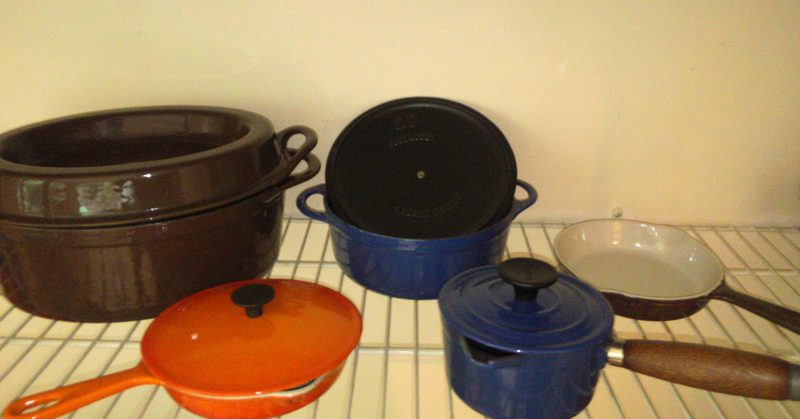
What to check, and what it tells you
| Where to look | What you see | What it means |
|---|---|---|
| The interior cooking surface | Chips exposing dark gray or rust-orange iron beneath | Exposed iron can rust and may leach into food. Small chips in the base are a use-at-your-own-risk situation; large or numerous chips are a reason to walk away or to use the piece for display only. |
| The interior cooking surface | A network of fine hairline cracks, often called crazing | Crazing means the enamel has been thermal-shocked, usually by rapid temperature changes. The coating is intact but weakened. Further thermal stress is more likely to cause chipping. Cosmetically acceptable to many; structurally a caution. |
| The rim and lid seat | Flaking or missing enamel along the top edge | The rim takes the most mechanical wear. Flaking here is common and usually cosmetic, but check that the lid still seals flat and that no fragments have fallen into the interior. |
| The exterior base and sides | Discolouration, darkening, or burn marks that do not wipe clean | Exterior enamel is more durable than interior but still stains permanently if a piece has been used on too-high heat. Does not affect safety but does affect appearance, and the staining will not come off with any household cleaner. |
| The interior, especially near the base | Dark staining or residue that resists scrubbing | Often baked-on food rather than enamel damage. A long soak in warm water with dish soap resolves most of it. If the staining has a rough, pitted texture, that is enamel degradation, not food residue - a meaningfully different finding. |
| The underside of the lid | Cracks radiating from the knob mounting point | Lids crack here if they have been dropped or if the knob was overtightened. A cracked lid is a safety concern - fragments can fall into food. Replacement lids exist for some sizes and makers, but fit is not guaranteed. |
| The entire outer body | Rust streaks running from chips or the base ring | The iron body rusts wherever the enamel is gone. Surface rust from a chip is manageable. If rust has run extensively across the exterior, the piece has been stored wet for a long time and the chip damage underneath is likely worse than it appears. |
What enameled cast iron is
Enameled cast iron starts as a standard iron casting. Before it leaves the foundry, the interior and exterior surfaces are coated with powdered glass - porcelain or vitreous enamel - and fired at temperatures high enough to fuse the glass permanently to the iron. The result is a piece that behaves like cast iron in terms of heat mass and retention but presents a non-porous, chemically inert surface to food and to the air.
That combination was commercially valuable from roughly the 1920s onward, when consumers began to want cookware that would not require the constant maintenance of bare iron and would not react with acidic foods. A bare cast iron pot will pick up flavors from tomato sauce, wine, or citrus and will turn those same foods gray. Enameled iron does neither. It also does not need to be dried immediately after washing or rubbed with oil between uses. For a mid-twentieth century household, that was a significant practical improvement.
The coating is the whole point of the piece - and also its principal weakness. Understanding that trade-off is what this page is for.
Sizes, forms, and what they were called
Enameled cast iron was applied to nearly every form that bare iron took: skillets, Dutch ovens, braisers, sauce pots, griddles, and roasting pans. The Dutch oven is by far the most common surviving form, because it was the most useful and was made in the largest numbers.
Sizes for round Dutch ovens are generally expressed in quarts in American production and in centimeters of diameter in European production. A piece marked "24 cm" and one described as "approximately 4.5 quart" are likely close in capacity, though not necessarily interchangeable in lid fit. American makers in the mid-twentieth century often labeled pieces by a number system that corresponded loosely to quart capacity but was not standardized across manufacturers - a "No. 8" from one company is not the same size as a "No. 8" from another.
Braisers and wide, shallow oval roasters were made for braising whole cuts of meat and for oven roasting. These are less common on the secondhand market than round Dutch ovens and can command a premium in good condition, partly because they are genuinely useful and partly because fewer survived intact.
Lids are worth discussing separately. On bare cast iron, lids from different manufacturers often fit well enough to be swapped. On enameled pieces, the enamel buildup on the rim means that fits are less interchangeable, and a lid from a different maker or even a different size within the same maker's line may not seal properly. This matters for braising, where a poor seal loses moisture.
Makers worth knowing - and some to approach carefully
The best-known enameled cast iron of the twentieth century came from European foundries, particularly French and Belgian operations, some of which were exporting to the American market by mid-century. These pieces are generally dated to the 1950s through 1970s and are still widely available on the secondhand market. Quality in this era was high: thick, even castings; well-applied enamel with few voids; and lids that still fit after decades of use. Pieces from this period from reputable makers are usually worth buying in good condition.
Several American foundries produced enameled iron through roughly the same period. Quality varied more widely than in European production. Some American pieces from the mid-century are excellent; others have thin enamel that crazes readily or interior coatings that discolor quickly. Without knowing the specific maker, American enameled iron from this era requires closer inspection before purchase. See the makers directory for notes on specific foundries.
Beginning in the 1990s and accelerating through the 2000s, a large volume of enameled cast iron began arriving from Chinese foundries, sold under both new brand names and under licenses from established names. Quality in this category spans a very wide range. Some Chinese-produced pieces are well made; others have thin or unevenly applied enamel, rough casting surfaces beneath the coat, and lids that do not fit squarely. The resale market has not fully sorted these pieces, and collector interest in them is generally low. A piece of uncertain recent origin should be inspected more carefully than a piece with a clear mid-century American or European provenance.
The value guide has more on how provenance affects what enameled pieces are worth on the current market.
How to inspect a piece before buying
Enameled iron requires a different inspection routine than bare iron. The identify page covers general approaches, but the following are specific to enamel.
Start with the interior cooking surface under good light, ideally daylight or a strong flashlight held at an angle. You are looking for:
- Chips, which appear as small craters or missing patches where the gray or orange iron is visible beneath
- Crazing, a network of fine cracks that do not go all the way through the coating but indicate thermal stress
- Pitting, which looks like a rough or granular texture and suggests the enamel has begun to degrade from within
- Dark staining that is rough to the touch rather than smooth - smooth dark staining is usually food residue; rough dark staining usually indicates enamel damage
Run a clean finger across the interior. A sound enamel surface feels perfectly smooth, like glass. Any roughness is worth investigating.
Inspect the rim carefully. This is where chips and flaking are most common. Check that no fragments of enamel are loose - a piece with loose or nearly-detached enamel on the rim is a hazard, since those fragments can fall into food.
If there is a lid, seat it and look for light around the edge. A good lid fits without rocking and without obvious gaps. Lift and replace it a few times - it should seat consistently in the same position.
Check the exterior base for rust, which indicates enamel loss on the underside. Some rust on the very bottom ring, where enamel is often thin from manufacture, is common and usually not serious. Rust running up the sides from chips is more concerning.
How this form fails
Enameled cast iron does not fail the way bare iron does. It does not rust evenly across an unprotected surface; it fails at specific points where the glass coating has been compromised.
Thermal shock is the most common cause of damage. Putting a cold piece on a very hot burner, or plunging a hot piece into cold water, can crack the enamel. The crack may be immediate and dramatic - a large chip or fracture - or it may be invisible at first but leave the enamel weakened so that ordinary use eventually causes a chip. This is why a piece with visible crazing is at higher risk of further damage.
Mechanical impact - dropping the piece, knocking it against a hard surface, or storing it carelessly with other heavy cookware - causes chips. The rim and the interior base are the most vulnerable points. A chip on the interior base, where food contacts the iron directly, is the most significant finding in a used piece.
The knob on a lid is a stress concentration point. Lids are frequently dropped. A lid with cracks radiating from the knob should be considered unsafe to continue using.
Enamel does not scratch easily under normal cooking conditions, but metal utensils used aggressively over time can abrade the surface. Scratches in enamel are superficial and do not usually compromise the coating, but they do make the surface rougher and more prone to food sticking.
What restoration involves - and its limits
This is where enameled cast iron diverges most sharply from bare iron. A bare iron skillet in almost any state of rust can be stripped, seasoned, and returned to full use. Enameled iron cannot be restored in the same way, and it is important to understand why.
The enamel coating cannot be re-applied at home. Professional enamel re-coating exists but is expensive, is not widely available, and the results depend heavily on the skill of the operator. For most pieces, re-enameling is not economically practical. Our services page does not currently offer enamel re-coating, and we say so plainly rather than let a customer send a piece expecting that outcome.
What can be done is cleaning and stabilizing the piece. A piece with heavy exterior staining, baked-on food residue, or surface discoloration can often be significantly improved with the right approach: long soaks in warm soapy water, gentle scrubbing with non-abrasive materials, and occasionally a careful use of an oven cleaner on the exterior only. The care page covers safe cleaning methods in detail.
Rust on exposed iron at chip sites can be addressed - the rust can be removed and the spot stabilized - but the chip itself cannot be filled invisibly. Some owners use food-safe epoxy to seal a chip and prevent further rust, which is a practical if imperfect solution for a piece they want to keep using.
Interior chips cannot be fully remediated. A piece with significant interior chipping should be considered for display or retired from cooking use.
In actual use
Enameled cast iron behaves similarly to bare iron in terms of heat mass: it takes time to heat evenly, retains heat well once hot, and is well suited to braising, slow cooking, and oven work. The enamel adds no meaningful insulating layer, so heat performance is comparable to a bare iron piece of the same weight.
On a modern gas or electric stovetop, enameled iron works well. On induction, it also works, since the iron substrate responds to the magnetic field. The enamel does not interfere with induction heating.
The most important difference in use is temperature management. Bare iron can tolerate and even benefit from high heat. Enameled iron should not be run empty on high heat, should not go from cold to very hot quickly, and should not be subjected to sudden temperature changes. These rules are not optional - they are what prevents enamel damage. Medium and medium-low heat covers most stovetop applications; the oven is often a more forgiving environment than the burner.
Cooking spray and high-heat oils can leave a buildup on enamel that darkens the interior over time. This is cosmetic but stubborn. A light coating of oil, or no oil at all for moist braises, is the better approach.
Metal utensils are generally discouraged, not because they will immediately destroy the enamel but because habitual use over years does abrade the surface. Wood, silicone, and nylon utensils are safer choices.
What gets misread
The most common mistake is treating enameled iron as though it were bare iron that happens to have a colorful coat. It is not. The rules about heat, cleaning, and restoration are genuinely different, and applying bare-iron logic to an enameled piece is how most damage happens.
The second common mistake is dismissing a piece entirely because the exterior is stained or the color is faded. Exterior cosmetic condition and interior functional condition are separate questions. A piece with a heavily discolored outside may have a perfectly sound interior. Interior condition is what determines useability; exterior condition is what determines appearance.
The third mistake is underestimating crazing. Fine interior cracks look minor and are easy to rationalize as acceptable. They indicate a piece that has been thermally stressed and is at higher risk of chipping under further use. That does not mean a crazed piece should be discarded, but it should be used carefully - no high heat, no thermal shocks - and its interior should be checked regularly.
If you are uncertain about a piece you already own or are considering buying, the dating guide and faq are useful starting points, and you are welcome to reach out through our quote page with photos.
Looking for one?
Stock here is one piece at a time and it moves. Say what you are after and we will write to you when a enameled piece is listed. Nothing else, ever, and one click stops it.
Questions
About Enameled cast iron
Is it safe to cook in an enameled cast iron pot that has chips on the interior?
The answer depends on the size and number of chips. Small, isolated chips are widely used without incident, but the exposed iron can rust and there is some evidence that iron leaches into food at chip sites, particularly with acidic dishes. Large chips, numerous chips, or any loose or flaking enamel are stronger reasons to stop cooking with the piece. There is no definitive regulatory ruling on this, and collectors and cooks genuinely disagree. The conservative position is to retire a chipped interior from cooking use.
Can enameled cast iron be re-seasoned the way bare iron can?
No, and this is one of the most important things to understand about enameled iron. Seasoning is a process that bonds oil to bare iron. Enamel is glass, not iron, and oil does not bond to it in the same way. You can apply a light coat of oil to the interior before storage, and some makers recommend this to keep the surface conditioned, but it is not the same as seasoning bare iron and it does not create a protective layer in the same sense. Enamel either works as a coating or it does not; there is no building it back up.
How do I clean a badly stained interior without damaging the enamel?
Start with a long soak - an hour or more - in warm water with ordinary dish soap. Most baked-on residue will soften enough to remove with a soft cloth or nylon scrubber. For more stubborn staining, a paste of baking soda and water left on the surface for several hours helps with many stains. Avoid steel wool, abrasive powders, and anything metal. Bleach-based cleaners are sometimes suggested for white interiors and do work, but they should be diluted and rinsed thoroughly. The goal is always the gentlest effective method first.
My enamel has fine cracks all over the inside but no chips. Is this a problem?
This is crazing, and it means the enamel has experienced thermal shock at some point - probably being heated or cooled too quickly. The coating is intact but the fine cracks make it more brittle, so further thermal stress is more likely to cause actual chipping. A crazed piece can still be used, but it should be treated carefully: heat it gradually, never move it from the burner to cold water or a cold surface, and avoid very high heat. Check the interior periodically for any new chips. Crazing alone is not a reason to stop using a piece, but it is a reason to change how you use it.
Is vintage enameled cast iron worth more than modern production?
Generally, yes, for pieces from established mid-century European and American makers in good condition. The casting quality and enamel application from the 1950s through 1970s is widely considered superior to most mass-market production of the last two decades, and collector interest has pushed prices for clean vintage examples upward. Even so, condition matters more than age. A heavily chipped vintage piece is worth less than a sound modern one from a quality maker. Unusual colors, uncommon forms like oval braisers, and pieces with clear maker identification in excellent condition are what command the most attention on the current market.
Start a restoration
Tell us what you have
Send a couple of photos and the markings you can read on the bottom. We will tell you what the piece is, what it needs, and what it costs before anything ships. Identification and assessment are free, and stay free if you decide to do nothing.
Would rather just talk it through? (802) 348-1550