Skillets and frying pans
A cast iron skillet is a flat-bottomed pan with sloped or straight sides, used for frying, searing, baking, and general stovetop cooking. It is the most common piece of vintage cast iron a person will encounter, and the most practical to put to daily use. Flatness of the cooking surface is the single most important quality to check. The name varies - skillet, frying pan, frypan, spider - but the object is essentially the same.
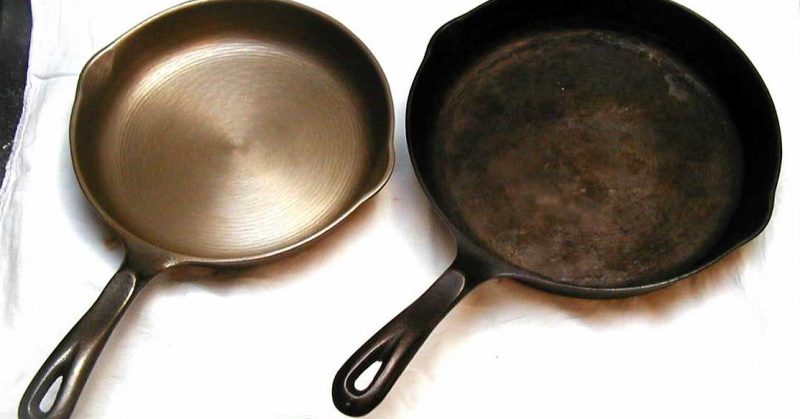
What to check, and what it tells you
| Where to look | What you see | What it means |
|---|---|---|
| The cooking surface | A gap you can rock a straightedge over, or visible warping when viewed edge-on | A warped pan will rock on a flat burner and cook unevenly. This is the single most disqualifying flaw. Check before anything else. |
| The cooking surface | Pitting concentrated in the center of the pan, ranging from fine stippling to deep craters | Light pitting cooks through fine and will smooth with use. Deep pitting in the center indicates heavy rust damage or aggressive cleaning and may affect searing performance. |
| The bottom of the pan (exterior) | A pronounced heat ring - a raised ring cast into the base | Heat rings were common on pre-1950s skillets designed for wood and coal stoves. They center the pan over a stove eye but can prevent full contact on modern flat-top ranges. |
| The handle | A crack, repair weld, or visible repair fill anywhere along the handle or at the handle-to-pan junction | Handle cracks are common and serious. A cracked handle can fail under load. Welded repairs are generally considered a defect by collectors, though a pan with a welded handle can still cook. |
| The rim | Chips, nicks, or missing iron along the pouring lip or top edge | Minor rim chips are cosmetic and common. A chip that extends into the cooking surface or compromises a pour spout affects function and may indicate a drop or impact history. |
| The sidewall | Thin spots visible when the pan is held up to light, or a wall that flexes slightly under thumb pressure | Thin walls result from repeated aggressive grinding or electrolytic cleaning done too many times. A structurally thin pan is a safety concern at high heat. |
| The cooking surface | A smooth, glassy surface with very fine machining marks still faintly visible | Many quality American skillets were machine-polished at the foundry. This surface takes and holds seasoning well. Modern reproductions generally lack this finish. |
What a skillet is and what it was actually for
A cast iron skillet is a shallow, flat-bottomed pan, typically with one long handle and one short helper handle on larger sizes, with sides that flare outward at a low angle. It was the everyday workhorse of American kitchens from at least the 1870s through the mid-twentieth century. Foundries made them by the millions. Hardware stores, general stores, and mail-order catalogs stocked them in multiple sizes. They were not specialty items.
The skillet's job was direct-heat cooking: frying eggs, searing meat, making cornbread, pan-frying chicken. The flat bottom transferred heat from a burner or a wood stove eye evenly across the cooking surface. The low, flared sides allowed steam to escape and gave the cook room to maneuver a spatula. Nothing about the design was decorative. It was the result of what cooks needed and what foundries could cast efficiently.
The term "spider" - still used in New England and by some collectors - originally referred to a legged skillet used directly in a fireplace or over coals. By the late nineteenth century, most production skillets had flat bottoms for stove use, and the word "spider" persisted as a regional term for any cast iron skillet regardless of whether it had legs. You will see the terms skillet, frying pan, and frypan used interchangeably by both collectors and foundries. There is no meaningful distinction between them in American production ware.
Sizes and how they are named
American cast iron skillets were sold by number, not by measurement. A No. 3 skillet from Griswold and a No. 3 from Lodge are not identical in diameter - each foundry set its own sizing - but they are close. Collector references and the dating guide on this site can help you match a number to an approximate diameter for a specific maker.
The common range runs from No. 3 (roughly 6 inches across the cooking surface) to No. 14 (roughly 15 inches). No. 8 and No. 10 are the sizes most often found and most often used. No. 3 and No. 4 were children's sizes or novelty items and were produced in smaller quantities; they are harder to find and tend to command a premium. No. 13 and No. 14 are large enough to be impractical for most modern households and are also less common.
Some foundries produced half-size or intermediate numbers. A few made skillets with lids - these are sometimes called covered skillets or utility pans and are more versatile but harder to find complete. A skillet sold with its matching lid as a set was generally a more expensive product when new and holds more collector interest today.
Specialty variants include the square skillet (less common, used for toast and sandwiches), the chicken fryer (a skillet with higher sides, essentially splitting the difference between a skillet and a Dutch oven), and the long-handled deep skillet sometimes called a steak pan or camp skillet. These all follow the same basic inspection logic as a standard skillet.
Makers worth seeking and makers to approach with caution
For cooking use, the makers consistently praised by collectors for quality of casting and surface finish are Griswold (Erie, Pennsylvania), Wagner (Sidney, Ohio), and Lodge (South Pittsburg, Tennessee). Wapak (Wapakoneta, Ohio) and Favorite Piqua Ware also produced skillets with good surface finish. The makers directory on this site has individual pages for each of these foundries.
Griswold's skilled production, generally dated to the late 1800s through the mid-twentieth century, is the most discussed in collector circles. The finish on a well-preserved Griswold skillet is notably smooth. Wagner pieces are comparable in quality and are sometimes slightly easier to find in good condition. Lodge is the only major maker from this era that continued production and is still operating; earlier Lodge pieces, generally placed in the pre-1960s range, are considered vintage and are sound cooking pieces.
Less consistent are the unbranded or unmarked skillets sold under hardware store house brands or produced by smaller regional foundries whose names have been lost. These are not necessarily bad - many cook just as well - but without a known maker, condition inspection becomes the only guide. Do not pay a premium for an unmarked pan.
Avoid any skillet that has been ground, sanded, or polished with modern power tools in an attempt to create a smooth surface. This treatment removes iron, thins the walls, and alters the cooking characteristics without improving anything meaningful. A naturally smooth original surface is very different from a machine-sanded one.
How to inspect a skillet before buying
The identify page covers general cast iron inspection. For a skillet specifically, start with flatness. Set the pan on a flat surface and press the rim on both sides. It should not rock. Then lay a straightedge across the cooking surface in multiple directions. Any gap indicates warping. A warped skillet is not necessarily useless - on a gas burner with an open flame it may cook adequately - but on an electric coil or glass-top range it will rock and heat unevenly. Know what you are buying.
Next, examine the cooking surface under good light. Pitting from rust is common and ranges from barely visible stippling to deep craters. Fine pitting is cosmetic and will season over without incident. Heavy pitting in the center of the pan, where food actually contacts the surface, is worth factoring into your decision - not as a disqualifier, but as an honest limitation.
Check the handle carefully. Run your fingers along the underside and examine the junction where the handle meets the pan body. Cracks at this junction are common, especially on pans that were dropped or used on very high heat repeatedly. A crack at the handle root is the most serious structural flaw a skillet can have. Do not cook with a cracked-handle pan.
Look at the sidewalls for evidence of aggressive previous restoration. Very thin walls - detectable by holding the pan up to a light source and looking for variations in the iron's opacity - suggest repeated electrolytic stripping or grinding. This is a safety issue, not just a cosmetic one.
Finally, check the pour spouts (the small notches in the rim that let you tip grease out). Chips and cracks at the spout are common from impact damage and are mostly cosmetic unless the chip extends into the cooking surface.
Where the damage happens
Warping is the dominant failure mode for a skillet and is not always visible to the naked eye. It results from rapid temperature change: a hot pan run under cold water, or a cold pan placed directly onto a very high burner. The iron expands unevenly and the bottom does not return to flat. A warped pan can sometimes be corrected by a skilled restoration shop, but many cases are not reversible. This is worth knowing before you buy.
Handle cracks occur from drops, from being used as a lever, or from thermal shock in the same way as warping. The handle-to-body junction is the weakest point. Cracks here are not always visible without close inspection in good light.
Pitting results from sustained rust, usually from storage without seasoning in a damp environment. The longer bare iron sits wet, the deeper the pitting. Surface rust can be cleaned away; the pits it leaves behind are permanent.
Chips and gouges to the cooking surface sometimes occur from metal utensils used aggressively, but more often result from previous owners using power tools during restoration attempts. A grinder or flap disc removes metal permanently and cannot be undone.
What restoring a skillet involves
Restoration of a skillet is generally straightforward relative to more complex pieces. The services page explains what is included in a standard restoration. For a skillet, the main steps are cleaning (removing rust, old seasoning, and grease buildup), surface inspection, and re-seasoning.
Cleaning methods range from electrolysis to lye baths to oven self-clean cycles. Each has trade-offs. Electrolysis is effective but must be monitored - over-electrolysis contributes to wall thinning over time. Lye baths are very effective for stripping seasoning and grease without affecting iron. Oven self-clean cycles work but subject the pan to thermal stress repeatedly, which is not ideal for a pan with any pre-existing warping.
Re-seasoning a flat skillet is easier than seasoning a Dutch oven or a piece with complex interior geometry. The entire cooking surface is accessible. Multiple thin layers of oil, baked in at appropriate temperature, build a surface that releases food and resists rust. The care page covers this in detail.
What is harder about a skillet than some other pieces is the flatness problem. If a pan arrives warped, re-seasoning will not fix it. The cooking surface must be flat before seasoning makes sense. Correction of warping, where possible, requires controlled heat application and pressure and is not something to attempt casually.
How a vintage skillet behaves on a modern stove
On a gas range, a vintage cast iron skillet with a heat ring causes no trouble. The ring does not contact the burner grate and the flame reaches the base of the pan normally.
On an electric coil range, a heat ring may prevent full contact between the pan bottom and the coil. The pan will still heat, but less efficiently. A flat-bottomed pan (no heat ring) is preferable here.
On a glass-top or induction range, a heat ring is a genuine problem. The pan sits on the ring rather than the flat base, reducing heat transfer significantly and potentially scratching the glass surface. A flat-bottomed vintage skillet without a heat ring works acceptably on glass-top ranges, provided it is also flat (not warped). Induction requires ferrous metal, which cast iron satisfies, but again flatness is essential for good contact.
In an oven, a vintage skillet behaves exactly as you would expect. It holds and radiates heat well, making it very good for cornbread, frittatas, roasted vegetables, and similar applications. Handle temperature in the oven will match the oven temperature, which modern cooks sometimes forget.
An honest word on value
Skillets are the most common piece of vintage cast iron and, as a result, most sizes from most makers are still affordable compared to rarer forms. A No. 8 or No. 10 in good cooking condition is not a difficult find at flea markets, estate sales, or through online sellers. The value guide gives more context on what drives price variation.
Factors that push a skillet toward a premium include: small sizes (No. 3 and smaller), large sizes (No. 13 and up), complete sets with original lids, examples with early marks or rare maker variants, and condition that is genuinely exceptional rather than merely cleaned. A skillet in average used condition from a common maker in a common size should not require a significant outlay.
Factors that reduce value even when a pan looks clean: warping (almost always discoverable with a straightedge), handle cracks, heavy center pitting, evidence of power-tool grinding, and wall thinning from over-restoration. A clean, shiny skillet is not the same thing as a sound one.
Where people go wrong
The most common mistake is buying on appearance rather than flatness. A beautifully seasoned, rust-free skillet with a hairline warp will perform poorly on an electric or glass-top range and will be frustrating in daily use. The straightedge test takes thirty seconds and should always be done.
A close second is confusing a smooth original surface with a sanded surface. Foundry-polished skillets - those that were machine-smoothed during manufacture - have a very fine, consistent texture with faint parallel marks. A pan that has been hit with a belt sander or angle grinder has a different texture, often with visible swirl marks, and has lost iron permanently. Knowing the difference matters both for cooking performance and for an honest sense of what you are buying.
Third: collectors sometimes prize early marks or rare variants highly enough that condition takes second place. For a display piece, that is a personal choice. For a pan you intend to cook in, condition - especially flatness and handle integrity - should come first. A quote from our shop can help you understand what a given piece would need before it is ready for regular use.
Finally, the name matters less than the casting. A skillet marked with a hardware store brand, or unmarked entirely, that is flat, sound, and has a good surface will outperform a famous-brand skillet that has been warped, pitted, or over-restored. Buy the pan, not the mark.
Looking for one?
Stock here is one piece at a time and it moves. Say what you are after and we will write to you when a skillet is listed. Nothing else, ever, and one click stops it.
Questions
About Skillets and frying pans
Does the brand name on a skillet actually affect how it cooks?
For most practical purposes, no. Foundry reputation matters because it correlates with casting quality and surface finish, both of which affect seasoning and release. A well-preserved Griswold or Wagner with a smooth, flat surface will cook beautifully. So will a sound, flat, unmarked pan with comparable surface quality. The brand predicts probability of quality; it does not guarantee it. Inspect the actual pan rather than buying on the name alone.
My vintage skillet rocks on my glass-top stove. Can this be fixed?
Sometimes. A warped pan can occasionally be corrected by a restoration shop using controlled heat and pressure, but many warps are not reversible, and the correction process carries its own risks. The more important question is whether you knew about the warp before buying. On a gas range, minor warping is often tolerable. On glass-top and induction ranges, it is a real functional problem. Check flatness with a straightedge before purchasing any skillet intended for flat-surface cooking.
What is a heat ring and do I need to worry about it?
A heat ring is a raised ring cast into the bottom of older skillets, originally designed to help center the pan over a wood or coal stove eye. On a gas range it usually causes no trouble. On electric coil ranges it reduces contact slightly. On glass-top ranges it is a problem: the pan sits on the ring rather than the flat base, cooking inefficiently and potentially scratching the glass. If you cook on a glass-top or induction range, look for a flat-bottomed skillet without a heat ring.
How do I know if pitting on the cooking surface is too bad to bother with?
Light pitting - fine stippling or scattered shallow marks across the surface - cooks through fine and will gradually smooth with seasoning and use. Deep pitting concentrated in the center of the pan, where food makes the most contact, is a bigger limitation. It will not prevent the pan from cooking, but it will make searing uneven and cleaning harder. There is no single threshold; it is a judgment call. If the pitting is deep enough to trap food visibly, factor that into your decision rather than expecting seasoning to solve it.
Is it safe to use a vintage skillet that has a small crack in the handle?
No. A cracked handle is the one flaw that makes a skillet genuinely unsafe. Cast iron does not flex; a crack under load will propagate and the handle can fail suddenly, dropping a heavy pan of hot food. This applies especially to cracks at the junction where the handle meets the pan body, which is where stress concentrates. A welded repair done by a skilled welder may restore function, but collectors generally consider it a defect. A pan with a cracked handle is a wall hanger, not a cooking tool.
Start a restoration
Tell us what you have
Send a couple of photos and the markings you can read on the bottom. We will tell you what the piece is, what it needs, and what it costs before anything ships. Identification and assessment are free, and stay free if you decide to do nothing.
Would rather just talk it through? (802) 348-1550