Waffle irons and their bases
A cast iron waffle iron is a hinged pair of patterned paddles, usually round, designed to cook waffles over a heat source. What most buyers overlook is that the iron is only half the item: the base ring - low or high - is what holds it upright and lets you flip it. Without the right base, a waffle iron is incomplete and often unusable. That is the central fact this page is built around.
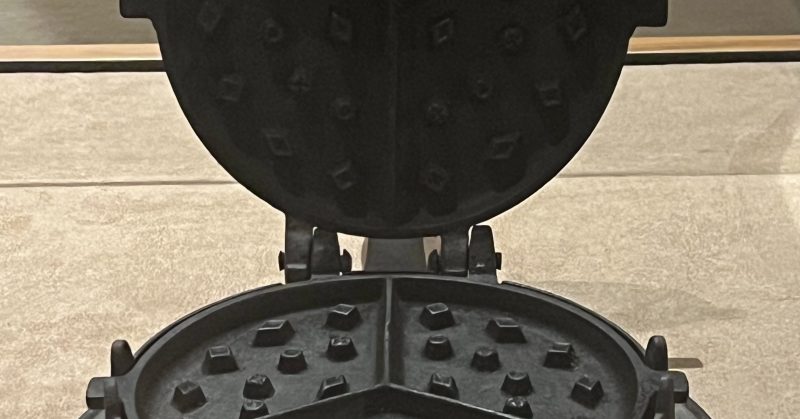
What to check, and what it tells you
| Where to look | What you see | What it means |
|---|---|---|
| The hinge pin | Pin is present, straight, and does not wobble side to side | A loose or bent hinge pin causes the grids to misalign and bake unevenly. Replacement pins can be fabricated, but a tight original is always preferable. |
| The grid faces (both halves) | Pitting, deep rust scarring, or filled-in pattern channels | Light surface rust restores cleanly. Pitting that reaches into the pattern channels will trap batter and produce torn waffles regardless of seasoning. |
| The grid faces (both halves) | Warping - one face rocks or gaps against a flat surface | A warped grid will not close flush. The two halves need to meet evenly or the waffle bakes thin on one side and raw on the other. Warping in waffle irons is largely irreversible. |
| The base ring | Base ring present and matches the iron's manufacturer or pattern | A mismatched base may fit loosely, tip, or hold the iron at the wrong angle. Completeness matters for both usability and collector value. |
| The base ring | Cracks at the pivot socket or leg joints | The base takes mechanical stress every time the iron is flipped. Cracks here are a structural failure. A cracked base should not be used over an open flame or high heat. |
| The bail handle and its attachment points | Bail is bent, broken, or its ears are cracked | The bail is how you flip a loaded iron. A compromised bail is a safety issue. Bails are sometimes replaceable but original intact hardware is preferred. |
| The body casting overall | Casting number, size number, or maker name on the top or underside | Markings help establish maker and era. Cross-reference with the base ring markings - if they do not agree, the set may have been assembled from mismatched pieces. |
What a waffle iron is and what it was actually for
A cast iron waffle iron consists of two hinged paddles, each faced with a grid pattern, that clamp together around a portion of batter and cook it from both sides simultaneously. The result is a waffle: a cooked cake with a characteristic grid of cells that hold butter and syrup. The form goes back well before cast iron was common in American kitchens - long-handled wafer irons held over a fire are documented from colonial times - but the familiar round, handled, base-mounted cast iron version is generally dated to the latter half of the nineteenth century and remained in production through roughly the 1950s, when electric waffle makers became the household standard.
The piece works by trapping heat around the batter. When the iron is properly preheated and the batter poured, steam builds inside the closed halves, the batter sets, and the grid imprints on both faces. Flipping the iron partway through cooking is common practice with stove-top versions: it ensures the batter flows to fill both halves before it sets, and it distributes heat evenly between top and bottom. That flipping motion is why the base matters as much as the iron itself.
The base: low, high, and missing
The base ring - sometimes called the stand - is a separate casting that the iron sits in while cooking. It holds the closed iron upright, raises it to a workable height, and provides a pivot point for flipping. Without the correct base, you cannot flip the iron safely, and the whole mechanism becomes impractical.
Two main base heights exist in the collected record:
- Low base: A short ring, generally used with the iron sitting directly on a stovetop burner or a low wood stove grate. The iron is close to the heat source.
- High base: A taller ring that elevates the iron several inches above the surface. High bases are associated with use over open flames, higher wood stove grates, or situations where more air circulation under the iron was wanted.
The pairing of iron and base matters in a practical sense. A base that is too short may let the iron drag on the burner surface when flipped. A base that is too tall may hold the iron so far from the heat that cooking becomes slow and uneven. Collectors and users alike find that a matched, original set - iron and base from the same maker and pattern - is the starting point for reliable results.
There is also the older wafer iron form, which is distinct: a long-handled, scissor-action tool held directly over a fire, without a base at all. These predate the familiar round stovetop iron and are made of wrought iron as often as cast iron. They are generally considered a separate category by collectors.
Sizes and variants
Waffle irons were made in a range of sizes, typically designated by a number stamped or cast into the piece, in the same general system used for skillets and Dutch ovens. Sizes roughly correlate to the diameter of the cooking grid, though the numbering is not perfectly consistent across makers. Size 8 is probably the most commonly encountered. Smaller sizes - 6 and 7 - show up regularly. Larger sizes exist and are somewhat harder to find.
Beyond round grids, square-grid irons exist, as do irons with novelty patterns: hearts, animals, geometric designs. These variant patterns generally command more collector interest than the standard crosshatch grid.
Some makers produced irons with a latch or clamp mechanism to hold the two halves together during cooking. Others relied on the hinge and the weight of the iron itself. The latch design is a minor collector distinction, not a meaningful cooking advantage.
Whose to look for
Several well-regarded American foundries produced waffle irons as part of their broader cookware lines. Griswold Manufacturing, based in Erie, Pennsylvania, made waffle irons in multiple sizes and with several base variants. Their irons are generally well finished, clearly marked, and popular with collectors. Exploring maker marks is a good starting point at /makers.
Wagner Ware, from Sidney, Ohio, also produced waffle irons and is similarly well regarded. Both Griswold and Wagner irons tend to be easy to date and identify because the markings are usually clear.
Other foundries - including some regional producers whose names are less thoroughly documented - made waffle irons of varying quality. Some unmarked irons are entirely functional; others show rougher casting work that results in thicker, heavier grids that heat more slowly and less evenly.
Irons to approach with more caution include unmarked pieces assembled from mismatched bases and irons, and any piece where the casting quality is visibly coarser. The grid face is a finishing surface in a way a skillet bottom is not: rough casting marks on the cooking grid will affect the finished waffle.
Inspecting one before you buy
The identification guide at /identify covers general cast iron inspection, but waffle irons have specific points that differ from flat cookware.
Start with the grid faces. Look at them in good light and feel them with your fingers. Pitting from deep rust leaves holes that will catch batter. Pattern channels that are partially filled with old grease, rust, or a thick buildup may clean up fully, or may not - you often cannot tell until the piece is stripped. Lightly rusty but structurally sound grids are fine to buy.
Check that the two halves close flush. Hold the iron closed and look at the seam around the edge. A consistent, even gap is normal and fine. An uneven gap - one side touching, one side open - indicates a warped or bent casting. Warping in waffle irons is difficult to correct and will produce uneven waffles regardless of technique.
Examine the hinge pin. It should turn smoothly and without side-to-side play. A very loose pin can sometimes be peened or replaced, but it is a complication.
Look at the base carefully. Check the legs and the pivot socket where the iron sits. Cracks at these stress points are common because the base takes repeated mechanical load. A cracked base should not be used over heat. Check that the base and iron are from the same maker if markings are present, and that the iron sits in the base without significant wobble.
The bail handle and its attachment ears are another point to check. The bail takes the full weight of the iron plus batter when you flip. Bent or cracked bail ears are a safety issue.
How waffle irons fail
Cast iron waffle irons fail in ways that plain skillets do not.
Warping is the most serious issue specific to this form. The two halves are designed to close against each other. Any distortion in either half means they no longer mate correctly.
Hinge wear and pin damage is common on heavily used irons. The constant open-close cycle over decades stresses the hinge joint.
Base damage - particularly cracked legs or a cracked pivot socket - is frequent because the base is often the piece that gets set down hard, knocked over, or stored carelessly.
Grid pitting, as noted above, is not always visible until the piece is cleaned. Some pitting is cosmetic; deep pitting into the cooking channels is a real problem.
Finally, a mismatch between base and iron is not technically damage, but it is a functional problem that is easy to overlook when buying.
Restoring a waffle iron
Restoration follows the same general process as flat cast iron - stripping old seasoning, removing rust, re-seasoning - but the geometry creates complications. The grid pattern has deep channels and corners that are difficult to reach with abrasives. An electrolysis tank or a lye bath is generally more effective than mechanical stripping for waffle irons because the chemistry reaches into recessed areas that wire brushes and sandpaper cannot.
After stripping, the channels need to be inspected carefully. Any residue left in the pattern will bake in during seasoning and become harder to remove.
Seasoning a waffle iron requires getting oil into the channels of both faces. Brush-applying oil is more reliable than wiping alone. The hinge pin and the pivot mechanism should be kept clear of seasoning buildup, which can cause the action to stiffen.
The base is often ignored during restoration because it is not a cooking surface, but it should be cleaned and given a light coat of oil to prevent rust.
If you are considering sending a waffle iron for professional restoration, note that the base and the iron should travel together. Our mail-in service handles waffle irons as a set - see /services for what to expect.
Using a waffle iron on a modern stove
Stovetop cast iron waffle irons were designed for wood and coal stoves, which produce sustained, even, moderate heat across a wide surface. Modern gas and electric burners are smaller and more concentrated, which creates challenges.
On a gas burner, the concentrated flame heats the center of the grid much faster than the edges. Rotating the iron on the base periodically, or using a diffuser, can help even out the heat.
On a smooth electric or induction cooktop, a cast iron waffle iron with a base is difficult to use safely because the base elevates the iron away from the surface, reducing contact and heat transfer. Some cooks use such irons on the grate of a gas oven set to broil, or over a camp stove where open flame is more forgiving of the gap between burner and iron.
Preheating is essential and takes longer than most people expect - five to ten minutes over moderate heat. A properly preheated iron needs little or no added fat because the seasoned surface releases cleanly when the waffle is set. An underheated iron will stick reliably.
The iron cannot be used in a conventional oven in the same way a skillet can, because the base is not designed for oven rack placement and the form does not work without being able to flip it.
Value without numbers
Waffle irons in matched, complete sets - iron plus correct original base - are worth meaningfully more than orphaned irons without bases. A complete Griswold or Wagner set in good condition commands a noticeable premium over comparable unmarked pieces. Unusual sizes, novelty grid patterns, and variant base styles all increase collector interest. Irons with damaged grids, warped halves, or cracked bases sell at a discount even when the maker is desirable. The value guide at /value-guide gives broader context on what moves cast iron prices.
Still-affordable options exist in the form of smaller, lesser-known makers with intact grids and functional - if mismatched - bases. These are often the best choice for someone who actually wants to cook waffles rather than collect.
The usual misunderstandings
The most common mistake is buying an iron without a base and assuming a base will turn up later, or that the iron will work without one. It will not work safely or reliably without the correct base, and finding a matching base separately is genuinely difficult. Buy the set or plan to buy an incomplete piece at a price that reflects the missing component.
A close second is misreading a dirty or lightly rusted grid as permanently damaged. Light rust cleans. Pitting does not. Taking the time to read the dating and condition guide at /dating-guide before buying can save a frustrating purchase.
Third is underestimating preheat time. People accustomed to electric waffle makers, which preheat in under two minutes, find stovetop cast iron irons slow. The iron needs to reach an even temperature all the way through the casting before it will cook well. Rushing it produces pale, sticky waffles and a discouraging first experience with a piece that would otherwise perform well.
Finally, some buyers overlook the base ring when inspecting a set, focusing entirely on the grid faces. The base is a structural component under repeated mechanical stress. Its condition matters as much as the iron's.
Looking for one?
Stock here is one piece at a time and it moves. Say what you are after and we will write to you when a waffle iron is listed. Nothing else, ever, and one click stops it.
Questions
About Waffle irons and their bases
Can I use a waffle iron without its original base?
Not safely or reliably. The base holds the iron upright and gives you a pivot point to flip it while it is loaded with hot batter. Without it, you cannot flip the iron without risk of burns or spillage, and the iron will not sit level on a burner. A mismatched base from the same size category will sometimes work in practice, but expect some wobble and check that the pivot socket actually engages. A missing base is a real defect, not a cosmetic one.
How do I tell a low base from a high base, and does it matter for cooking?
Low bases are short rings that keep the iron close to the burner surface, generally suited to flat stovetop use. High bases elevate the iron several inches, which was useful over open flames or taller wood stove grates. On a modern gas burner, a low base usually works better because the iron sits closer to the heat. A high base on a flat burner can result in slow, uneven heating because the iron is held away from the heat source. Measure the ring height if you are uncertain which you have.
The grid on my waffle iron is pitted. Can it be restored to usable condition?
It depends on the depth and location of the pitting. Surface pitting from rust, where the metal is slightly roughened but the pattern channels are still clearly defined, usually produces acceptable waffles once the iron is cleaned and well seasoned. Deep pitting that extends into the channels themselves is harder to work around: batter catches in the voids, the waffle tears on release, and no amount of seasoning fully fixes the problem. Inspect the channels specifically, not just the raised grid faces, before deciding.
My two grid halves do not close evenly - one side has a larger gap than the other. Is this fixable?
Usually not in any practical sense. An uneven gap when closed means one or both halves are warped or bent. Waffle irons are not flat like a skillet, so there is no good way to surface-grind or re-flatten the grid faces without destroying the pattern. The iron will cook unevenly: thinner on the side where the gap is larger, thicker and possibly undercooked on the other. A mild warp may still produce usable waffles, but a pronounced one is a fundamental defect. Factor this into your buying decision.
What is the best way to season a waffle iron given all the recessed channels?
Brush-apply a thin coat of oil rather than wiping with a cloth, which tends to leave the channel bottoms dry. A pastry brush or a small silicone brush reaches into the pattern better than a folded cloth or paper towel. Season both grid faces, paying attention to the channels. Avoid heavy application: pooled oil in the channels will polymerize unevenly and can create sticky patches. Two or three light coats, each baked fully, will build a more reliable surface than one heavy coat. The care guide at /care covers seasoning technique in full.
Start a restoration
Tell us what you have
Send a couple of photos and the markings you can read on the bottom. We will tell you what the piece is, what it needs, and what it costs before anything ships. Identification and assessment are free, and stay free if you decide to do nothing.
Would rather just talk it through? (802) 348-1550