Descoware
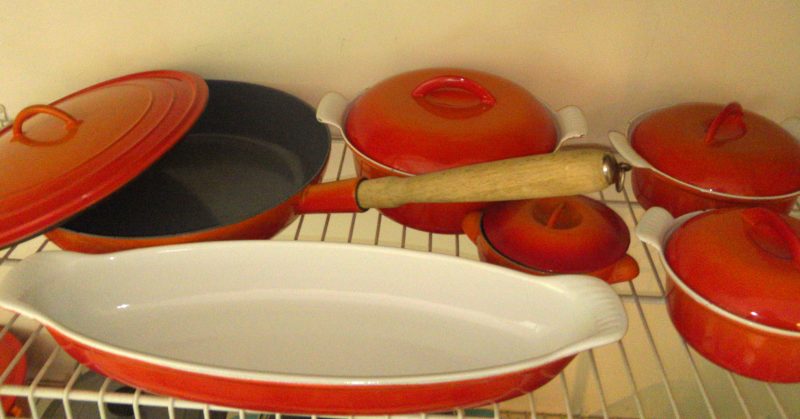
Descoware is a Belgian brand of enameled cast iron cookware produced during the mid twentieth century. It is not widely known by name, but it has a devoted following among collectors and cooks - largely because Julia Child used it on her television program and in her kitchen. The pots themselves are solid, well-finished midcentury enameled ware. The name behind them is considerably harder to pin down than the reputation.
The marks, and what each one dates it to
| Era | Mark | What it tells you |
|---|---|---|
| Mid twentieth century - date uncertain | DESCOWARE BELGIUM cast or stamped into the base, sometimes with a flame or fleur-de-lis style device | The standard mark seen on most pieces in circulation. Presence of BELGIUM rather than MADE IN BELGIUM may have era implications, but the sequence is not settled among collectors. |
| Mid twentieth century - date uncertain | MADE IN BELGIUM added below or alongside the DESCOWARE name | Widely thought to be a later or export-market variant, possibly introduced to satisfy U.S. import labeling requirements, but the precise timing is not documented. |
| Mid twentieth century - date uncertain | DESCO mark, abbreviated form of the full brand name, sometimes accompanied by a size or shape number | Found on some pieces, possibly an earlier or alternate product line. The relationship between DESCO and DESCOWARE pieces is not clearly established in the literature. |
| Disputed | Color or glaze batch codes, typically single letters or short number strings, stamped or painted on the base | These are production codes, not marks indicating a different maker or era. They are occasionally misread by sellers as model numbers or date codes. |
| Mark history - overall assessment | No verified, sequenced mark chronology exists for Descoware | Collectors and researchers have not established a clean timeline. Treat any highly specific dating based on marks alone with caution. |
What Descoware is
Descoware is a brand of enameled cast iron cookware made in Belgium during the mid twentieth century. The company sold under the name Descoware of Belgium, and some pieces carry only the abbreviated name Desco. The cookware was imported into the United States and found a market among home cooks interested in French-style braising and slow cooking, which was gaining a following in American kitchens during the postwar decades.
The brand's reputation in the United States is tied closely to Julia Child. She used Descoware pieces in her kitchen and on her television program, and that association has kept the name alive among collectors and cooks long after production ended. The cookware itself is capable and well made, but it is honest to say that without that association it would probably sit in the same mid-tier category as several other European enameled brands of the same period.
The company behind the brand
The internal history of Descoware - who founded it, where exactly it was manufactured, how large the operation was, and precisely when it began and ended - is not settled. Collector communities and secondhand references repeat certain claims, but primary documentation is scarce. What can be said with reasonable confidence is that Descoware was a Belgian-made product sold during the mid twentieth century, and that it was actively marketed in the United States during the period when French cooking was becoming a serious interest for American home cooks.
This is an area where honest uncertainty is more useful than a tidy story. If you are researching Descoware's corporate history, be aware that much of what circulates online traces back to a small number of sources that have been copied rather than independently verified.
Reading an unmarked Descoware
Because the mark history is incomplete, learning to recognize Descoware by its physical characteristics is genuinely useful. These are general traits seen across multiple pieces and reported consistently by collectors, rather than guaranteed identifiers.
- The casting is relatively smooth for midcentury enameled ware. Interior surfaces on good examples have an even, slightly glossy enamel that was applied with care.
- The enamel colors most commonly seen are a warm flame orange-red, a deep red, and a pale yellow. Other colors exist but are less frequently encountered. The flame color is the one most strongly associated with Child's kitchen and tends to attract a premium among collectors.
- Lids fit with a moderate, snug drop. Descoware lids are not as precisely fitted as some higher-end contemporary European brands, but they are better than many American enameled pieces of the same period.
- Handles are cast as part of the body on most Dutch oven and cocotte forms, following the same approach used by French and Belgian competitors. The handle geometry is somewhat utilitarian - functional but not as refined as pieces from makers who were competing at the top of the market.
- Wall thickness is consistent and moderate. These are not the heaviest enameled pieces you will encounter, but they are not thin or fragile either.
- Base markings are typically clear and well-cast rather than faint or eroded, which makes identification more straightforward than with some other midcentury imports.
Marks and what they tell you
As noted in the mark timeline above, no verified chronological sequence of Descoware marks has been established. The marks most commonly seen are DESCOWARE BELGIUM and MADE IN BELGIUM, with some pieces carrying the abbreviated DESCO. There is a general collector assumption that BELGIUM alone predates MADE IN BELGIUM, based on the pattern seen with other import brands subject to U.S. customs labeling rules, but this has not been confirmed with documentation for Descoware specifically.
Size and shape numbers appear on many pieces and are useful for matching lids to bases, but they are not reliable dating tools. Color codes and batch markings on the base are production references, not era indicators, and should not be used to assign a date or authenticate a piece.
If you are trying to date a piece and someone offers a very precise year range based on the mark alone, treat that claim skeptically. The honest answer is that Descoware pieces are generally placed in the mid twentieth century, and finer precision than that is not well supported.
What Descoware made well
The Dutch oven and oval cocotte forms are where Descoware is strongest. These pieces were designed for exactly the kind of long, low, covered cooking that French cuisine depends on, and they perform that function reliably. The enamel on well-preserved examples holds up to acidic ingredients - wine, tomatoes, citrus - without the staining and pitting that affects lower-quality enameled ware.
Skillets and fry pans in the Descoware line are less celebrated. The enamel on cooking surfaces in these forms takes more abuse than the interior of a Dutch oven, and surviving examples in good condition are less common. They work, but they are not the reason collectors seek out the brand.
Lids are worth noting separately. A matching lid in good condition adds real utility to a Descoware piece and is worth acquiring if you find one. Lids were sold with the original sets and do turn up separately, but confirming the fit before committing is worthwhile since sizing was not perfectly standardized.
What to watch for
Condition is the primary concern with any enameled cast iron, and Descoware is no exception. Check the interior enamel carefully for chips, cracks, and crazing. Light surface staining is normal and cleans up. Chipping down to bare iron is a more serious problem - cooking on chipped enamel is not recommended, and re-enameling is a specialist process that is not what we do at this shop. Exterior chips are cosmetic and do not affect cooking performance.
Reproductions and deliberate fakes of Descoware are not a widely reported problem in the way they are with some American cast iron. The brand does not carry the kind of premium that makes sophisticated faking economically attractive. What you are more likely to encounter is misidentification - other Belgian or French enameled ware sold as Descoware, either through honest mistake or wishful attribution. The flame-orange color in particular appears on pieces by other makers, and color alone is not proof of origin.
Pieces sometimes turn up with no mark at all, with the enamel covering the base stamp. This is not automatically suspicious - enamel coverage of marks happened in production - but it does make confident attribution harder. Use casting characteristics and form alongside any marks you can find. Our identification guide walks through the process in more detail.
Using one now
Descoware performs well on gas and electric coil burners. The flat base on most pieces is adequate for smooth-top electric and induction surfaces, though you should confirm the base is truly flat on any individual piece before committing to induction use - older cast iron can warp, and enameled ware is not immune.
Heat distribution is even and retention is good, as expected from cast iron of reasonable wall thickness. These pieces respond better to moderate heat than to high heat. The enamel on the interior, particularly on older pieces, appreciates being brought up to temperature gradually rather than blasted. For braising, stewing, and oven work at moderate temperatures, Descoware is a genuinely pleasant tool. See our care guide for specifics on cooking with and maintaining enameled cast iron.
Where the evidence runs out
The following are genuine open questions, not settled by available evidence:
- The precise founding and closing dates of the company or the brand.
- The manufacturing location or locations within Belgium.
- The exact sequence and dating of mark variations.
- Whether DESCO pieces represent an earlier line, a parallel line, or simply an abbreviated branding choice.
- The relationship, if any, between Descoware and other Belgian enameled ware manufacturers of the same period.
Collectors have offered answers to most of these questions, but the answers vary and the primary sources have not been produced. If you have documentation - original catalogs, import records, correspondence - the collector community would benefit from it.
Collectibility and value
Descoware sits in a moderate collectibility band. It is not affordable to ignore and not so scarce that finding a good example requires serious effort or significant outlay. The Julia Child association keeps demand steady, and the flame-orange color in particular commands a premium over other colors. Pieces in genuinely excellent condition - bright, unchipped enamel inside and out, matching lid, clear marks - are worth seeking out. Pieces with significant interior damage are worth less, because the cooking utility is compromised and re-enameling adds cost and complication.
If you are buying to cook rather than to collect, a Descoware Dutch oven in good condition is a sound purchase. If you are buying to resell, condition and color are the two variables that matter most. Our value guide covers the general principles that apply to enameled cast iron, and if you have a piece you are considering selling, our sell page explains how the process works.
Looking for a piece by Descoware?
Stock here is one piece at a time and it moves. Say what you are after and we will write to you when a piece by Descoware is listed. Nothing else, ever, and one click stops it.
Questions
About Descoware
Is Descoware the same as Le Creuset or Staub?
No. Descoware is a Belgian brand but it is a separate company from Le Creuset, which is French, and Staub, also French. They occupied a similar market position - enameled cast iron aimed at cooks interested in French-style cooking - and the products are broadly comparable in use. Descoware is generally considered a step below Le Creuset in terms of finish refinement and market prestige, though collectors of Descoware would argue its practical cooking performance is close. The brands are sometimes confused in listings, so checking marks is worthwhile.
How do I know if my Descoware piece is actually Descoware and not something else?
Look for the DESCOWARE or DESCO mark on the base, usually accompanied by BELGIUM or MADE IN BELGIUM. If the base enamel covers the mark, look at casting characteristics: the form, handle geometry, wall thickness, and enamel color. Flame orange, deep red, and pale yellow are the most common Descoware colors, but those colors appear on other Belgian and French pieces too. Color alone is not confirmation. Our identification guide covers the full process, and you can submit photos through our quote page if you want a second opinion.
My Descoware has chips in the interior enamel. Is it safe to cook in?
Small chips that expose bare iron are generally considered a reason not to cook in a piece, particularly for acidic foods. The iron itself is not toxic, but a chipped surface can harbor bacteria, and cooking acidic ingredients against exposed iron will cause both metallic taste and further enamel degradation. Light surface staining or very minor surface crazing is different from chipping and does not necessarily rule out use. If the interior has significant chipping, the piece is best treated as a display item or restored before cooking use. We do not re-enamel pieces at this shop.
Why does the flame-orange color command a higher price than other colors?
The flame-orange color is the one most associated with Julia Child's kitchen and television appearances, and collector demand follows that association. It is not that orange pieces are rarer in an absolute sense - they appear frequently - but that demand for them is higher than for other colors. Deep red and pale yellow examples exist and are perfectly usable, but they attract less attention in the resale market. If you are buying to cook rather than collect, color should be a lower priority than condition.
Can I use Descoware on an induction cooktop?
Cast iron is induction-compatible as a material, so Descoware pieces will generally work on induction surfaces. The practical issue is base flatness. Midcentury cast iron can develop a slight warp over decades of use and thermal cycling, and induction cooktops are sensitive to poor contact. Before committing a Descoware piece to regular induction use, place it on a flat surface and check that the base sits without rocking. A piece that wobbles will have reduced efficiency on induction and may cause the burner to cycle on and off unpredictably.
Start a restoration
Tell us what you have
Send a couple of photos and the markings you can read on the bottom. We will tell you what the piece is, what it needs, and what it costs before anything ships. Identification and assessment are free, and stay free if you decide to do nothing.
Would rather just talk it through? (802) 348-1550