Erie and the early Griswold marks
The earliest cast iron sold under what would become the Griswold name came out of Erie, Pennsylvania in the 1880s and carried no Griswold name at all - just the word ERIE, sometimes alongside a spider or web motif. These pieces predate the familiar cross-and-logo marks by at least a decade and represent the foundry in its formative years. Collectors treat them as a distinct category, and the spider skillet in particular commands serious attention.
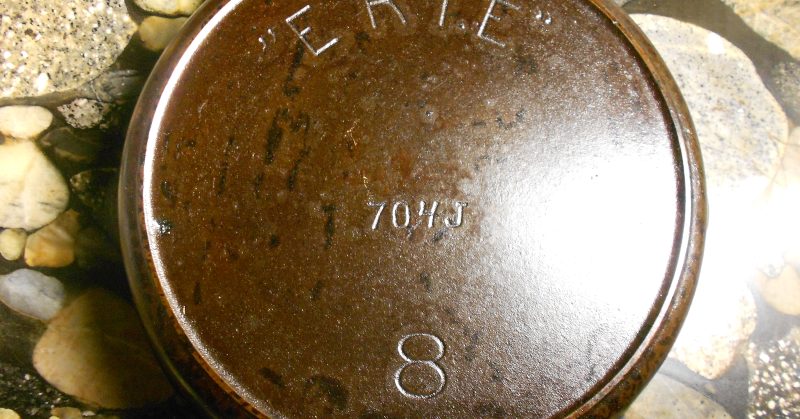
The marks, and what each one dates it to
| Era | Mark | What it tells you |
|---|---|---|
| 1880s | ERIE in plain block letters, no cross, no logo, sometimes with a patent date cast into the iron | The earliest identified mark from this foundry. No Griswold name appears. Seeing this alone places a piece in the foundry's formative period, though exact year boundaries are not settled. |
| 1880s - 1890s | ERIE with a spider or web emblem cast into the lid or base, often on the spider skillet form | The spider mark is the most recognized early variant. Collectors disagree about exactly when it was introduced and how long it ran alongside plain ERIE marks. |
| 1880s - 1900s | ERIE with a size number and occasionally a pattern number, no other branding | Numbered pieces help with dating and identification relative to later Griswold catalogs, but a clean cross-reference between early ERIE pattern numbers and later Griswold numbers does not exist in the public record. |
| Late 1890s - early 1900s (transition, disputed) | ERIE alongside an early Griswold name or the beginnings of the cross mark, appearing on the same piece or the same product line | Transition pieces are known but not well documented. The exact point at which ERIE marking gave way to Griswold marking is genuinely unclear. Pieces from this window are sometimes attributed to either period. |
| Disputed | ERIE with no other identifiers and no size number | Some unmarked or minimally marked pieces are attributed to this era on the basis of casting style and gate scar position alone. Attribution in these cases is collector consensus, not documented fact. |
The foundry and its place in American cast iron
The company that would become Griswold Manufacturing began operating in Erie, Pennsylvania in the 1860s, though the earliest pieces collectors specifically seek under the ERIE banner are generally dated to the 1880s. At that point the foundry was known by an earlier corporate name - the exact sequence of name changes in the pre-Griswold period is not fully settled in the public record - and the castings it sold carried the city name rather than any family name.
Erie, Pennsylvania was a practical location for iron foundry work: close to Great Lakes shipping, with access to coal and iron-bearing raw materials moving through the industrial corridor of the upper Midwest and Northeast. The city supported several foundries, and the one that became Griswold was not yet the dominant name in American cast iron that it would be by the early twentieth century. These early decades were formative, and the castings from this period reflect a foundry still refining its methods.
Understanding this context matters because ERIE-marked pieces are not simply early Griswold pieces with a different stamp. They predate the organizational and manufacturing identity that made Griswold famous. For collectors working through the dating guide, ERIE marks represent a genuinely separate chapter.
Recognizing the work by casting character
Collectors who focus on ERIE-marked pieces often develop an eye for characteristics that go beyond the mark itself, because marks can be ground off, worn smooth, or counterfeited. The casting characteristics of genuine early ERIE work are worth understanding.
The iron in pieces from this period tends to be relatively thick by the standards of the thin-wall skillets Griswold would later become known for. The cooking surfaces, particularly on skillets, are smooth but not always as uniformly finished as the machined surfaces on mid-era Griswold. The heat rings on the bases - the raised ring that keeps the flat cooking surface slightly off the stove top - are present on most skillet forms but vary in profile across the product line.
Gate scars, the marks left where molten iron entered the mold, are typically found on the handle underside or near the pour point on lids. On genuine early pieces these scars are often larger and less neatly dressed than on later production. That is not a flaw so much as a signature of the period's finishing standards.
The surface texture of unrestored pieces, once decades of grease and seasoning are removed, often has a slightly coarser grain than mid-century American cast iron. This is consistent with the iron composition and sand-casting methods of the era and is not a negative attribute. It simply looks and feels different from later work.
The spider skillet
The spider skillet is the piece most immediately associated with the ERIE mark and the one that draws the most collector attention. A spider skillet is a skillet with legs - short feet cast integrally with the base - designed to sit over coals or an open hearth rather than on a flat stove top. The name comes from the legged silhouette, which resembles a spider standing over its heat source.
By the 1880s, flat-bottomed skillets for stove-top cooking were already common, and the spider skillet was in some ways a holdover from an earlier cooking technology. That the Erie foundry was producing them in this period reflects both a continued market for hearth cooking tools and a product line that bridged older and newer domestic technologies.
The spider skillet with ERIE markings and a web or spider emblem cast into the piece is the variant that commands the most attention. The emblem itself - a simplified web design, sometimes with a spider form - appears on lids and bases and varies in detail across examples. Collectors disagree about how many distinct emblem variants exist and whether variation reflects different production runs or simply mold wear and repair. This is not settled.
Mark changes and what they bracket
The plain ERIE block letter mark is the starting point. It appears without any logo and without the Griswold name. Pieces with this mark alone are generally placed in the earlier part of the 1880s - 1900s window, though the evidence for narrowing it further is thin.
The addition of a spider or web emblem to the ERIE mark is generally treated as a slightly later development, but the sequence is not documented with the kind of factory records or dated catalog evidence that would allow clean bracketing. Collectors date the transition on the basis of example accumulation and stylistic comparison, which is useful but not conclusive.
The transition from ERIE marking to Griswold marking - with the cross logo and the family name - happened gradually rather than all at once. There are pieces known that carry both ERIE and early Griswold identifiers, and there are product lines that seem to have continued under ERIE marking while others shifted. Anyone presenting a precise year for this transition is working from inference, not documentation.
For a broader view of how American foundry marks evolved across this period, the dating guide covers the general conventions that apply across makers.
What it made well
The spider skillet is the standout, but the early ERIE line included a range of skillets in standard sizes, Dutch ovens, and lids. The skillets cook well. The iron is heavy enough to hold heat evenly, and properly restored examples perform on a modern stove with no meaningful disadvantage relative to later cast iron - with the caveat noted below about flat stove tops.
The Dutch ovens and covered pieces from this era are functional and well-made. They are not as refined as the mid-era Griswold output, but they were made to work and they do.
How it cooks today
The spider skillet form is not well suited to a modern flat-top stove because the legs hold the cooking surface away from direct contact with the heat source. On a gas burner with open grates it sits adequately but unevenly. On a glass or ceramic flat-top it should not be used at all, because the legs create point contact that can crack the surface.
Flat-bottomed ERIE-marked skillets and Dutch ovens behave like any heavy cast iron on a modern stove. They are slow to heat and slow to cool, which is a characteristic, not a defect. Induction compatibility depends on the iron composition, which varies. Testing with a magnet is the practical check - if a magnet holds strongly, the piece will generally work on induction.
Anyone bringing these pieces back into regular cooking use should review the care guide before seasoning, as early iron surfaces sometimes respond differently to modern seasoning oils than mid-century castings do.
What to be careful of
ERIE-marked pieces, and spider skillets in particular, are among the most reproduced and faked items in American cast iron collecting. The spider skillet's visual distinctiveness and collector demand make it a target.
Reproductions range from obvious to difficult. The easiest to spot are those with wrong proportions, poorly defined lettering, or casting surfaces that are too uniform - modern production methods leave different surface signatures than nineteenth-century sand casting. The gate scars on reproductions are often in the wrong position or are too small and neat. The weight may be off: either too light for the form or distributed differently than on originals.
Fakes - meaning pieces altered to appear more valuable, rather than outright copies - sometimes involve grinding and re-stamping marks, or attaching legs to flat-bottomed skillets. Examining the junction between legs and base on any spider skillet is worth doing. On original pieces the legs flow integrally from the casting with no visible seam or weld.
Pieces from other Erie, Pennsylvania foundries occasionally turn up marked with the city name and are sometimes mistaken for Griswold-era ERIE work. Erie was home to more than one foundry. Comparing the casting style, mark typography, and form details against documented examples is the only reliable method. The identify page covers the general approach to unknown pieces.
Points still in dispute
Honest collectors acknowledge significant gaps in the ERIE record. The exact founding sequence and early corporate names of the foundry are not fully documented in sources accessible to collectors. The year-by-year mark sequence has not been established from factory records - it is built from collector accumulation and is subject to revision. The number of distinct spider or web emblem variants, and whether variation is meaningful or random, is debated. The transition date from ERIE to Griswold marking is not pinned down. Production volumes, the full range of forms made under the ERIE mark, and the relationship between early ERIE pattern numbers and later Griswold catalog numbers are all areas where the record is incomplete.
This is worth saying plainly because the collector literature sometimes presents more certainty than the evidence supports.
Value and collectibility
ERIE-marked pieces, and especially the spider skillet, sit at the high end of American cast iron collecting in terms of demand. Spiders with the web emblem in good condition with intact legs and clear markings command a significant premium over even desirable mid-era Griswold pieces. Plain ERIE block letter skillets in common sizes are more accessible but still carry a premium over comparable later production.
Condition matters enormously at this end of the market. Cracks, repairs, pitting under the cooking surface, or missing legs on a spider form all reduce desirability substantially. Reproductions and fakes have depressed confidence in unprovenanced examples without strong attribution. Buying from sources who can speak to a piece's history and who will describe condition honestly is important. The value guide covers general condition factors that apply across makers. If you are considering selling an ERIE piece, the sell page explains the process.
Looking for a piece by Erie and the early Griswold marks?
Stock here is one piece at a time and it moves. Say what you are after and we will write to you when a piece by Erie and the early Griswold marks is listed. Nothing else, ever, and one click stops it.
Questions
About Erie and the early Griswold marks
How do I know if my spider skillet is a genuine ERIE piece or a reproduction?
Start with the gate scar - on genuine early pieces it is typically larger and less neatly finished than on modern reproductions, and positioned on the handle underside or near the natural pour point for the form. The legs on an original are cast integrally with the base, with no seam, weld, or visible joint at the junction. The lettering on genuine marks has a hand-cut mold quality: slightly irregular under magnification, not laser-sharp. Weight and balance also differ from modern castings, though this takes handling multiple examples to calibrate. When in doubt, comparison against documented examples in established collector references is the most reliable method.
Can I actually cook on a spider skillet, or is it a display piece?
You can cook on it, but the form dictates the heat source. The legs are designed to straddle coals or sit over an open hearth, not to rest on a modern flat stove top. On a gas range with open grates it will sit, but unevenly. On a flat glass or ceramic cooktop the legs create point contact that risks cracking the stove surface - do not use it there. A campfire or outdoor fire pit is the most natural fit. For regular indoor cooking, a flat-bottomed ERIE skillet is the better choice. Properly restored and seasoned, the cooking surface on either form performs well once at temperature.
What is the difference between an ERIE mark and an early Griswold mark, and which is more desirable?
ERIE-marked pieces carry only the city name - no cross logo, no Griswold family name. Early Griswold marks introduced the cross emblem and the Griswold name, generally sometime around the late 1890s into the early 1900s, though the exact transition is not documented precisely. Among collectors, ERIE-marked pieces, particularly the spider skillet, are generally treated as more desirable and rarer than early Griswold cross-mark pieces. All the same, transition pieces carrying elements of both marks are of significant interest in their own right. Desirability also depends heavily on the specific form and condition.
My piece is marked ERIE but has no spider and no size number. Is it still from this period?
Possibly. Plain ERIE block letter marks with no emblem and no size number are known from the early part of this foundry's output, and some collectors attribute minimally marked pieces to the earliest production runs. However, attribution based on the mark alone, when the mark is minimal, is uncertain. The casting characteristics - gate scar position and size, base profile, surface texture, heat ring style - should be evaluated alongside the mark. It is also worth checking whether ERIE without a size number might represent a different form or product line rather than an unusually early skillet. If the attribution matters to you, consulting a specialist is the practical step.
Can Cast Iron Restoration restore an ERIE spider skillet without affecting its value?
Restoration affects collector value in ways that depend on who is buying and why. A piece destined for regular cooking use benefits from full restoration: electrolytic cleaning, seasoning, and any structural assessment. A piece being held primarily as a collectible occupies a grayer area - some collectors prefer patina and original surface condition, while others want a functional piece. We will assess and describe condition honestly before any work begins. The services page explains what the restoration process involves, and you can start a quote request to discuss a specific piece before committing to anything.
Start a restoration
Tell us what you have
Send a couple of photos and the markings you can read on the bottom. We will tell you what the piece is, what it needs, and what it costs before anything ships. Identification and assessment are free, and stay free if you decide to do nothing.
Would rather just talk it through? (802) 348-1550