Filley
Filley refers to the hollow ware operation associated with Oliver Filley, working across Troy, New York and St. Louis, Missouri during the nineteenth century. The pieces attributed to this name are among the earliest marked American cast iron hollow ware known to collectors, predating the famous foundries by a generation or more. For anyone studying the origins of American cast iron cookware, Filley is a starting point, not a footnote.
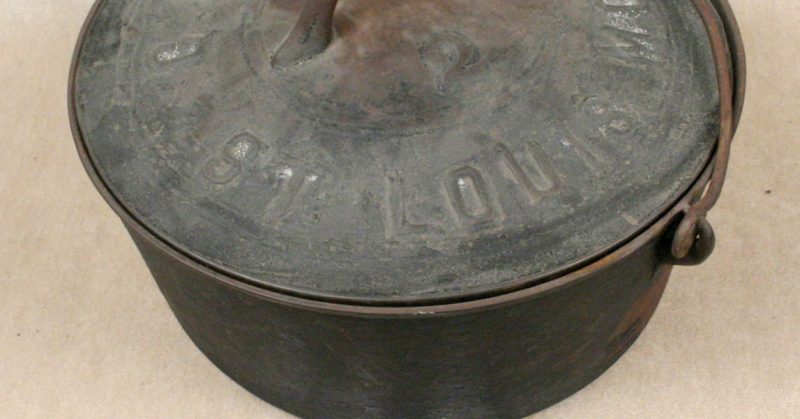
The marks, and what each one dates it to
| Era | Mark | What it tells you |
|---|---|---|
| Early to mid 1800s | FILLEY cast in raised letters, typically on the gate scar side or base, without a city name | The simplest form of the mark. Seeing it alone does not confirm which operation or city produced the piece. Attribution is debated among collectors. |
| Mid 1800s | O. FILLEY or OLIVER FILLEY cast into the base, sometimes with a city designation such as ST. LOUIS or TROY | The inclusion of a city name is the clearest evidence for placing a piece geographically. Pieces marked with St. Louis point to the Missouri operation; Troy markings point to New York. Both are considered genuinely early. |
| Mid to late 1800s | FILLEY with a size numeral cast nearby, occasionally with hollow ware shape-specific details on the lid or bail mount | Size numerals on early American hollow ware do not follow a standardized system. A numeral on a Filley piece cannot be read the same way as a numeral on a later Griswold or Wagner piece. |
| Disputed | Unmarked pieces attributed to Filley on the basis of casting style, gate placement, and construction details alone | A significant body of very early American hollow ware circulates without clear marks. Some collectors attribute these to Filley operations on stylistic grounds. That attribution is reasonable but not confirmed. Treat any unmarked piece as attributed rather than verified. |
Filley among American foundries
Most collectors encounter cast iron through the major late-nineteenth and early-twentieth century foundries. Griswold, Wagner, Lodge, and their contemporaries built their reputations on standardized production, machined cooking surfaces, and national distribution. Filley operated in an earlier world entirely.
The Filley name is associated with hollow ware production in Troy, New York and St. Louis, Missouri across the nineteenth century. The precise founding dates of each operation, the exact relationship between the Troy and St. Louis ventures, and the full range of what was produced are all questions that remain only partially answered. What is settled is that pieces carrying the Filley mark are generally placed among the earliest documented marked American cast iron cookware. For collectors and historians of American domestic material culture, that makes them significant regardless of their condition or completeness.
Troy, New York was a center of American iron production in the early and middle nineteenth century, and the presence of a Filley operation there fits the geography of early American foundry activity. St. Louis, Missouri was a growing commercial hub and a gateway to western expansion across the same period. How the two operations were connected, whether by family, by business arrangement, or simply by shared name, is not fully documented in sources available to collectors. Anyone who tells you the relationship is simple and clear is working from incomplete evidence.
Spotting Filley without a mark
Because marked examples are scarce and unmarked attribution is common, learning to recognize Filley work by physical characteristics matters as much as reading the mark.
Filley pieces reflect the casting technology and priorities of their era. Gate marks are the most immediately obvious feature. A gate mark is the raised nub or scar left where molten iron entered the mold. Nineteenth century hollow ware was typically poured through a gate in the base or side of the casting, and the gate was broken off and left largely unfinished. Later foundries moved toward bottom-gated and then gateless casting as finishing technology improved. A prominent, rough gate scar on a skillet or kettle is a strong indicator of early production, and Filley pieces almost always show this. See the dating guide for more on how gate marks help bracket age.
Beyond the gate, Filley castings tend to show:
- Relatively thick walls compared to the machined-thin castings of the Griswold era
- Less uniformity in wall thickness from piece to piece, reflecting hand-finishing and the limits of early mold technology
- A coarser surface texture on cooking and exterior surfaces, without the machined smoothness that later became standard
- Bail attachments and handle construction that differ from standardized later patterns, often showing more variation between individual pieces
- Lid fits that are functional but not precision-matched, again reflecting the manufacturing norms of the period
None of these features alone is diagnostic. Taken together, especially combined with a mark, they build a credible attribution.
The marks and what they tell you
The mark history for Filley is less cleanly documented than for the major later foundries, and anyone presenting a tidy five-step mark evolution is likely filling gaps with guesswork. What collectors generally accept is the following.
The simplest marks are the most likely to be early: a plain FILLEY or O. FILLEY without additional text. When a city name appears alongside the personal or family name, it provides geographic grounding. ST. LOUIS and TROY both appear on documented examples. Size numerals appear on some pieces but do not correspond to the later standardized sizing systems used by foundries like Griswold, so cross-referencing sizes between makers from different eras is unreliable.
A meaningful portion of pieces attributed to Filley carry no readable mark at all, or carry only partial marks where the casting or finishing obscured the text. This is common with very early American cast iron generally. The identification guide at /identify covers how to work through a piece when the mark is absent or ambiguous.
What Filley made well
Filley production centered on hollow ware: kettles, spiders (the legged skillets used over hearth fires), Dutch ovens, and related kitchen and fireplace equipment suited to the cooking methods of the early and middle nineteenth century.
These were working pieces made for a market that cooked over open fires and in early wood stoves. The thick walls and relatively heavy construction that look like crude manufacturing to modern eyes were functional choices. A thick-walled kettle holds and distributes heat more evenly over an uneven fire than a thin-walled one. The cooking performance of these pieces in their original context was appropriate to that context.
What Filley did not produce, as far as the collector record shows, is the refined, lightweight, machined cookware that defines the later American cast iron golden age. There are no documented Filley waffle irons with complex hinge systems, no long series of matching skillets in graduated sizes with standardized heat rings, none of the catalog-driven variety that Griswold and Wagner developed. The range appears to have been practical and relatively narrow.
On a modern stove
This is a practical question worth addressing honestly. Very early cast iron, including Filley pieces, was designed for hearth cooking and early wood stoves with relatively even heat distribution across a wide surface. Modern gas and electric ranges concentrate heat at a central burner.
Thick-walled early pieces can handle modern stoves, but they reward patience. They take longer to come to temperature, and they will show hot spots over a modern burner more than a thin machined skillet would, counterintuitively, because the thicker walls resist conforming quickly to a small heat source. Once at temperature they hold heat well. Induction cooktops will work with cast iron generally, but verify that the base of any very early piece is flat enough to make consistent contact. Warped or uneven bases are not uncommon on pieces of this age.
For more on daily use, the care guide covers seasoning and maintenance practices that apply regardless of maker.
Reproductions and mistaken identity
Filley pieces are early enough and scarce enough that misattribution is a real problem, running in both directions.
Some sellers apply the Filley name to any unmarked early gate-marked hollow ware, treating the name as a synonym for "very old American cast iron." That is not accurate. Early gate-marked hollow ware was produced by many foundries, most of them now anonymous. An unmarked early kettle is not a Filley kettle simply because it is old and has a gate mark.
In the other direction, genuine marked Filley pieces are sometimes overlooked or misread. Marks on early cast iron were not always cleanly cast, and a partially obscured O. FILLEY can be misread or dismissed. If you have a piece with an unclear mark and early casting characteristics, professional cleaning before assessment is worthwhile. The services page covers what restoration involves before identification.
Reproductions of very early American cast iron are less common than reproductions of popular later pieces, but they exist. The casting quality of reproduction early hollow ware is usually distinguishable from the real thing by surface texture, gate scar treatment, and the overall weight and wall thickness profile. If a piece looks too clean and too consistent while claiming to be early, that is worth scrutiny.
Where the evidence runs out
The honest answer is that a great deal about Filley remains unsettled.
The exact relationship between the Troy and St. Louis operations is not documented clearly in sources accessible to collectors. Whether Oliver Filley himself was a founder, an operator, an investor, or primarily a name associated with a family business is not established with the kind of documentary evidence that would satisfy a historian. Production dates for specific forms, the full range of what was made, and the sequence of mark changes are all matters where collector consensus exists but firm evidence is thin. The dating guide covers general methods for bracketing early American cast iron when maker-specific records are absent.
Treat what is known with confidence and treat the rest as working hypothesis.
Value and collectibility
Filley pieces, when genuinely identified, command a significant premium over later American cast iron of comparable condition. The reasons are straightforward: genuine examples are scarce, they represent a documented early chapter in American cast iron history, and collectors of early American material culture compete for them alongside cast iron specialists.
Condition matters, but the standards differ from later cookware. A Filley piece is not expected to have a machined cooking surface. Roughness, visible casting texture, and honest wear are part of what the piece is. Cracks, repairs, and missing components affect value as they do with any cast iron, but a piece does not need to look like a Griswold to be desirable. Visit the value guide for a broader framework on how condition and rarity interact.
Unmarked pieces attributed to Filley on stylistic grounds are collectible and interesting, but they sell at a meaningful discount to marked examples, as they should. Attribution is not the same as identification. If you are considering a purchase or sale, the sell page and the quote form are the right starting points for an honest assessment.
Looking for a piece by Filley?
Stock here is one piece at a time and it moves. Say what you are after and we will write to you when a piece by Filley is listed. Nothing else, ever, and one click stops it.
Questions
About Filley
How do I know if my old kettle or skillet is actually a Filley piece?
The clearest confirmation is a legible mark: FILLEY, O. FILLEY, or OLIVER FILLEY cast into the base or gate area, sometimes with a city name. Beyond the mark, look for a prominent gate scar, thick and somewhat uneven walls, and a coarser surface texture than you would see on later machined cookware. None of those physical features alone confirms Filley, but together with a partial or unclear mark they build a reasonable case. When in doubt, professional cleaning before assessment is the right first step, since marks on early cast iron are often obscured by old seasoning or rust.
What is the difference between a Troy piece and a St. Louis piece, and does it matter to value?
When a city name appears in the mark, it provides geographic grounding: TROY points to the New York operation and ST. LOUIS to the Missouri one. Whether one is more desirable than the other is not settled among collectors. The Troy operation fits into the well-documented iron production history of upstate New York, which may give those pieces a slight edge in provenance clarity for some buyers. The St. Louis pieces reflect a different market and period. In practice, marked examples from either city are scarce enough that the mark itself, readable and genuine, is the primary driver of collector interest.
Can I actually cook on a Filley piece, or is it strictly for display?
You can cook on it. These were working pieces made for serious daily use, and the heavy construction means they are physically durable if structurally sound. Against that, most collectors treat marked Filley pieces as historically significant objects and are cautious about heavy use. If you want to cook on early cast iron, confirm the piece has no cracks or repairs, re-season it carefully, and use it on lower to medium heat to bring it up slowly. The thick walls take time to heat evenly over a modern burner. The care guide covers seasoning and use practices in detail.
Are there fakes or reproductions of Filley cast iron I should know about?
Deliberate Filley-specific fakes are not widely documented, but two problems are common. First, unmarked early gate-marked hollow ware is sometimes sold as Filley without evidence, trading on the name as a shorthand for early American cast iron generally. Second, reproduction early American hollow ware does exist, and it can look superficially convincing. Genuine early castings have a surface texture, wall thickness profile, and gate scar character that is difficult to fake precisely. If a piece looks too consistent and too clean while claiming to be nineteenth century, treat that as a flag worth investigating before purchase.
I have a piece marked only with a number and what might be a partial name. How do I figure out if it is Filley?
Partial marks on early cast iron are common because the casting process was less precise and old seasoning or rust frequently obscures text. Start by cleaning the area around the partial mark carefully, without grinding or aggressive wire brushing that would damage the casting surface. Once clean, examine the partial text under raking light and photograph it. A size numeral alone does not identify Filley, since many early foundries used numerals. Look for letterforms consistent with FILLEY alongside the numeral, and compare the casting characteristics to documented examples. The identification guide at /identify walks through this process in more detail.
Start a restoration
Tell us what you have
Send a couple of photos and the markings you can read on the bottom. We will tell you what the piece is, what it needs, and what it costs before anything ships. Identification and assessment are free, and stay free if you decide to do nothing.
Would rather just talk it through? (802) 348-1550