Griswold Manufacturing Company
Griswold Manufacturing Company operated in Erie, Pennsylvania from 1865 to 1957 and produced cast iron cookware that collectors regard as the benchmark of American foundry work. The company's skillets are sought for their thin walls, light weight relative to their size, and exceptionally smooth cooking surfaces. No other American cast iron maker has attracted a deeper or more active collector following.
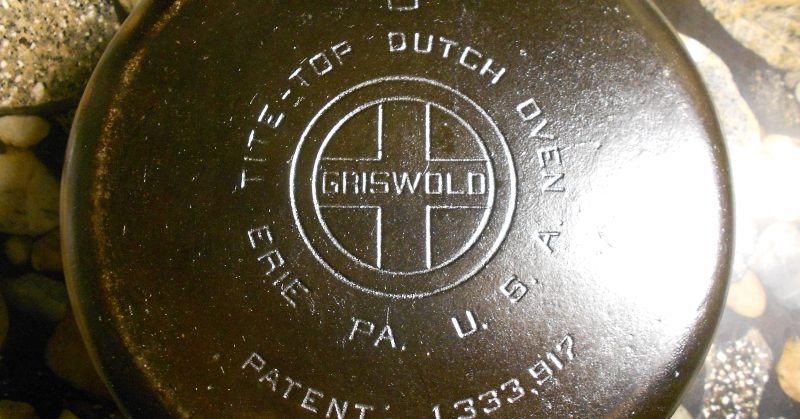
The marks, and what each one dates it to
| Era | Mark | What it tells you |
|---|---|---|
| 1865 - early 1880s | Selden & Griswold or similar partnership-era markings, Erie PA | Pre-corporate era. Pieces with this mark are rare and the full mark sequence for these years is not settled. If you have one, treat attribution as tentative until confirmed by a specialist. |
| 1880s - early 1900s | GRISWOLD with a small cross or early spider logo, ERIE PA, piece number | Early corporate-era marks. The lettering tends to be shallow and the logo relatively small. Generally associated with heavier, thicker castings than later production. |
| 1900s - 1920s | Large block GRISWOLD inside a large circle with ERIE PA and cross logo, piece number prominent | Known among collectors as the Large Logo or Large Block Logo. The oversized circle and bold lettering are the most visually distinctive Griswold marks. Pieces from this period are among the most sought. |
| 1920s - 1940s | GRISWOLD in a smaller circle with ERIE PA, cross logo, piece number | Known as the Small Logo. The mark is visually similar to the Large Logo but noticeably reduced in diameter. Castings from this period are generally considered among the lightest and most refined. |
| 1940s - early 1950s | GRISWOLD with ERIE PA but no enclosing circle, or a slant logo variant; cross logo retained | Post-circle era. Sometimes called the Slant logo. The absence of the enclosing circle is the quick identifier. Quality is generally considered slightly more variable than earlier Small Logo production. |
| Early 1950s - 1957 | GRISWOLD with ERIE PA, block or script lettering variants, some pieces marked only with piece number and GRISWOLD | Late production under changing corporate ownership. Finish and casting quality are widely considered inconsistent. The exact mark sequence in these final years is not fully settled among collectors. |
Where this foundry sits
Griswold Manufacturing Company grew out of a hardware partnership in Erie, Pennsylvania, generally dated to 1865. The early business operated under the name Selden and Griswold before reorganizing under the Griswold name in the later nineteenth century. The company produced a wide range of cast iron goods over its long life - hollowware, waffle irons, corn stick pans, griddles, Dutch ovens, and specialty items - but it is the skillet line that defined Griswold's reputation and that still drives the collector market today.
By the early twentieth century, Griswold occupied a position in American kitchens that was both practical and aspirational. The foundry's skillets were lighter and smoother than most competitors', and the company marketed this actively. Whether Griswold's manufacturing methods were genuinely superior or whether the company simply held to tighter finishing standards longer than others is a question collectors still debate. What is not debated is the result: a Griswold skillet from the prime Small Logo era is noticeably more refined in the hand than most of what was made by competitors at the same time.
The company was acquired by a series of outside buyers beginning in the late 1950s and production at Erie ended in 1957. Subsequent owners continued to use the Griswold name on cookware made elsewhere, which is a source of confusion for newer collectors. Only pieces made at Erie before 1957 are considered authentic Griswold by serious collectors.
The maker's index lists the other Erie-area foundries that were active during Griswold's lifetime, some of which made closely related wares.
Griswold by the casting alone
The mark is the primary identifier, but casting characteristics matter too, both because marks can be faked and because a few early or transitional pieces have ambiguous markings.
Griswold skillets from the prime production decades are notably thin-walled relative to their diameter. This is not just a collector talking point - it is measurable. Lift a prime-era Griswold No. 8 skillet next to a comparable piece from most other makers of the same period and the weight difference is perceptible. The cooking surface on well-preserved examples is very smooth, often described as almost machined in appearance, though this surface was achieved through careful grinding and polishing rather than machining in the modern sense.
The heat ring - the raised ring on the bottom of the skillet designed to sit on old wood or coal stoves - is present on most pre-1940s production and is a useful dating clue. Later pieces sometimes lack it or carry a modified version. The gate mark, a small scar left where molten iron entered the mold, appears on very early pieces and its absence does not by itself date a piece to any specific era, but its presence suggests earlier production.
Handle shape changed over the decades. Early handles tend to be wider and flatter. Later handles are narrower and more finger-friendly. These changes were gradual and no clean date boundaries are established. If you are using handle shape to date a piece, treat your conclusion as approximate.
The finish inside the cooking surface is worth examining under good light. Authentic prime-era Griswold pieces show a consistent, fine-grained surface. Coarser pitting that looks like it extends through the surface - rather than sitting on top of it - usually indicates heavy rust damage or a piece that was not among the foundry's better production runs.
How the marks changed
The dating guide covers mark evolution across American cast iron broadly. For Griswold specifically, the broad sequence runs from partnership-era marks through early corporate marks, then into the Large Logo period, the Small Logo period, the Slant or no-circle period, and finally the late production years before Erie closed.
The Large Logo period, generally placed in the first two decades of the twentieth century, produced some of the most visually striking Griswold pieces. The mark itself - a large circle enclosing the Griswold name, the Erie PA designation, and the cross logo - takes up a significant portion of the skillet bottom. Collectors prize these pieces both for the mark's appearance and because the castings from this period are generally considered very well made.
The Small Logo period, generally associated with the 1920s through the late 1930s or early 1940s, is where most collectors believe Griswold reached its highest production quality. The enclosing circle shrank, the casting walls thinned further, and the surface finish was consistently excellent. Small Logo skillets in good condition represent the peak of what the company made and command a corresponding premium.
The Slant logo and late-production marks indicate pieces made as the company changed hands and production priorities shifted. These are still genuine Erie Griswold pieces and still good cookware, but collectors and restorers generally do not rank them with prime Small Logo production.
Exact years for each mark transition are not agreed on in the collector literature. Ranges of five to ten years are the honest brackets to use.
What Griswold got right, and what it did not
Griswold's reputation rests almost entirely on its skillet production, and deservedly so. The No. 8 and No. 9 skillets are the pieces most collectors pursue first, and for practical cooks they are also the most useful sizes. The cooking surface on a well-restored prime-era Griswold skillet is genuinely exceptional and performs noticeably well on both traditional and modern heat sources.
Dutch ovens and the matching lids made by Griswold are solid and well-regarded, though they do not carry quite the premium that the skillets do. The fit between a Griswold Dutch oven and its correct lid is generally very good, which matters for slow cooking. Pieces with their original matching lids are worth more than orphaned bottoms or lids alone.
Specialty pieces - corn stick pans, waffle irons, muffin pans, and the like - vary considerably. Some are beautifully made and have their own collector following. Others were clearly production items where finish quality was secondary. Waffle irons in particular can vary a great deal depending on the era of production and whether all the mechanical parts are present and functional.
Griddles are made well but attract a more limited collector following, partly because their size makes them awkward to store and ship.
The chicken fryer - a low, wide skillet with a domed lid - is often described as one of Griswold's most practical specialty pieces. Collectors frequently pursue these as users rather than display items.
What Griswold made less impressively: very large pieces, particularly No. 12 and larger skillets, show more variation in surface finish and wall thickness than the mid-range sizes. This is not unusual - large castings are harder to control - but it is worth examining large Griswold pieces carefully before purchasing.
Where people get caught out
Griswold's collector status means reproduction and outright fake pieces exist. This is not a minor problem. The identify tool is a reasonable starting point if you have an unfamiliar piece, but hands-on assessment by someone familiar with authentic examples is more reliable for high-value pieces.
Reproductions range from pieces cast from original molds (which can be very difficult to distinguish) to cruder copies that are easier to spot. Points to check:
- Weight relative to size. Reproductions cast from worn or copied molds often run slightly heavier than authentic pieces because dimensional detail has been lost.
- Surface texture. Authentic prime-era pieces have a distinctive fine-grained surface. Reproductions often show coarser grain or visible casting porosity.
- Mark sharpness. On authentic pieces, the letters and logo are usually crisp. On reproductions, letters may appear soft, slightly indistinct, or incorrectly proportioned.
- The cross logo. On authentic pieces, the cross within the circle is well-formed and consistent. Fakes sometimes get the proportions wrong.
- Heat ring shape and depth. Reproducing the heat ring correctly is apparently difficult, and fakes often have a ring that sits slightly differently than on authentic pieces.
Commonly confused makers include Wagner Ware (Sidney, Ohio), Lodge (South Pittsburg, Tennessee), and Favorite Piqua Ware (Piqua, Ohio). All made quality cast iron and all are collectable in their own right, but none are Griswold. The casting style and marks are distinct once you have handled a number of pieces from each maker. See the makers index for individual pages on these foundries.
Late production pieces made after 1957 under the Griswold name by subsequent owners are a separate category. They are not Erie Griswold and should not be priced or treated as such.
On today's cooktops
A well-restored Griswold skillet performs very well on a modern gas range. The thinner walls that collectors prize also mean the pan heats more quickly and responds to temperature changes faster than heavier cast iron. This is practical as well as aesthetically pleasing.
Electric coil and smooth-top electric ranges are a more complicated story. Griswold's thin walls can make flat contact with a smooth cooktop uneven if the pan has any warp - and some old Griswold pieces have slight warping from decades of use or improper cooling. Before using a prime-era Griswold skillet on a glass or ceramic cooktop, check it on a flat surface first. Our care guide has more detail on assessing and cooking with restored cast iron.
Induction cooktops work with cast iron generally, and Griswold is no exception, but the same warping caution applies. An induction burner with a pan that rocks slightly will perform poorly.
Oven use is straightforward. Griswold skillets were designed for oven use and handle it well. The thin walls do mean they cool more quickly after removal from the oven, which is worth knowing when timing a dish.
Value, without the optimism
Griswold commands a premium over almost every other American cast iron maker, and within the Griswold line, prime Small Logo production commands a premium over everything else. This is well established and is unlikely to change given the depth of the collector following.
All the same, the market for Griswold is active and well-documented enough that obvious bargains are rare. Estate sales, farm auctions, and less-observed online venues still produce finds, but anyone selling Griswold in a venue with any collector traffic generally knows what they have.
Late production pieces, very large sizes, and specialty items in less popular categories are still affordable relative to prime-era mid-range skillets. Pieces needing restoration are similarly more accessible in price. Our value guide discusses relative value across the broader cast iron market.
Condition matters enormously. A prime Small Logo No. 8 with a crack, a warp, or heavy pitting is worth substantially less than a clean example. Restored pieces are generally more valuable than unrestored pieces in poor condition, but the restoration must be done correctly - improper restoration can damage value. Our services page describes what a proper restoration involves.
What is still argued over
Several things about Griswold are genuinely disputed or simply unknown, and honest collectors admit this.
The exact year-by-year mark transition sequence is not agreed upon. Published timelines in collector guides differ by several years on almost every transition point. Any source that gives you a single precise year for a mark change is presenting a consensus or a guess as a fact.
The relationship between specific marks and specific casting quality is assumed more than proven. The common view - that Small Logo equals the best quality - is widely shared and probably broadly accurate, but systematic comparison across large numbers of dated pieces has not been published in a rigorous way. The assumption could be oversimplified.
The early partnership-era history, including what exactly Selden and Griswold produced and how that production related to the later corporate line, is not thoroughly documented in publicly available sources.
Production numbers for any piece or era are not known. Claims about how many of a particular piece were made should be treated as speculation unless a primary source is cited.
The FAQ and blog carry additional discussion of contested points in American cast iron history.
Looking for a piece by Griswold Manufacturing Company?
Stock here is one piece at a time and it moves. Say what you are after and we will write to you when a piece by Griswold Manufacturing Company is listed. Nothing else, ever, and one click stops it.
Questions
About Griswold Manufacturing Company
How do I know if my Griswold skillet is from the prime Small Logo era?
Look at the bottom of the skillet. A Small Logo piece has the Griswold name inside a circle, with Erie PA and the cross logo, but the circle is noticeably smaller than on a Large Logo piece. The piece number should also be clearly cast. The transition from Large to Small Logo is generally placed somewhere in the 1920s, but the exact boundary is not agreed on, so treat a piece near the transition as approximately dated rather than firmly placed. Weight and surface finish can support but not confirm the dating.
Is a cracked Griswold skillet worth restoring?
A crack in cast iron is structural damage that cannot be safely repaired for cooking use. A cracked Griswold skillet has display or parts value only - it should not be used on a heat source. If you are buying a Griswold piece and the seller does not mention cracks, inspect the casting carefully under good light, running your fingers along the walls and base. Hairline cracks can be very difficult to see on a dirty or rusty surface. Restoration services address rust and seasoning, not structural damage.
What is the difference between a Griswold skillet and a Wagner skillet?
Both are respected American cast iron makers and both made skillets of high quality, but they are distinct foundries from different states and their pieces are not interchangeable collectibles. Griswold is from Erie, Pennsylvania; Wagner Ware is from Sidney, Ohio. The marks are different and not easily confused once you have seen both. Casting characteristics differ too - Griswold in its prime era is generally considered slightly lighter and more finely finished than comparable Wagner production, though Wagner has its own devoted following. See the Wagner page on this site for more.
I found a piece marked Griswold but it looks different from others I have seen. Could it be fake?
It could be, but it could also be a less common authentic piece, a late-production piece, or a specialty item you have not encountered before. Griswold made a wide range of products over ninety years, and not every piece looks like the standard skillet. Check the mark closely for correct proportions and letter sharpness. Weigh the piece relative to its size. If you are still uncertain, the identify tool on this site is a reasonable first step, and posting clear photographs in a collector forum will usually get you informed responses within a day or two.
Can I use my Griswold skillet on a glass-top electric stove?
You can, with some caution. The main concern is warping. Older Griswold pieces sometimes have slight warps from decades of use or from being cooled too quickly on a cold surface. A warped pan will rock on a glass cooktop and heat unevenly. Before using your skillet on a smooth-top range, set it on a flat surface and check for rocking. A flat piece will generally perform well. Avoid sliding the pan across a glass cooktop, as cast iron can scratch the surface. Our care guide has further detail on cooking surface compatibility.
Start a restoration
Tell us what you have
Send a couple of photos and the markings you can read on the bottom. We will tell you what the piece is, what it needs, and what it costs before anything ships. Identification and assessment are free, and stay free if you decide to do nothing.
Would rather just talk it through? (802) 348-1550